

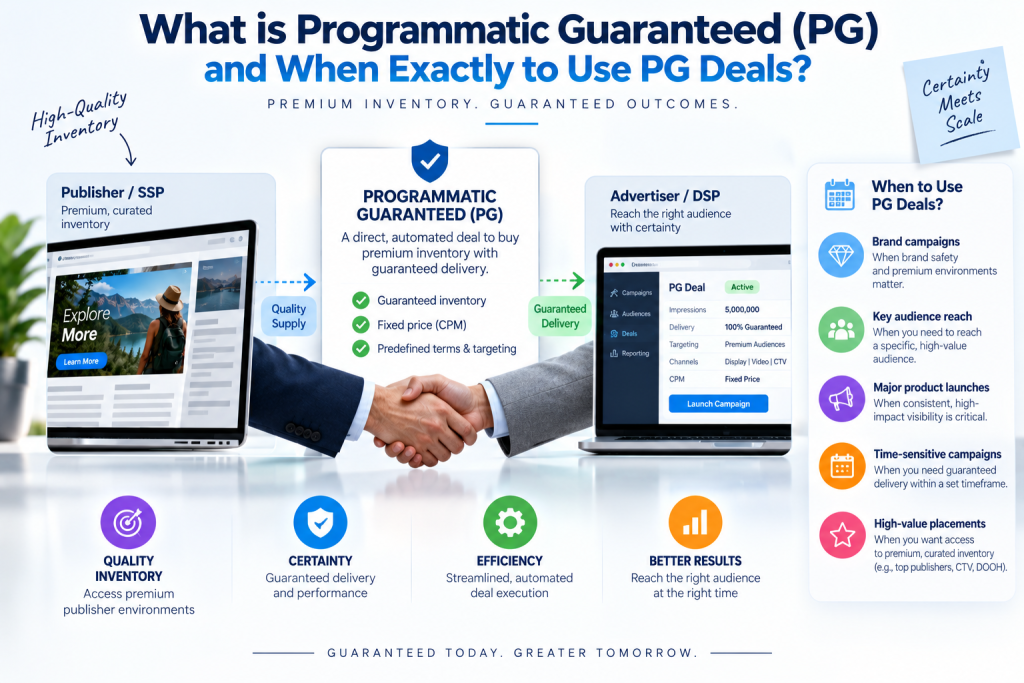
First, let’s understand what Programmatic Guaranteed (PG) is:
Imagine you are planning a big event and need to buy a specific number of tickets in advance. Instead of bidding against other people at the last minute, you go straight to the venue and lock in a fixed price for the exact seats you want. In programmatic advertising, programmatic guaranteed works the exact same way:
- The deal: A website or an app (publisher) agrees to sell a specific number of impressions directly to a brand or advertiser at a set price.
- No auctions: Unlike regular digital ads (open auction) where advertisers and brands fight for each impression via bidding, this bypasses the bidding process entirely.
- The benefits: It gives advertisers total predictability, better brand safety (knowing exactly where their ad will show up), and guaranteed delivery.
Let’s Talk About Real-World Examples
To see why companies use this, let’s look at two common scenarios:
- The political campaign: A political party needs to run ads strictly on trusted news websites to follow strict election laws and avoid appearing next to controversial content. Programmatic guaranteed lets them lock in those exact, safe spaces in advance.
- The holiday retailer: A major store wants a massive homepage banner on a popular tech review site during the week of Cyber Monday. By using programmatic guaranteed, they lock in that slot ahead of time so that competitors can’t steal it when traffic is at its peak.
Why is Programmatic Guaranteed So Popular?
- Huge time saver: According to a report published by Boston Consulting Group, agencies and advertisers save up to 29% more time using programmatic guaranteed compared to old-school manual buying methods.
- Growing on Smart TVs: It’s becoming especially popular for Connected TVs (CTV)—the ads you see when watching your favorite shows on smart TVs—helping make up a quarter of all CTV ad buys in 2024.
The takeaway? While programmatic guaranteed doesn’t completely replace open auction ad buys or other ad buying methods, it’s a powerful tool for high-stakes campaigns where certainty, safety, and timing are everything.
Programmatic Guaranteed vs. Open Auction
| Feature | Programmatic Guaranteed | Open Auction |
| How it works | A direct, 1-on-1 agreement between an advertiser and a website owner (publisher). | A virtual trading floor where dozens or hundreds of advertisers automatically bid against each other. |
| The analogy | Booking a VIP table at a restaurant ahead of time for a set price. | Showing up to a crowded auction house and fighting for whatever seats are left. |
| Price | Fixed and pre-negotiated price. | Dynamic – It changes second by second based on who bids the highest. |
| Is delivery guaranteed? | Yes, you are promised a specific number of impressions which are guaranteed. | No, you only win if your bid is high enough, and you might miss out if competition spikes. |
| Ad placement & safety | High control of ad placement and safety as you know the exact sites and apps where your ads will appear. | Lower control, since your ads can end up on a wide variety of random websites and apps. |
| Best used for | High-stakes campaigns, big brand launches, political campaigns, or major holidays (Cyber Monday, Black Friday, Thanksgiving, etc.). | Campaigns which are focused on massive reach, flexibility, and getting a lot of cheap clicks or impressions. |
In short:
- Use open auctions when you want maximum scale, flexibility, and low costs.
- Use PG when failure is not an option and you must have premium placement, absolute brand safety, and guaranteed visibility.
When to Use Programmatic Guaranteed
You should use programmatic guaranteed when your campaign requires absolute certainty, premium placement, and control. Because you are locking in a fixed price and a guaranteed number of views ahead of time, it is not meant for everyday, run-of-the-mill ads—it is reserved for high-stakes scenarios.
Let’s talk about the best scenarios for using PG deals:
- High-stakes and time-sensitive campaigns
- The situation: Imagine you are running a campaign with a high budget and a tight window, where missing your timing or losing impressions to a competitor would ruin the campaign (e.g., political campaigns, movie premieres, or major retail holidays like Cyber Monday).
- Why PG: It locks in your inventory in advance so you aren’t left scrambling or out-bid on an open market when traffic and competition peak.
- Strict brand safety and compliance needs
- The situation: Your brand has a zero-tolerance policy for where ads appear (e.g., pharmaceuticals, finance, nutra, or government campaigns).
- Why PG: Open auctions can sometimes land your ads on random low-quality websites. PG allows you to hand-pick specific, trusted publishers (major news sites or top review platforms) to protect your brand reputation.
- Buying premium or scarce inventory (like CTV)
- The situation: You want high-impact ad formats, such as home page takeovers or ad slots on streaming services (CTV).
- Why PG: Premium publishers often keep their best ad spaces out of open auctions to protect their pricing. PG gives you VIP access to inventory that you couldn’t otherwise buy programmatically.
- When you need exact forecasting
- The situation: You have a fixed marketing budget and must hit a precise target of impressions to report back to stakeholders.
- Why PG: Unlike open auctions where delivery can fluctuate based on how many people are bidding, PG guarantees that the publisher will deliver the exact number of impressions you agreed upon.