

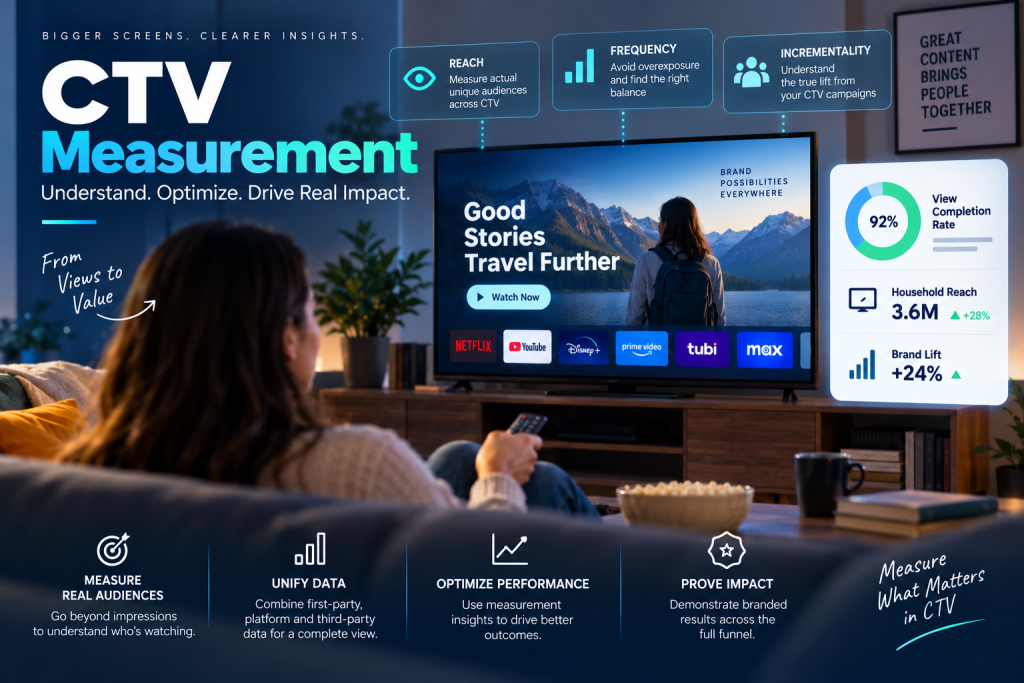
Since many years advertisers have used conventional TV as one of the best ways to reach a massive audience and build brand awareness. Unfortunately, measuring the performance of any TV advertisement has never been easy. Typically, advertisers have relied on estimates of viewers or changes in the number of visitors to websites and stores after airing a TV commercial.
CTV advertising is revolutionizing how TV campaigns are measured by advertisers. Through connected TV, advertisers will be able to collect a lot more information about their TV ads delivery and the interaction of viewers with commercials. The marketers will be able to know the exact number of people who viewed the ad, and whether the ad helped contribute to the conversion process. With these metrics and key performance indicators, it means that CTV is more than just a brand awareness channel.
What is CTV Measurement?
CTV measurement is the practice of measuring and analysing the success of connected TV advertising campaigns. It allows advertisers to measure things like:
- How many viewers have seen my ad?
- How many households were reached?
- How often have they seen the ad?
- Have they watched the ad in its entirety?
- Have they visited my website following viewing?
- Have they completed the desired action?
How Does CTV Measurement Work?
Specific actions or events are recorded through use of tracking pixel or other measurement technology. The choice of the actions to be measured is made between the advertiser and the CTV advertising platform.
Example, one individual can be viewing an ad from the CTV and later visit the site of the company advertising its products and complete the purchase. This action would be considered view through conversion in case it happens during the period of your campaign’s measurement.
Important CTV metrics
- Impression Impressions refers to number of times the ad was seen. If your ad received 50,000 impressions during your campaign, it means that the ad was shown 50,000 times.Impressions are great in determining how much delivery was achieved, however, it does not tell you how many unique people saw the ad. That is why impressions should be considered together with other metrics like reach or frequency.
- Frequency Frequency shows how many times your target viewer or household has been reached by your advertisement. Frequency is critical since advertisers must reach that balance, which means when the number of exposures is too low, there won’t be any recollection of brand and when the exposure is too high, ad fatigue may happen. Advertisers can use frequency caps that will allow them to limit how many times the same audience can see the same advertisement.
- Cost Per Mille (CPM) Cost per mille (CPM) is the price of reaching to 1,000 impressions. Formula for CPM is as below: CPM = (Campaign cost ÷ Impressions) x 1,000If an advertiser pays $10,000 and receives 500,000 impressions, then CPM will be $20. CPM allows advertisers to evaluate the price of the media and compare the CTV inventory or campaign strategy.
- Unique Households CTV differs from other digital channels in terms of the fact that the advertisement in the screen is seen by multiple viewers at once. Consider, four different people of come household can be watching the CTV advertisement simultaneously.Unique household helps the advertisers calculate how many unique households saw the ad instead of calculating impressions.
- Completion rate Completion rate measures how many times the viewers complete watching and advertisement to its end. Example, if out of 100,000 started ad views 95,000 people complete the process, the completion rate is 95%.It shows that people stay with the ad and get its brand message completely. In addition, it may assist in comparing the effectiveness of different creatives.
- Cost Per Completed View (CPCV) CPCV measures the average price per one completed video view. If the price of campaign is $5,000 and there are 100,000 completed views, then CPCV is $0,05. CPCV is effective if the goal of the campaign is to make the viewers watch the whole ad.
- Return On Ad Spend (ROAS) ROAS is used to measure the revenue against the price spent on advertising. The formula is as follows: ROAS = Revenue ÷ Advertising CostIf you are spending $10,000 for ads and the revenue is $40,000, ROAS would be 4. It means you are gaining $4 for each $1 invested. ROAS is especially effective for performance-driven campaigns aimed at linking CTV ads and their outcomes.
- View Through Conversions Many CTV ads lack a typical click-through format, which means that the user can watch an ad on TV and then proceed to visit the advertiser’s website from their mobile device or desktop computer. A view through conversion is a metric that reflects a conversion resulting form the exposure to an ad during the measurement period.
- Conversion rate Conversion rate is the metric that represents the share of the users who performed the desired action. It may be a purchase, registration, form fill-out, visiting of the website, etc. For example, if 1,000 measured users come to the website and 50 buy something, the conversion rate is 5%.
Using CTV Measurement for Brand Lift Studies
There are CTV campaigns which don’t necessarily aim to get instant conversions from the audience. In most cases, brands utilise CTV ads to improve brand awareness, brand recall and perception.
Brand lift studies consist in comparison of the group which saw the advertisement with another group which didn’t see the campaign. Advertisers can compare the following aspects between the groups:
- Brand awareness
- Brand recall
- Brand favourability
- Consumer perception
- Brand consideration
Such type of measurement is especially important for campaigns that are designed to raise brand awareness.
Conclusion
The simplest wat to grasp CTV metrics is to consider hoe each metric answers the question “What is the performance of our CTV ad?”: Impressions, frequency, COM, Unique households and completion rate show how your ad was served and consumed by your audience. Whereas CPCV, view-through conversions, conversion rate and ROAS give insight into whether the campaign helped drive measurable action or outcomes.
CTV is also becoming increasingly performance driven. Retailers and streaming services are now looking into leveraging shoppable ads to measure performance against TV advertising exposure. Overall, the future of CTV measurement is heading toward a better and more accurate measurement, as well as cross-device and privacy conscious measurement.