

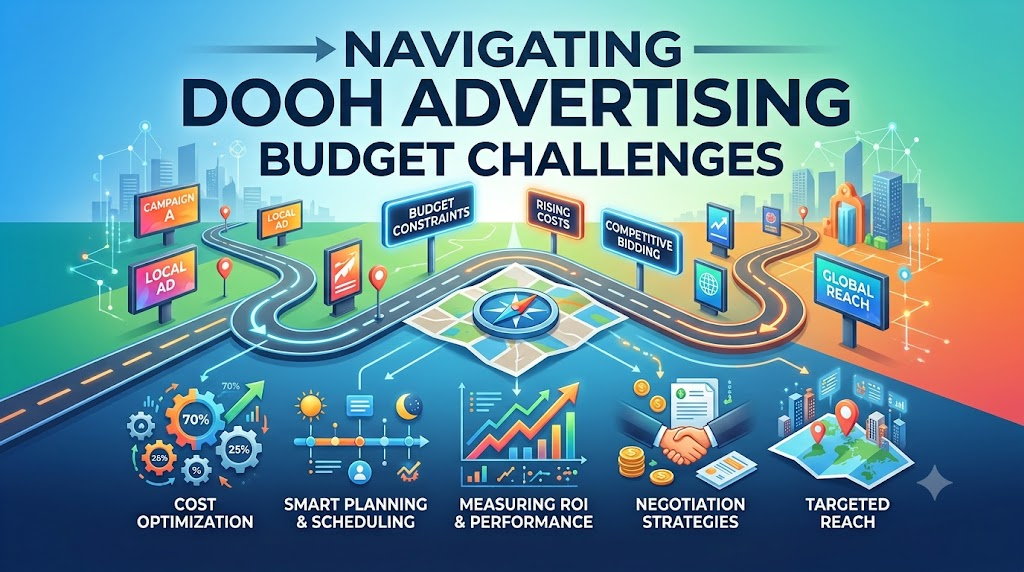
Navigating DOOH Advertising Budget Challenges
Digital out-of-home (DOOH) advertising is changing the way brands connect with consumers in the physical world.
Instead of relying only on traditional billboards, advertisers can now use digital screens across locations such as city streets, airports, shopping centers, subway stations, retail stores, and other high-traffic environments.
The growth of programmatic DOOH has made this even more flexible. Advertisers can use programmatic technology to buy digital screen inventory, manage campaigns across multiple locations, and make adjustments based on available data and campaign performance.
However, budget is still one of the biggest concerns for advertisers considering DOOH.
Premium locations can be expensive, measurement can be more complex than digital channels, and advertisers may not always know which screens will provide the best value.
The good news is that DOOH doesn’t always require a large budget.
By choosing the right locations, pricing model, campaign timing, and buying strategy, advertisers can make their DOOH investment more efficient.
What Factors Affect DOOH Advertising Costs?
There isn’t one fixed price for DOOH advertising. The cost of a campaign can vary significantly depending on several factors, including:
- Location
- Audience and traffic volume
- Screen size and type
- Campaign duration
- Time of day
- Seasonality
- Demand for the inventory
- Buying method
Understanding these factors can help advertisers make better decisions when planning their DOOH budgets.
Location and Traffic Volume
Location is one of the biggest factors affecting DOOH pricing. Screens in busy city centers, major highways, airports, train stations, and other high-traffic locations generally cost more because they can provide greater exposure.
For example, a large digital billboard in a major city center will typically cost more than a smaller screen inside a suburban retail location. However, the most expensive location isn’t necessarily the best option for every campaign.
A smaller screen in a highly relevant location may deliver better value if it reaches the right audience.
Audience and Demographics
The audience associated with a location can also influence its value. Screens located in business districts, shopping areas, affluent neighborhoods, or other areas with a desirable audience may command higher prices.
Advertisers should therefore look beyond the number of people who may see an advertisement.
The more important question is – Are the people seeing the advertisement relevant to the campaign?
A lower-cost placement that reaches the right audience can sometimes provide better value than an expensive placement with a much larger but less relevant audience.
Screen Size and Type
The type and size of the screen also affect pricing. Large digital billboards and high-impact displays usually cost more than smaller screens in places such as,
- Subway stations
- Retail stores
- Gas stations
- Shopping centers
- Office buildings
Large-format screens can provide strong visual impact, while smaller screens can offer more targeted exposure in specific environments. The right choice depends on the campaign objective.
Campaign Duration and Timing
How long a campaign runs can also affect its overall cost. Longer campaigns may provide better efficiency depending on the inventory and pricing arrangement.
Timing matters as well. For example, advertising during:
- Morning and evening commuting hours
- Major sporting events
- Holidays
- Shopping seasons
- Large local events
may cost more because demand for advertising inventory can increase during these periods.
Seasonality
DOOH pricing can also change depending on the time of year. Demand may increase around major shopping periods, holidays, sporting events, festivals, and other important events.
Seasonality can also vary by industry. For example, travel-related advertising may have stronger demand during popular travel periods, while retail advertising may become more competitive during major shopping seasons.
Planning campaigns in advance can help advertisers manage these fluctuations.
DOOH Advertising Pricing Models
Advertisers can purchase DOOH inventory using different pricing models. Three common approaches are:
- CPM-based pricing
- Flat-rate pricing
- Auction-based pricing
The right model depends on the campaign’s goals, budget, inventory, and buying method.
1. CPM-Based Pricing
With CPM (cost per thousand impressions) pricing, advertisers pay based on the number of impressions delivered.
For example, if the CPM is $10, the advertiser pays $10 for every 1,000 impressions.
CPM pricing can make it easier to compare inventory and manage campaigns based on expected exposure.
Pros and Cons of CPM Pricing
| Pros | Cons |
| Costs are connected to the number of impressions delivered. | The number of impressions does not automatically mean the audience is highly relevant. |
| Can work for both smaller and larger campaigns. | Final costs can vary if impression delivery changes. |
| Makes it easier to compare different inventory options. | Impression estimates and measurement methods can vary between providers. |
| Can provide a scalable approach to campaign planning. | A low CPM does not always mean better campaign performance. |
2. Flat-Rate Pricing
With flat-rate pricing, an advertiser pays a fixed amount to display an advertisement for a specific period. This approach is common for premium or high-visibility placements where advertisers want guaranteed access to a particular location or screen.
For example, an advertiser may pay a fixed amount to run an advertisement on a specific digital billboard for a defined period.
Pros and Cons of Flat-Rate Pricing
| Pros | Cons |
| Advertisers know the cost before the campaign begins. | The advertiser pays the agreed rate even if actual exposure varies. |
| Makes budgeting easier. | Premium locations can be expensive. |
| Useful when a specific screen or location is important to the campaign. | It can be less flexible than impression-based buying. |
| Straightforward for advertisers who want a fixed placement. | Comparing value across different placements can be more difficult. |
3. Auction-Based Pricing
Auction-based pricing allows advertisers to compete for available advertising opportunities through a bidding process. This approach is commonly associated with programmatic DOOH.
Instead of paying a fixed amount for a particular placement, advertisers can bid based on campaign requirements, available inventory, and market demand.
Pros and Cons of Auction-Based Pricing
| Pros | Cons |
| Can provide more flexibility in how budgets are allocated. | Prices can increase when demand is high. |
| Advertisers can adjust campaigns based on available performance data and inventory. | Final costs can be less predictable. |
| Can provide access to a wider range of inventory. | Smaller budgets may have difficulty competing for highly sought-after inventory. |
| Can support more data-driven campaign buying. | Buying and optimization can require a better understanding of programmatic technology. |
Which DOOH Pricing Model Is Best?
There isn’t a single pricing model that works for every campaign.
CPM pricing may be suitable when:
- You want to manage spending based on impressions.
- You need a scalable campaign.
- You want to compare inventory using a common cost metric.
Flat-rate pricing may be suitable when:
- A particular location is strategically important.
- You want predictable upfront costs.
- You want guaranteed access to a specific placement.
Auction-based pricing may be suitable when:
- You want greater flexibility.
- You are using programmatic DOOH.
- You want to adjust buying based on demand and available inventory.
The most important thing is to compare value, not just price. A cheaper screen isn’t necessarily better if it reaches fewer relevant people.
How Much Does DOOH Advertising Cost?
DOOH pricing can vary significantly by market, inventory type, location, audience, campaign timing, and buying model. Because of this, there is no universal DOOH rate that applies to every campaign.
CPM can be useful as a benchmark when comparing different inventory options, but advertisers should also consider:
- Estimated reach
- Audience relevance
- Location quality
- Screen visibility
- Frequency
- Campaign duration
- Time of day
- Inventory availability
- Measurement capabilities
For example, a premium digital billboard may have a higher CPM but provide exceptional visibility. A smaller screen in a retail environment may have a lower CPM but reach consumers closer to the point of purchase.
The best investment depends on what the campaign is trying to achieve.
Common Budget Challenges in DOOH Advertising
Although DOOH offers flexibility, advertisers can still face several budget challenges.
1. The Perception That DOOH Is Expensive
Large digital billboards in premium locations can create the impression that DOOH is only suitable for brands with large advertising budgets. That’s not necessarily the case.
DOOH inventory is available across different screen sizes, locations, and price points. Advertisers can start with smaller or more targeted placements and expand the campaign based on results.
The key is to select inventory based on audience relevance and campaign objectives, rather than choosing the most expensive screen available.
2. Measuring ROI Can Be More Complex
Measuring the impact of OOH advertising has traditionally been more difficult than measuring digital channels.
A display or search campaign can often be connected directly to online actions. OOH happens in the physical world, so connecting an advertisement to a specific consumer action can be more challenging.
However, measurement capabilities have improved significantly. Depending on the campaign and available data, advertisers can now evaluate:
- Reach
- Frequency
- Foot traffic
- Brand lift
- Sales lift
- Online activity
- Other attribution measures
Advertisers should define their measurement approach before launching the campaign so they know what success looks like.
3. Competition With Other Marketing Channels
Marketing budgets are often divided across many channels. Advertisers may need to decide how much to invest in:
- Search
- Social
- Display
- Video
- CTV
- Audio
- OOH
- DOOH
Channels with direct conversion tracking can sometimes appear more attractive because their results are easier to measure.
However, DOOH can play an important role in building awareness and reaching audiences in the physical world.
The right approach is to evaluate DOOH based on how it contributes to the overall marketing strategy, rather than expecting every channel to deliver the same type of result.
4. Seasonal Budget Changes
DOOH costs can increase when demand for inventory is high. This can happen around:
- Holidays
- Major sporting events
- Festivals
- Large conferences
- Shopping seasons
- Local events
Advertisers should account for these periods when planning their annual media budgets. Booking early and being flexible about locations and timing can help manage costs.
5. Limited Flexibility in Traditional Buying
Traditional OOH buying can involve fixed placements and longer commitments. Once a static advertisement is installed, changing the creative requires a physical replacement.
Programmatic DOOH provides more flexibility because digital inventory can be managed through technology and, where supported, campaigns can be adjusted based on available data and inventory.
This makes programmatic DOOH particularly useful for advertisers who want to change budgets, timing, locations, or creative during a campaign.
Strategies to Overcome DOOH Budget Constraints
A limited budget doesn’t necessarily mean DOOH is out of reach. Here are some practical ways advertisers can make their budget work harder.
1. Educate Stakeholders
Before asking for more budget, explain what DOOH can actually deliver. Show stakeholders how different screen types and locations provide different levels of reach, relevance, and cost.
Instead of focusing only on premium billboards, demonstrate the range of available inventory. This can make it easier to create a realistic test budget.
2. Focus on Relevant Placements
Don’t choose a location simply because it has a large number of impressions. Consider whether the people passing through that location match your target audience.
For example, a B2B company may benefit more from screens near business districts or conference venues than from a high-traffic location with little relevance to its audience.
Likewise, a retail brand may prioritize screens near stores or shopping areas. Relevance can be more valuable than scale alone.
3. Use Programmatic DOOH to Improve Budget Efficiency
Programmatic DOOH can make campaign management more flexible. Depending on the platform and inventory, advertisers can manage multiple placements through a centralized buying process and adjust campaign parameters based on available data.
This can help reduce manual work and make it easier to manage budgets across different locations.
Programmatic buying can also make it easier to test different placements before committing more budget to the strongest-performing areas.
4. Combine Traditional OOH and DOOH
Advertisers don’t have to choose between traditional OOH and digital OOH. A hybrid strategy can use both. For example:
Traditional OOH: Provide consistent visibility through static billboards.
DOOH: Add dynamic messaging and flexible digital placements.
This approach can help balance reach, creative flexibility, and budget.
5. Use Day-Parting
Day-parting means showing advertisements during specific times of the day. For example, a brand targeting commuters could concentrate its budget around:
- Morning commute
- Evening commute
A restaurant could focus on lunch and dinner periods. This allows advertisers to prioritize the times when their target audience is most likely to be present.
Rather than running continuously throughout the day, advertisers can focus their budget on the most relevant time periods where the inventory supports this type of scheduling.
6. Negotiate With Media Owners
For direct OOH purchases, advertisers may be able to negotiate pricing with media owners, especially when planning larger or longer campaigns.
Depending on the media owner, advertisers may be able to negotiate:
- Volume discounts
- Longer-term rates
- Added-value placements
- Flexible campaign terms
- Additional inventory
This approach is particularly useful when an advertiser has a clear long-term plan or intends to purchase multiple placements.
How Agencies Can Pitch DOOH Advertising to Clients
Agencies introducing DOOH to clients should focus on the business value, rather than presenting it simply as another advertising format.
Clients may have questions about cost, measurement, and whether DOOH can deliver meaningful results.
A clear pitch should address these concerns.
1. Explain What Makes DOOH Different
Start by explaining where DOOH can reach consumers. People see OOH advertising while they are:
- Commuting
- Shopping
- Traveling
- Working
- Attending events
- Visiting public spaces
This allows brands to reach consumers in real-world environments that digital advertising alone cannot fully replicate.
2. Address Cost and ROI Questions
Don’t position DOOH as an expensive premium channel. Instead, explain that there are different types of inventory available at different price points.
Show clients how they can start with a focused campaign and expand based on the results. Where measurement is available, use metrics such as:
- Reach
- Frequency
- Brand lift
- Foot traffic
- Website activity
- Sales lift
This gives clients a clearer way to evaluate the investment.
3. Create Campaigns Around Specific Objectives
A DOOH proposal becomes stronger when it solves a specific marketing problem.
For example:
Product launch: Use high-visibility screens in key markets.
Retail campaign: Use screens near stores to reach consumers closer to purchase.
Event promotion: Advertise around venues and transportation hubs.
B2B campaign: Target locations around business districts and industry events.
The campaign should start with the objective and then determine the appropriate locations and inventory.
4. Use Data and Programmatic Technology
Programmatic DOOH can make campaigns more flexible and data-driven. Depending on the platform, advertisers can use available information to select inventory, manage budgets, adjust campaigns, and evaluate performance.
This can make DOOH easier to integrate into broader programmatic strategies.
5. Position DOOH as Part of an Omnichannel Strategy
DOOH works best when it is not treated as an isolated channel. It can complement:
- CTV
- Display
- Video
- Mobile
- Audio
- Social
- Search
For example, a brand could use DOOH to build awareness in a particular location and then use digital channels to continue communicating with the audience.
This creates a more connected experience between physical and digital advertising.
6. Start With a Small Test
If a client is unsure about DOOH, a smaller campaign can be a practical starting point. Instead of immediately investing in premium, high-cost screens, consider testing:
- A limited geographic area
- A smaller number of screens
- A specific audience
- A short campaign period
- A particular time of day
The goal is to learn what works before increasing the investment. This reduces risk and gives the client real campaign data to use when deciding whether to scale.
Programmatic DOOH: Benefits and Scalability
Programmatic DOOH gives advertisers more flexibility in how they use their budgets. Campaigns can potentially run across different environments, from premium digital billboards to smaller screens in retail locations, transportation hubs, and other high-traffic spaces.
This means advertisers don’t have to put their entire budget into one expensive placement.
They can distribute spending across multiple locations and adjust the campaign based on the available inventory and campaign objectives.
Programmatic technology can also make campaign management more efficient by bringing buying, optimization, and reporting into a more centralized workflow.
The result is a DOOH strategy that can start small and scale as advertisers gain confidence in the channel.
Final Thoughts
DOOH advertising doesn’t have to be an expensive, one-size-fits-all investment. The cost depends on factors such as location, audience, screen type, timing, seasonality, inventory demand, and buying model.
The most important thing is to focus on the value of the placement rather than simply looking for the lowest price.
A premium billboard may be the right choice for a major product launch, while a network of smaller screens may be more effective for a targeted local campaign.
Programmatic DOOH adds another layer of flexibility by helping advertisers manage digital screen inventory, adjust campaigns, and integrate OOH into broader digital strategies.
For advertisers working with limited budgets, the best approach is to start with a clear objective, choose relevant locations, test different inventory, measure what matters, and scale what works.
DOOH is no longer just about buying a billboard.
It is becoming a flexible part of the modern media mix, connecting brands with consumers in the real world while bringing more of the data, automation, and flexibility associated with digital advertising.