

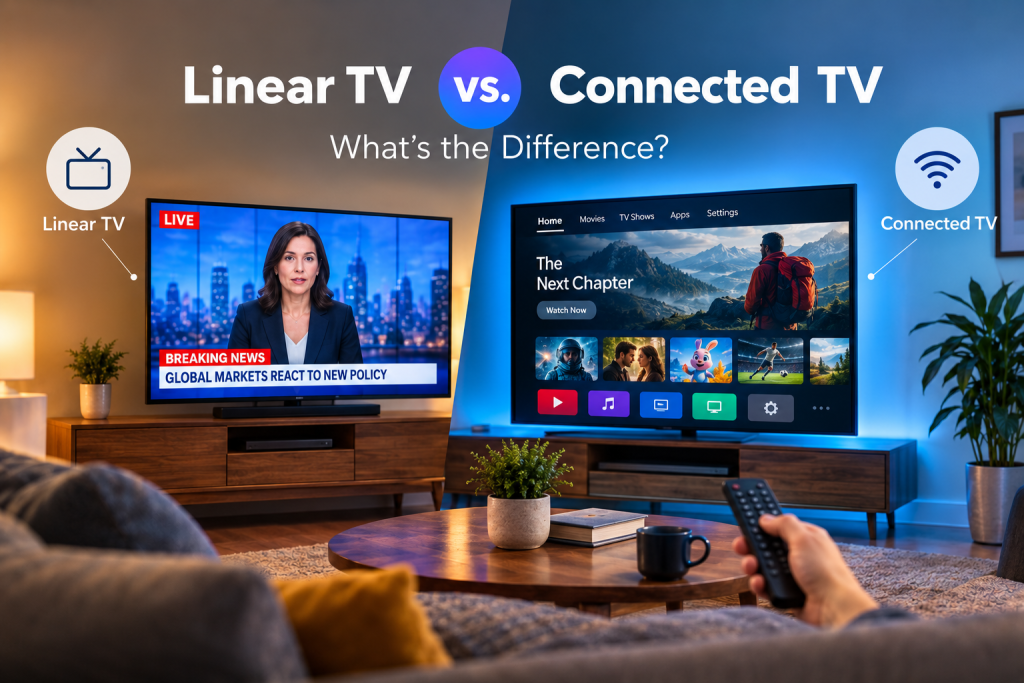
Linear TV vs. Connected TV: What’s the Difference?
Television advertising has changed significantly over the last few years.
For decades, linear TV was the primary way brands reached large audiences. People watched scheduled programs through cable, satellite, or broadcast television, and advertisers purchased commercial spots around those programs.
Today, viewers have many more choices. Instead of watching only scheduled programming, they can stream movies, TV shows, live events, news, and other content whenever they want. This has made Connected TV (CTV) an important part of modern advertising.
While linear TV and CTV both appear on television screens, the way audiences consume content-and the way advertisers buy and measure advertising-can be very different.
The simple way to think about it is
Linear TV = scheduled television programming.
CTV = television content delivered through an internet-connected device.
Both have their own advantages. The right choice depends on the campaign’s goals, audience, budget, and the type of reach an advertiser needs.
What Is Linear TV?
Linear TV refers to traditional television where viewers watch scheduled programming through broadcast, cable, or satellite services. The content follows a fixed schedule determined by the television network or channel.
For example, if a news program starts at 8:00 PM, viewers need to tune in at that time to watch it live.
The same principle applies to advertising. Advertisers purchase commercial spots within specific programs, channels, or time slots. The ads are then shown to the audience watching that programming.
Examples of linear TV environments include:
- Broadcast television
- Cable television
- Satellite television
- Scheduled news programming
- Live sports
- Live events
- Traditional TV channels
Linear TV is still relevant, particularly for campaigns that require large-scale reach, live programming, and broad audience exposure.
Benefits of Linear TV Advertising
1. Reach Large Audiences Through Live Programming
One of the biggest strengths of linear TV is its ability to deliver large audiences around live and highly anticipated programming. Examples include:
- Live sports
- Breaking news
- Awards shows
- Major entertainment events
- Political events
- Special broadcasts
Live programming remains valuable because viewers often want to watch events as they happen rather than wait for them to become available on demand.
For advertisers, these environments can create opportunities to reach a large number of viewers at the same time.
However, live content is no longer exclusive to traditional television. Many major events are now distributed across both traditional and streaming platforms.
This means advertisers increasingly need to consider both linear TV and CTV when planning campaigns around major live events.
2. Reach Audiences That Still Prefer Traditional TV
Although streaming continues to grow, not every viewer has moved completely away from traditional television.
Some audiences-particularly older demographics-continue to spend significant time watching broadcast and cable television.
This makes linear TV useful for brands that want to reach audiences who are more likely to consume traditional TV content.
For example, a brand targeting an older consumer segment may find linear TV valuable because those viewers may have stronger traditional-TV viewing habits.
At the same time, audience behavior is changing across generations. Younger audiences are also watching television content, but they are increasingly doing so through streaming services.
Therefore, advertisers should avoid treating age as the only deciding factor. Actual audience behavior and campaign objectives should guide the media strategy.
3. Plan Campaigns Around Channels and Time Slots
Linear TV provides advertisers with a relatively predictable way to plan campaigns. Advertisers can select:
- Specific channels
- Programs
- Time slots
- Dayparts
- Live events
- Geographic markets
Different programs attract different types of viewers.
For example, a brand targeting families may choose programming that is popular among family audiences. A financial services company may prefer news or business-related programming.
Prime-time programming can also provide broad exposure and help brands build awareness.
The key advantage is that advertisers can plan around where and when their desired audience is likely to be watching.
What Is Connected TV?
Connected TV, or CTV, refers to television content that is delivered through an internet-connected TV or device. This can include:
- Smart TVs
- Streaming devices
- Gaming consoles
- Connected set-top boxes
- Other internet-connected television devices
CTV allows viewers to watch content through streaming services instead of relying exclusively on traditional cable or satellite television.
Examples of CTV environments include streaming movies, TV shows, live channels, news, sports, and other digital content.
CTV advertising can appear before, during, or after video content. Depending on the publisher and platform, advertisers may also have access to different interactive or advanced video ad formats.
The major difference from traditional TV is the technology behind the advertising.
Instead of relying primarily on broad program or channel-based audiences, CTV advertising can use digital audience and contextual signals to make targeting more precise.
Benefits of Connected TV Advertising
1. More Precise Audience Targeting
One of the biggest advantages of CTV is its ability to bring digital-style targeting to the television environment.
Depending on the platform, publisher, and available data, advertisers may be able to target audiences using signals such as:
- Demographics
- Geographic location
- Interests
- Content preferences
- First-party data
- Audience segments
- Contextual signals
- Device information
- Behavioral signals
For example, instead of showing an advertisement to everyone watching a particular TV channel, an advertiser may be able to focus on a specific audience segment within CTV inventory.
This can help advertisers reduce wasted impressions and make their campaigns more relevant.
Contextual targeting is also important: CTV doesn’t have to rely only on information about the viewer. Advertisers can also consider the content being watched.
For example:
- A sports brand can advertise around sports content.
- A travel company can advertise around travel-related programming.
- A financial company can advertise around business or financial content.
- A food brand can advertise around cooking or lifestyle content.
This combination of audience and contextual targeting gives CTV advertisers more flexibility than traditional TV buying.
2. Better Measurement and Optimization
Measurement is another major difference between traditional TV and CTV. Traditional TV campaigns often depend on estimated audience data and post-campaign reporting. CTV works more like other digital advertising channels.
Depending on the platform and measurement setup, advertisers can receive detailed campaign metrics such as:
- Impressions
- Video completion rate
- Completed views
- Reach
- Frequency
- Cost metrics
- Conversion metrics
- Audience performance
This allows advertisers to understand how campaigns are performing and identify opportunities for optimization.
For example, if one audience segment is performing better than another, an advertiser can adjust the campaign strategy based on available data.
Similarly, advertisers can compare different creatives, audiences, publishers, or inventory sources. This creates a more data-driven approach to TV advertising.
It’s important to remember that measurement capabilities are not identical across every CTV platform. Available metrics depend on the publisher, device, measurement partner, and campaign setup.
3. Engaging Digital Viewing Experience
CTV combines the large-screen viewing experience of television with the technology of digital advertising.
Viewers can watch content on a large screen, often in high-quality video, while advertisers can use digital buying and targeting capabilities.
CTV is particularly useful for video storytelling because advertisers can use:
- Full-screen video
- Sound
- Motion
- Brand visuals
- Strong calls to action
- Interactive experiences where supported
Because the ad appears within a television viewing environment, CTV can be particularly effective for brand awareness and consideration campaigns.
However, CTV is not only an awareness channel. With the right measurement and audience strategy, it can also support consideration and performance-focused campaigns.
Linear TV vs. CTV: Key Differences
| Factor | Linear TV | Connected TV |
| Content delivery | Broadcast, cable, or satellite | Internet-based streaming |
| Viewing model | Mostly scheduled programming | On-demand and live streaming |
| Targeting | Primarily channel, program, time, and demographic based | Audience, contextual, geographic, and other digital signals |
| Reach | Strong broad reach, especially through traditional TV | Growing reach across streaming audiences |
| Live content | Strong for traditional live broadcasts | Increasingly important as live sports and events move to streaming |
| Measurement | Often based on estimated audience data | More granular digital-style measurement, depending on setup |
| Optimization | Limited once the media buy is placed | More flexible during a campaign |
| Creative | Primarily traditional TV commercials | Video ads and other supported digital TV formats |
| Buying approach | Traditionally planned and purchased in advance | Can be purchased through direct, programmatic, or hybrid approaches |
| Best suited for | Broad awareness and large-scale reach | Targeted reach, measurable campaigns, and incremental audiences |
The important point is that linear TV and CTV are not competing formats in every situation. They can complement each other.
How to Use Linear TV and CTV Together
Instead of asking, “Should I use linear TV or CTV?”, advertisers can often ask, “How can I use both to reach more of the right audience?”
A combined strategy can help brands take advantage of the strengths of both channels.
Here are three approaches.
1. Extend Existing TV Campaigns to CTV
If a brand already has a TV commercial, the same core creative can often be adapted for CTV. This can make it easier to extend an existing campaign into streaming environments.
For example, a brand running a 30-second commercial on traditional television could also use an appropriate version of that creative in CTV inventory. However, simply copying the same creative isn’t always the best approach.
CTV is a digital environment, so advertisers should also consider:
- Mobile and TV screen differences
- Clear branding
- Strong opening seconds
- Captions where appropriate
- Simple messaging
- Clear calls to action
- Different viewing environments
The goal is to make the creative work well on a large screen in a streaming environment, not simply reuse an asset without considering the context.
2. Use Linear TV and CTV to Increase Overall Reach
Using only one TV channel can limit the audiences a campaign reaches. A combined strategy can help advertisers reach people who still watch traditional television as well as audiences who primarily stream content.
For example: Linear TV can help reach traditional TV viewers and large audiences around scheduled programming.
CTV can help reach streaming audiences, including people who have reduced or completely stopped using traditional cable TV. Together, they can provide broader coverage across different viewing habits.
This is particularly useful as audiences become increasingly fragmented across broadcast channels, cable networks, streaming services, and digital platforms.
3. Build Cross-Channel Campaigns
CTV can also work as part of a broader digital advertising strategy. For example, a brand could:
- Show a CTV video ad to introduce the brand.
- Reach exposed audiences through display or native advertising.
- Retarget eligible audiences where the platform and privacy framework support it.
- Measure downstream actions such as website visits or conversions.
This creates a connected customer journey instead of treating every advertising channel as a separate campaign.
However, cross-device and cross-channel targeting should always follow the privacy, consent, identity, and measurement rules supported by the relevant platforms and markets.
Which One Should Advertisers Choose?
There isn’t one universal answer. The right choice depends on several factors, including:
Choose Linear TV when:
- You need broad traditional TV reach.
- Your audience strongly watches broadcast or cable TV.
- You want to advertise around major live programming.
- Your campaign is focused heavily on mass awareness.
- Channel and program selection are important to your strategy.
Consider CTV when:
- You need more precise audience targeting.
- Your audience spends significant time streaming.
- You want more detailed campaign measurement.
- You want greater flexibility in campaign optimization.
- You want to reach cord-cutters and streaming-first audiences.
- You want to integrate TV advertising with your broader digital strategy.
Consider using both when:
- You want broad reach and precise targeting.
- Your audience is spread across traditional TV and streaming.
- You want to increase incremental reach.
- You want to connect TV exposure with digital campaigns.
- You want to build a more complete video advertising strategy.
Final Thoughts
The television advertising landscape is no longer simply about choosing between traditional TV and streaming.
Viewers now move between broadcast television, cable, smart TVs, streaming services, connected devices, and live digital content depending on what they want to watch and when they want to watch it.
Linear TV continues to provide value through broad reach, scheduled programming, and live events. CTV brings many digital advertising capabilities to the television screen, including more flexible targeting, measurement, and optimization.
For many advertisers, the strongest strategy is therefore not linear TV vs. CTV, but linear TV + CTV.
By understanding where their audience watches content and matching each channel to the campaign objective, advertisers can build a more effective and flexible TV advertising strategy.