

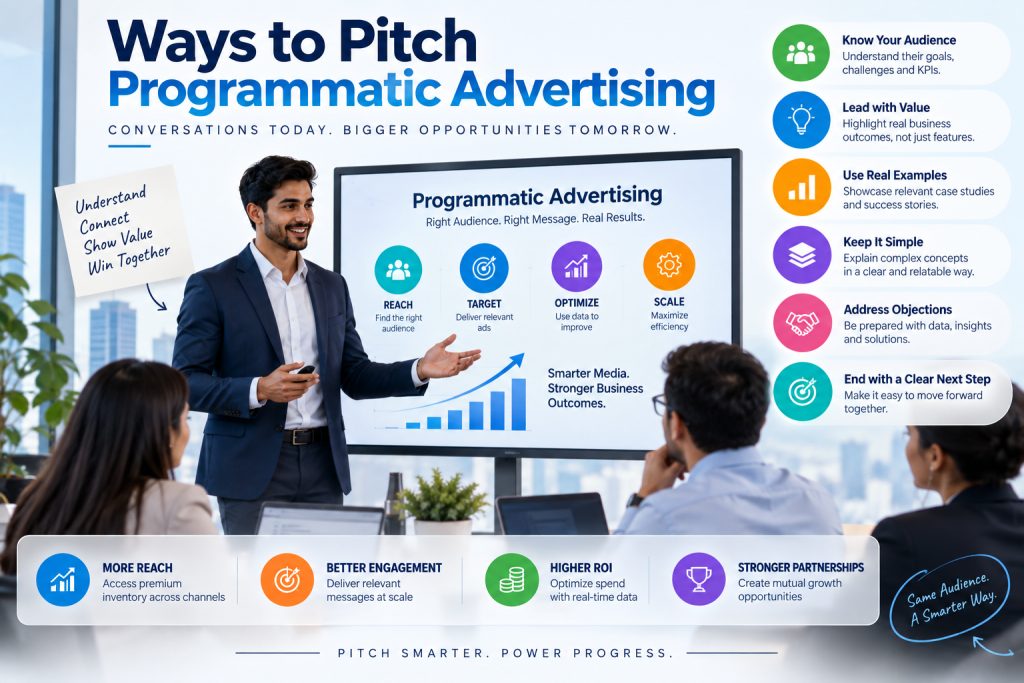
Before Pitching, Understand the Advertising Goals
Most of the time, people make the same mistake of not trying to understand the advertisement requirements, client’s expectations, KPIs, etc., and straightaway pitching what services or products they have.
You need to sit with clients to understand what their objectives are and what products or services they are offering before you pitch the advertising strategy to them.
If the client or agency is expecting “brand awareness,” you can recommend high-impact display, CTV/OTT, online video/in-stream, etc. If they are expecting “engagement,” then you can pitch rich media and interactive ads, playable ads, rewarded video, native, and branded content. You should be very familiar with the client’s expectations even before giving them advertising plans.
Always lead with strategy, not the list of products you offer. Let’s understand the basics here. You have to act as a strategist. Instead of telling them what you offer, sit with the client to understand what their advertisement goals are. Are they looking for top-of-the-funnel (TOFU) or bottom-of-the-funnel (BOFU) advertising?
Match the format to the goal—recommend display for brand awareness and brand uplift, carousels to tell stories, and rich media for user engagement.
Addressing Common Misunderstandings
Myth: Programmatic is too complex and complicated.
A lot of clients think programmatic is way too complex. The first step towards solving this misunderstanding is by simplifying things and explaining to them that today’s DSPs are built for transparency and clarity. You can show them how easy the campaign set-up is, how precise the audience targeting can be, and how seamless the reporting is.
Myth: Programmatic is only for big brands and is too expensive.
We at Digital East GmbH have proved this wrong time and again. Programmatic advertising once used to be expensive, and only giants were using it. Now, we have made it so simple that you can start campaigns even with just a $1,000 budget. Anyone can launch a pilot campaign, test it, learn, and scale. In today’s era, most programmatic platforms support small brands and agencies with lower minimal spends.
Myth: Brands lose control due to automation.
Many brands and agencies think that they might lose complete control because of automation. The answer to this confusion is that automation enacts your strategy. New-age platforms offer real-time data, reporting, and performance dashboards that put oversight back in your hands. You have the control panel to manage budgets, pacing, frequency cap tightening, targeting, creative swaps, etc. Programmatic platforms are built on transparency.
Position Programmatic as High Reward and Minimal Risk
You need to guide with the promise of programmatic as transparent, fast, controllable, and reliable.
- Start Small and Scale: Brands don’t want to commit big budgets to something they haven’t seen work. Programmatic lets them start small, see results as they happen, and change course whenever they are ready and whenever they need to.
- Total Agility: Audiences change their minds mid-campaign. With programmatic, so can you! Move the budget, adjust the bids, or put up fresh creative without pausing anything. Programmatic has got everything.
Explain Why Multi-Channel Reach Matters
Trace the path across channels right from display – video – audio – CTV/OTT – pDOOH – In-Game.
Here is what this looks like in practice:
- Start with native: Place the brand inside content the audience already trusts, in a format that doesn’t interrupt the read.
- Follow with display: Keep the brand in view for anyone who has already come across the native placement.
- Bring in CTV: A short, well-made spot on the big screen turns passing awareness into something the audience actually remembers.
- Layer in audio: Reach the same set of people while they are driving their automobile, walking, jogging, or working—the moments a screen can’t reach.
- Add pDOOH: Show up in high-footfall places such as malls, concerts, bus stations, airports, etc., so the brand appears in the physical world too.
- Finish with in-game: Catch the audiences during long, attentive sessions where there’s little else competing for their focus.
A campaign might run like this: Native to introduce, display to keep the brand visible, CTV/OTT to make it memorable, audio to catch people on the move, pDOOH to plant it in the real world, and in-game to reach them where attention runs deepest.
Address Targeting and Measurement Without the Detail
Talk about smarter insights, not spreadsheets. The point of programmatic isn’t the numbers it produces. It’s what those numbers tell you about your business.
Start with what a client already owns—their own customer data. Because it’s collected with permission and comes straight from their own customers, it’s accurate; it tells them who those customers are and how they behave. That means they can group their audience sensibly, reach the right people, and run ads that actually land. The same data lets them find new people who look and behave like their best customers, or reconnect with people who have bought before without depending on third-party tracking.
Live dashboards then show what’s working while the campaign is still running, not days or weeks later.
When pitching, skip the industry vocabulary. Frame it around three things instead:
- Knowing your audience: Who responded, and what they did next.
- Making smarter moves: Changes based on evidence, not hunches.
- Spending better: Every rupee reaching someone worth reaching.
Framed this way, targeting and measurement stop being a box to tick and start being something you work on together. The best programmatic pitches don’t sell the technology. They sell control—over who sees the brand, how often, and what happens next. Get that across in plain language, and the platform details take care of themselves.