

Even though digital advertising has been there since the early 1990s, programmatic advertising began in 2013 with the introduction of Google’s AdSense platform.
In the earlier days, the options were very limited, with brands and agencies primarily depending on just display advertising and very basic keyword targeting to reach audiences and enhance campaign performance.
Within a few years, a few other programmatic platforms entered the mix, allowing brands, agencies, and publishers to buy and sell inventory across multiple channels—including video, native, CTV, audio, in-game, and programmatic digital out-of-home (pDOOH)—revolutionizing programmatic advertising from a niche solution to the preferred method marketers use for delivering targeted multi-channel campaigns across digital and offline touchpoints like direct mail.
How Does Programmatic Advertising Fit Your Needs?
Let’s deep dive into how programmatic advertising fits into the modern marketing strategy.
In today’s world, marketers depend on an increasing number of strategies and channels, from SEO and content marketing to social media and email marketing, to engage their audiences and drive better results. But doing it efficiently and at scale has never been more demanding.
This is exactly where programmatic advertising enters.
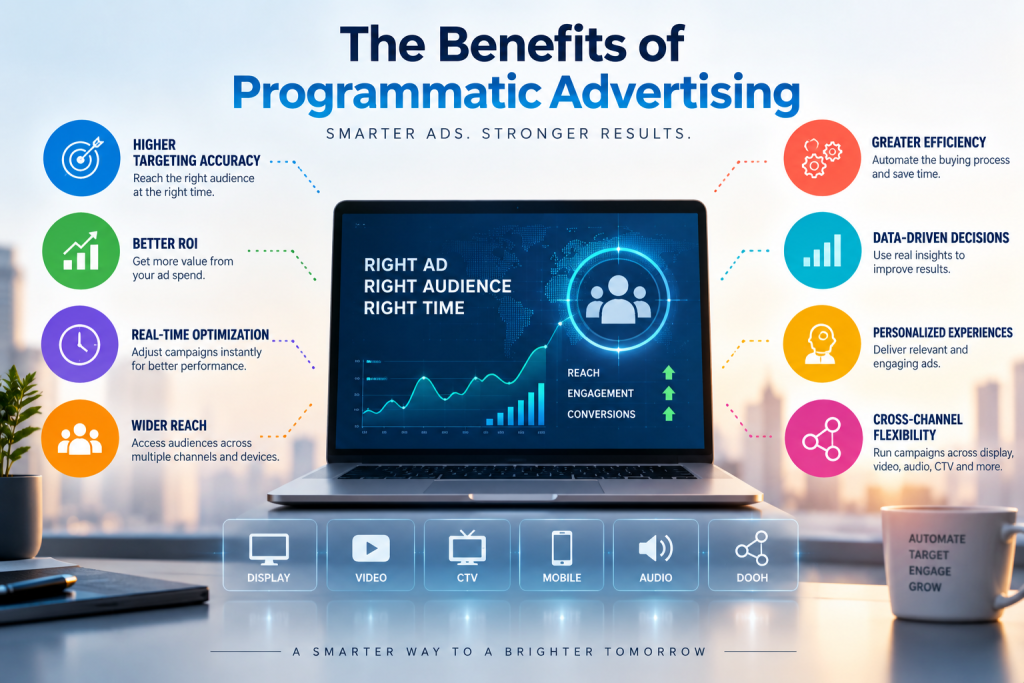
Programmatic advertising provides supreme accuracy, flexibility, and efficacy, allowing marketers to target the right audiences on the right platform at the perfect time while supplementing and enhancing other marketing efforts they already have in place.
The Core Benefits of Programmatic Advertising
| Feature | The Old Way | The Programmatic Way |
| Efficiency | Manual calls, price negotiations, contract signing, and uploading creatives to multiple publisher platforms individually. | Login to a single DSP, launch across thousands of sites, apps, and smart TVs instantly with a few clicks. |
| Cost & Scale | Prohibitive entry barriers; only multi-million dollar corporations could afford major TV networks or popular websites. | Group buying power via single ad slots; local startups and giants can bid on the exact same premium inventories. |
| Flexibility | Static print ads, billboards, or magazines. Zero room for edits once printed or published. | Total real-time control; update imagery, rewrite copy, or pause campaigns mid-broadcast instantly. |
| Reach | Fragmented and siloed to one specific physical location, website, or single TV channel. | Omnichannel presence everywhere your audience goes—news portals, mobile games, or streaming apps simultaneously. |
| Transparency | Blind trust metrics; hard to prove billboard impressions or exact conversion attribution. | Real-time dashboards displaying precise site lists, view-ability duration, click-throughs, and purchase conversions. |
1. Targeting
In simple terms, programmatic advertising is like hiring a digital matchmaker that instantly finds the perfect customers for your business. Instead of paying for a massive billboard on a highway hoping the right person sees it, you use a smart computer system to show your digital ad only to the exact people who care about your product or service.
Targeting parameters include:
- Demographics: Showing ads based on age, gender, or location (e.g., targeting only 30-year-olds in Mumbai).
- Behaviour: Targeting people based on actions, such as frequent online shoppers or frequent travelers.
- Interests: Targeting people based on affinity categories like cooking, scuba diving, gym workouts, or yoga.
2. Efficiency – Done in a Flash
Eliminate the friction of old-school media buying. Instead of juggling multiple publisher contracts, a single login to a Demand-Side Platform (DSP) automates placement across the entire web ecosystem instantly.
3. Cost-Effective: Group Buying Power
Because programmatic systems allow purchasing on a granular, single-slot basis, barriers to entry vanish. A local bakery can compete for consumer attention on the exact same high-value properties as a multi-national enterprise.
4. Flexibility: Change Your Mind Instantly
If live performance data shows creative fatigue or a pricing typo, you don’t have to wait for new prints. Adjustments happen mid-flight with the click of a button, giving you total dynamic control every second.
5. Reach: Be Everywhere, at Once
Break free from single-channel constraints. Your target accounts encounter your brand messaging dynamically whether they are reading digital newspapers, playing mobile titles, or streaming connected TV content.
6. Transparency and Optimization
With programmatic advertising, there are no secrets. You can log into your DSP dashboard at any time to review granular performance metrics:
- Exact lists of serving sites, apps, and TV channels.
- Impressions delivered and video watch durations.
- Click-through rates (CTR) and landing page conversions.
Why this matters: Because you have access to continuous data streams, you can optimize campaigns on the fly. If performance lags on gaming apps while thriving on news platforms, you can dynamically shift budgets instantly, ensuring capital works as hard as possible.