

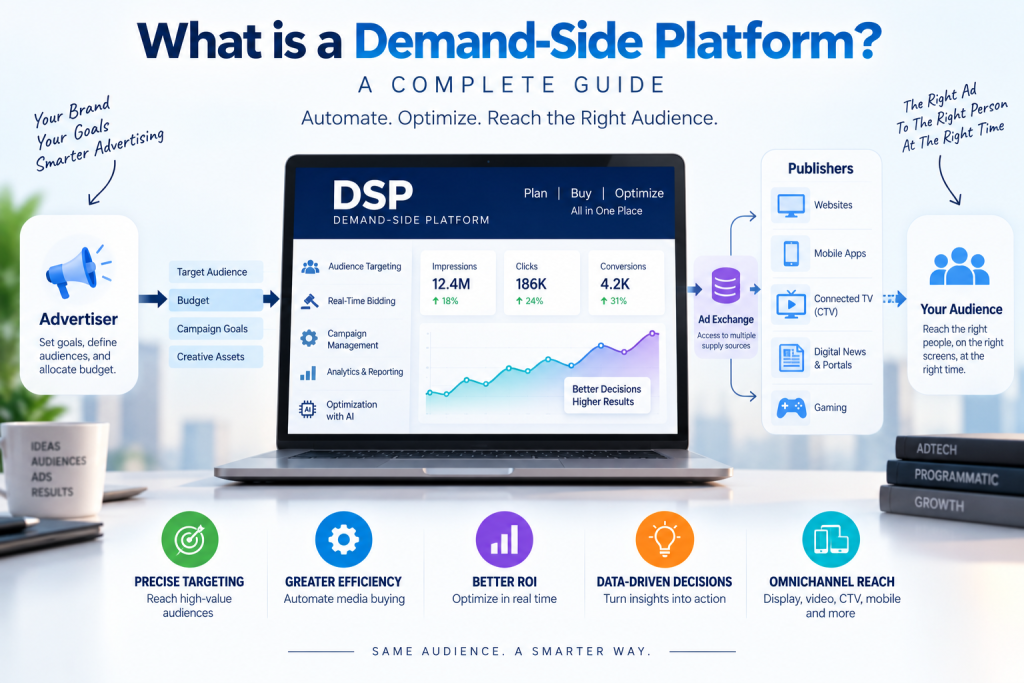
What is DSP (Demand Side Platform)? Introduction, and a complete guide.
Let’s talk about what is a DSP?
- A Demand Side Platform is a software that helps advertisers and agencies to buy inventory, manage and optimize campaigns in real time across thousands of sites and apps.
How and from where do DSPs get the inventory?
- A DSP is integrated with multiple SSPs (Supply Side Platforms) and Ad Exchanges, and every bid request (inventory) arrives from them. Fun Fact: A DSP almost never owns inventory!
Did you know?
- The founding year of the DSP is 2007! The first DSP appeared around 2007, with companies like Invite Media and MediaMath building the tools.
What is a DSP? Did it simplify the advertising process?
A Demand Side Platform (DSP) is a software that helps advertisers and agencies to buy inventory, manage, and optimize campaigns in real time across thousands of sites and apps.
DSPs basically simplify the complex process of programmatic advertising by letting marketers, agencies, and advertisers set budgets, define audiences (1st party, 3rd party), upload creatives, and manage multiple campaigns seamlessly, all from one single platform.
The Difference Between a DSP and an SSP
In simple terms, a DSP is a buyer who buys inventory on behalf of advertisers and agencies, and an SSP is a seller who sells inventory programmatically via oRTB and VAST integrations.
- DSP: DSPs are used by advertisers, agencies, and brands to buy ad inventory to reach the right audience at the right time by optimizing their spends against specific goals (e.g., Impressions, Clicks, CPC, Landing Page Visits, etc.).
- SSP: SSPs are used by “Publishers” (such as The Times Of India, BBC, CNN, Forbes, etc.) to sell their available ad space to monetize their inventory. In simple terms, publishers sell the inventory to multiple SSPs to make the best out of the available inventory so that it doesn’t go to waste.
Ad Exchanges sit between DSPs and SSPs acting as a marketplace where impressions are bought and sold via a technology called Real-Time Bidding (RTB). Through these exchanges, Supply Side Platforms make inventory accessible and available to multiple DSPs, giving advertisers, brands, and agencies access to a broad range of placements without even needing to negotiate with individual publishers separately.
When an ad opportunity becomes available, SSPs offer it to the Ad Exchanges, and DSPs will be eligible to bid on those ad requests based on the advertiser’s pre-determined criteria such as bid price, frequency capping, creative dimensions, geo-targeting, and other targeting parameters set in the campaign. Finally, a winning ad is shown to the user.
This entire process takes less than a millisecond—faster than a publisher page or content can fully load—thus making a DSP the perfect and preferred platform for purchasing ad placements in bulk without sacrificing control.
Different Types of Targeting in Programmatic Advertising
- Demographic (Demo) Targeting: These are attributed to Age, Gender, and HHI (House Hold Income, if available).
- Contextual Targeting: The ads are placed alongside relevant content. This helps ensure the creatives align with the context of the page where the ads appear.
- Behavioural Targeting: This focuses on past browsing activity and engagement signals of a user, helping brands connect with users who have already shown interest in certain products or services based on their online behavior.
- Device Targeting: This targeting is done based on devices such as Device Type (Desktop, Mobile, Tablet, Connected TV (CTV)), Device Make, Model, Operating System (OS) and its versions, Browser, etc.
- Geo Targeting (Geographic Targeting): This allows the advertisers to control exactly where they want to show the ads. This ranges from Country, Region (State), City, Zip Code, and Co-Ordinates. Let us explain geo-targeting one by one:
- Country/Region/City Targeting: You can target a campaign to an entire country or to a specific region or city. This is very common across all DSPs.
- Zip Code Targeting: You can target a campaign to specific postal codes, giving advertisers complete control.
- Coordinate-Based Targeting: This is precision targeting made using the Latitude and Longitude of a place and drawing a radius around it. This targeting works typically based on the device’s location signals.