

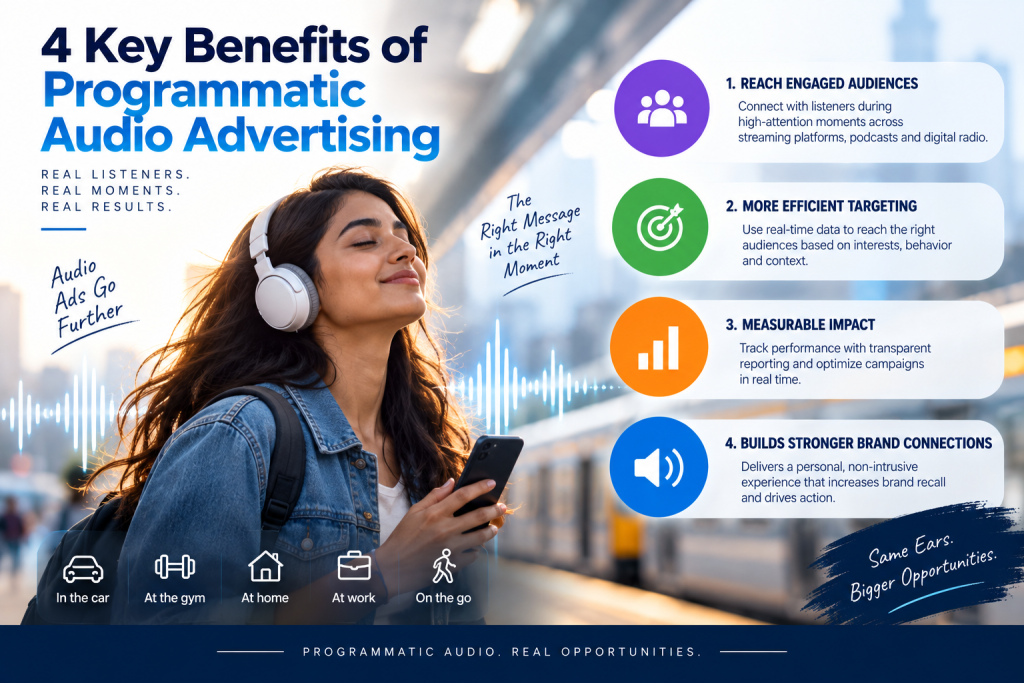
What is Programmatic Audio Advertising?
Audio has become an essential medium for digital content consumption. Music streaming, podcasts, internet radio, audiobooks, and other audio platforms give people opportunities to listen throughout the day.
Unlike display, video, or social advertising, audio does not require the user to look at a screen. People listen while commuting, exercising, cooking, working, or relaxing.
Programmatic audio advertising allows advertisers to automatically purchase audio ad placements using technology-driven bidding and targeting. Instead of manually selecting individual placements, advertisers use audience, contextual, geographic, device, and behavioural signals to reach listeners at scale.
1. Audio Creates a Strong Emotional Connection
Sound has a unique ability to influence how people feel. A familiar voice, piece of music, sound effect, or intentional tone can evoke an emotional response within seconds. This gives audio advertising an advantage when making a brand feel personal and memorable.
For example, a travel company can use calming music and an inspiring voiceover to create a feeling of relaxation and adventure. Similarly, a food delivery brand can use energetic sound design and conversational delivery to generate excitement.
A well-crafted audio ad coordinates five foundational elements:
- Voice: The persona and pacing representing the brand.
- Music: The melodic backing track setting the mood.
- Sound Effects: Environmental cues that build immersive context.
- Tone & Emotion: The feeling conveyed to the listener.
- Brand Messaging: The core proposition and call to action.
Why this matters: Visual banners are frequently scrolled past or ignored, but a distinctive voice, sound signature, or sonic logo stays with the listener long after the audio stream finishes.
2. Reaching Audiences During Screen-Free Moments
Digital audio does not require visual attention. Listeners engage with audio in scenarios where looking at a screen is impossible or unsafe:
- During morning and evening commutes
- While driving
- During gym workouts and runs
- While cooking or preparing meals
- During household chores
- While working, designing, or studying
- During leisure and relaxation time
These screen-free moments allow advertisers to maintain continuity outside conventional visual environments. Someone jogging cannot browse social feeds, but they remain engaged with a podcast or streaming playlist.
Complementing Existing Channels
Programmatic audio works alongside your multi-channel digital mix:
- Display Advertising: Reinforces brand recall through visual impressions.
- Video Advertising: Delivers high-impact initial product showcases.
- Connected TV (CTV): Anchors living room awareness on big screens.
- Native Advertising: Drives contextual in-article discovery.
- Social Campaigns: Captures active feed engagement.
- Search Campaigns: Captures high-intent conversion traffic.
3. Precise, Multi-Signal Targeting Capabilities
Modern programmatic audio platforms leverage rich data signals to reach relevant audiences without relying on visual real estate:
- Demographics: Age, gender, and household metrics.
- Geographic Location: Country, region, city, zip code, and radial geofencing.
- Device Profiles: Mobile handsets, smart speakers, desktop apps, and in-car systems.
- Interests & Affinities: Content categories, genres, and recreational preferences.
- Contextual Alignment: Matching ad copy to specific genres (e.g., placing finance ads next to business podcasts, or athletic apparel next to workout playlists).
- First-Party & Behavioral Data: Custom segments, CRM matching, and cross-channel retargeting pools.
Combining audience data with contextual relevance minimizes wasted impressions and ensures messaging lands when listeners are most receptive.
4. Building a Distinct Sonic Brand Identity
Branding extends beyond typography, hex palettes, and logos. Sound establishes immediate, sub-conscious brand recognition.
A recognizable voice talent, a tailored sonic signature, or recurring musical motifs enable listeners to identify a company instantly—even with their phone tucked away in a pocket.
Through audio storytelling, a 30-second spot can introduce a friction point, deliver an emotional hook, and resolve it with the brand’s solution. Voice delivery can shape brand perception across various dimensions:
- Friendly and approachable
- Authoritative and professional
- Energetic and urgent
- Inspirational and narrative-driven
- Lighthearted and humorous
Final Thoughts
Programmatic audio provides access to consumers when they are listening rather than looking. The four foundational pillars are:
- Emotional Engagement: Sound and voice cultivate deeper psychological resonance.
- Screen-Free Reach: Brands maintain presence in moments visual media cannot penetrate.
- Flexible Targeting: Real-time data ensures placement alongside relevant content and audiences.
- Sonic Identity: Recurring audio motifs build durable brand recall.
Audio delivers the highest return when creative assets are written and produced specifically for listening rather than retrofitted from existing video voice tracks.