

Video advertising is considered to be one of the most efficient ways of communication between brands and their target audience. Contrary to banners, which contain no visuals, sound, story telling and any other way to attract customer’s attention, explain his product, make him familiar with it and engage emotionally.
Through programmatic advertising, a brand can reach its potential client through video ads, displayed on multiple sites, applications or even other platforms. According to the type of video ad, a customer may come across the brand’s commercial before he watches the online video clip pr when he is reading an article.
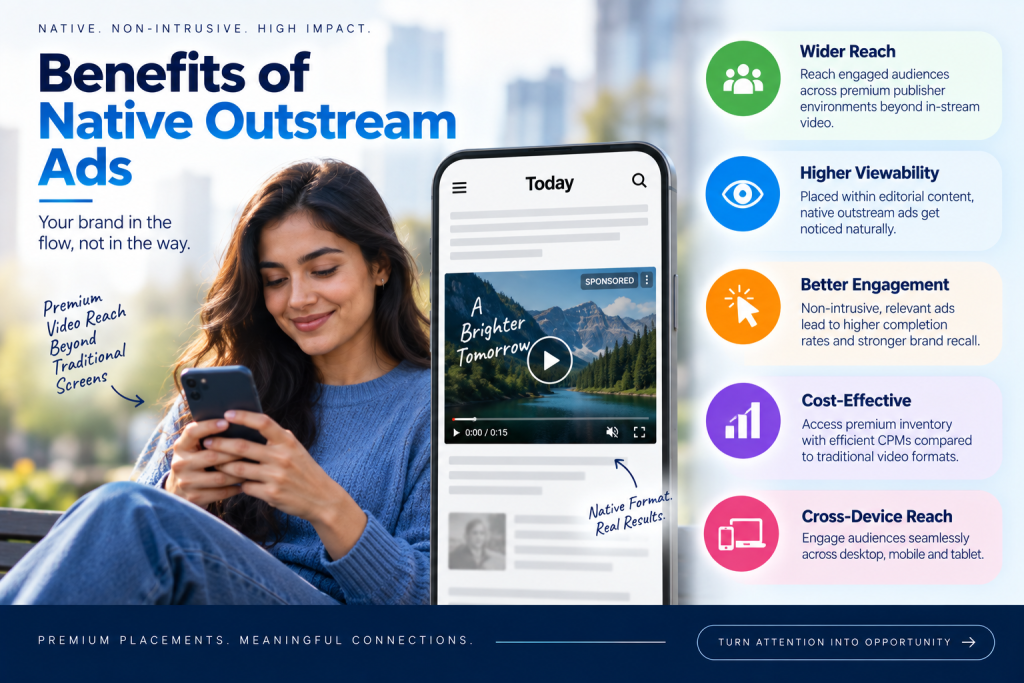
There are three main types of video ads: In-stream, Interstitial & Native Outstream. In-stream video ads are shown to users before, during and after video clips, selected by them. Interstitial video ads cover the whole screen, especially mobile and appear between two clips or at some transition point. Native outstream video ads appear along with the written content, between the paragrah’s of an article or a blog. The video starts playing when it becomes visible and stops if the user scrolls down from it. Since native outstream are ads are meant to be natural to the page, it will be possible to deliver advertisements in a less disruptive way.
What is Native Outstream Video?
Native outstream video refers to a type of video ads that appear in the content of the page and not within a video. The term “native” refers to the fact that this type of ad is naturally part of the content. Unlike other video ads, native outstream video ads do not appear as disruptive ads since users are watching something else. The “outstream” refers to the fact that this type of video does not require pre-existing videos on the page. Rather, it appears in between text content.
Generally, the video plays automatically once the ad is in the viewing range of the user and pauses once the user scrolls past it.
Outstream vs. In-stream video Ads: What’s the difference?
The most straightforward way of distinguishing between these types of ads is by asking where the ad is placed. The in-stream video ad plays withing video content. If while watching YouTube, for instance, an advertisement pops up before or along with the video, this is the in-stream video advertisement.
Outstream video ads do not require video context to play. These ads can play within an article or any other content in the webpage. The video will start playing once it comes into view and pauses once it is out of the view.
To put it simply:
- In-stream video ad: The ad plays withing the video.
- Outstream video ad: The ad plays independently within the webpage.
Benefits of Native Outstream Video Ad
There are many benefits of using Native Outstream video ads. Let us mention five of them.
1. Native Outstream Video Plays for viewability
One of the major benefits of native outstream video is that it is developed to play only when the ad is in view of the user. Outstream video will usually begin playing once the user has scrolled to the ad and will pause the user scrolls away from it.
The reason it is beneficial is that advertiser wants the video to be viewed. Outstream video addresses the issue of viewability by playing when the ad becomes visible. This could provide advertisers with valuable information on how users interact with their advertisements by watching videos.
2. Native Outstream May Provide Better Quality Video Completion
Quality of video completions is another crucial aspect. The video completion refers to the user watching a video until its end. In some traditional video advertisement formats, the video might still be playing even if the user is not watching it anymore.
Unlike in case of the native outstream, the video will most likely be paused whenever it goes out of out of view. Thus the video will be playing only for the time that the ad is in the user’s view. Therefore the video completion may better demonstrate whether the user watched the video from start to finish.
3. Access to inventory
The first benefit of native outstream is the ability for the advertiser to reach Tier 1 publishers, which are usually considered quality websites. Premium websites might not provide enough traditional video inventory to allow the campaign to be run at a needed scale through pre-roll or in-stream placement of the video ad.
That is why native outstream gives an additional option. As native outstream ads are being embedded into editorial content, the publisher can provide inventory even if there is no traditional video on the page. It allows advertisers to gain success to a larger pool of premium inventory.
4. Suits Longer Video Content
Most advertisers are acquainted with short form video ads, for example, 15 second and 30 second advertisements. However, nowadays brands are producing longer videos meant to teach, entertain or deliver an in-depth story.
Longer videos are not the best fit for traditional ore-roll advertising as the user would have to endure watching a long commercial in order to see the content he or she really wants to see. One alternative would be to use native outstream. Because video appears within the actual content, advertisers can utilize the format for distribution of longer branded content.
5. Native outstream can aid performance
At the end of the day, advertisers want their campaigns to be effective. The performance driven nature of viewability, user driven control, and availability of a lot of inventory. The video will play when in view. Thus the advertisers can find out whether the users were exposed to their videos.
Also native outstream may be useful format for advertisers, who measure metrics such as Cost Per Completed View (CPCV). CPCV informs the advertisers of the price they pay for each completed video view.
Conclusion
Native outstream video offers advertisers the possibility of using video content to engage audiences through use of different channel from instream video advertising. The capacity of native outstream video to play when the ad is in view, operate on editorial content, and incorporate long videos provides a number of benefits to programmatic advertising campaigns.
Native outstream video can be used by advertisers who seek to go beyond in-stream and pre roll video ads and increase their reach with the help of videos. The right metrics should be tracked, and it is crucial to understand how users behave and measure results to see whether they align with the goals of the campaign.