

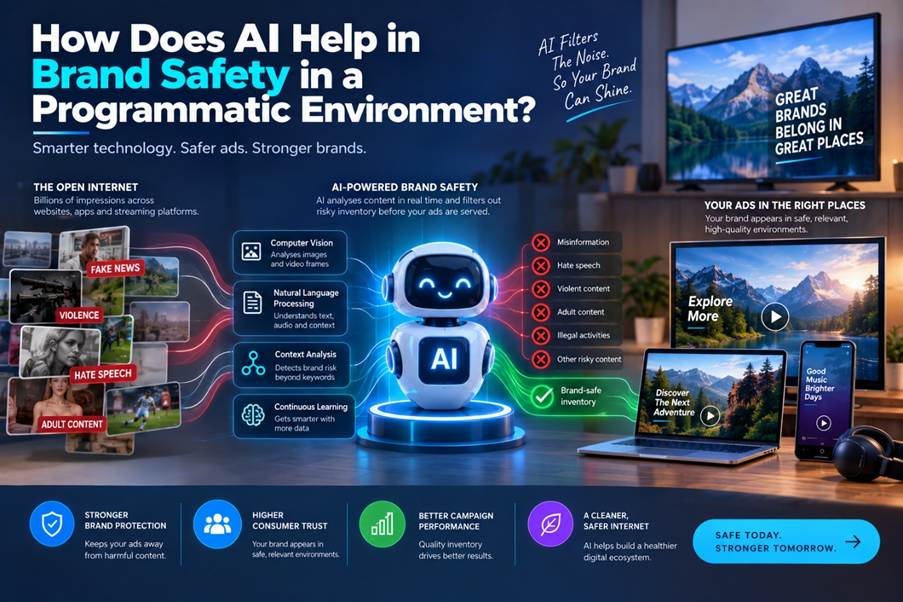
Programmatic advertising allows brands to reach large audiences across websites, apps, video platforms, CTV, and other digital channels. However, with millions of ad impressions being processed automatically, it can be difficult to manually check every environment where an ad may appear.
This is where Artificial Intelligence (AI) plays an important role in brand safety.
AI can analyse large volumes of content in real time, identify potential risks, and help advertisers decide whether an ad placement is appropriate before the impression is purchased.
How Does AI Support Brand Safety?
In a programmatic environment, AI can analyse different signals associated with an ad opportunity and determine whether the placement meets the advertiser’s brand safety requirements. A simplified process looks like this Content à AI Analysis à Risk Assessment à Brand Safety Decision à Ad Auction
If the environment is considered suitable, the impression can continue through the buying process. If it presents a significant brand safety risk, it can be excluded. Because programmatic auctions happen within milliseconds, AI helps perform these checks at a scale and speed that would not be possible through manual review.
1. Understanding Content Context
One of the biggest advantages of AI is its ability to understand the context of content. Traditional keyword-based systems may block a page simply because it contains a sensitive word. AI-based systems can look at the surrounding content and determine what the topic actually means. For example, an article may contain the word “violence” while reporting on a news event.
That does not necessarily mean the content is promoting violence or is unsuitable for every advertiser. AI can analyse the broader context and make a more informed assessment. This helps advertisers avoid both unsafe placements and unnecessary blocking.
2. Detecting Sensitive Content
AI can identify content related to categories that advertisers may want to avoid, such as
- Hate speech
- Violence
- Adult content
- Extremist content
- Illegal activities
- Misinformation
- Sensitive news events
Instead of manually reviewing individual pages, AI can classify content automatically and apply the advertiser’s predefined safety rules. This is particularly useful for campaigns running across a large number of websites and apps.
3. Analysing Images and Video
Brand safety is no longer limited to written content. Advertising campaigns increasingly run across online video, CTV, social platforms, and image-heavy environments. AI can analyse visual and video content to identify potentially unsuitable material. For example, AI-powered systems can examine frames, scenes, objects, and other visual signals to identify content that may not be appropriate for a particular brand. This provides an additional layer of protection beyond analysing page text alone.
4. Detecting Changes in Content
Digital content can change quickly. A website that was considered suitable earlier may later publish sensitive or controversial material. AI can continuously analyse content and identify these changes. This is particularly valuable for,
- Breaking news
- User-generated content
- Live content
- Video platforms
- Frequently updated websites
Instead of depending only on an old classification, AI can help provide a more current assessment of the environment.
5. Identifying Low-Quality and Risky Environments
AI can also help identify patterns associated with low-quality or potentially risky inventory. It can analyse signals such as
- Website and app behaviour
- Content quality
- Unusual traffic patterns
- Publisher characteristics
- Historical signals
- Other contextual information
This can help advertisers reduce exposure to environments that may create brand or media-quality concerns. However, brand safety and ad fraud or invalid traffic detection are separate areas, even though they can complement each other within a broader advertising quality strategy.
6. Improving Brand Suitability
AI can help advertisers move beyond a simple “safe” or “unsafe” decision. Different brands have different levels of tolerance for sensitive content. A news publisher may be comfortable advertising around certain topics, while a children’s brand may want to avoid them completely. AI can help classify content based on different levels of suitability, allowing advertisers to create rules that better match their brand values and audience. This gives advertisers more control without unnecessarily limiting campaign reach.
Why AI Is Important in Programmatic Advertising
The scale of programmatic advertising makes AI particularly useful. An advertiser may have thousands of websites, apps, videos, and other environments available for a campaign. Reviewing each one manually is not practical. AI can process these environments automatically and help make decisions at the speed required for programmatic buying. Its key advantages include
- Speed: Analyses content within the programmatic buying process.
- Scale: Can evaluate large volumes of impressions.
- Context: Looks beyond individual keywords.
- Adaptability: Can respond to changing content.
- Precision: Helps reduce unnecessary exclusions.
Is AI Enough for Brand Safety?
AI is a powerful tool, but it should not be the only layer of protection. Advertisers should combine AI with
- Clear brand safety guidelines
- Blocklists and allowlists
- Content and category exclusions
- Trusted publishers and inventory sources
- Regular campaign monitoring
- Human oversight where necessary
AI can make the process faster and more scalable, but the final brand safety strategy should still be based on the advertiser’s specific requirements.
Final Thoughts
AI is making brand safety more intelligent and scalable in programmatic advertising. Instead of relying only on basic keyword blocking, AI can analyse context, text, images, video, and other signals to determine whether an advertising environment is appropriate. This helps advertisers reduce the risk of harmful placements while also avoiding unnecessary restrictions that can limit campaign reach.
As programmatic advertising continues to expand across video, CTV, apps, audio, and other digital environments, AI will become an increasingly important layer in helping brands protect their reputation while reaching the right audiences at scale.