

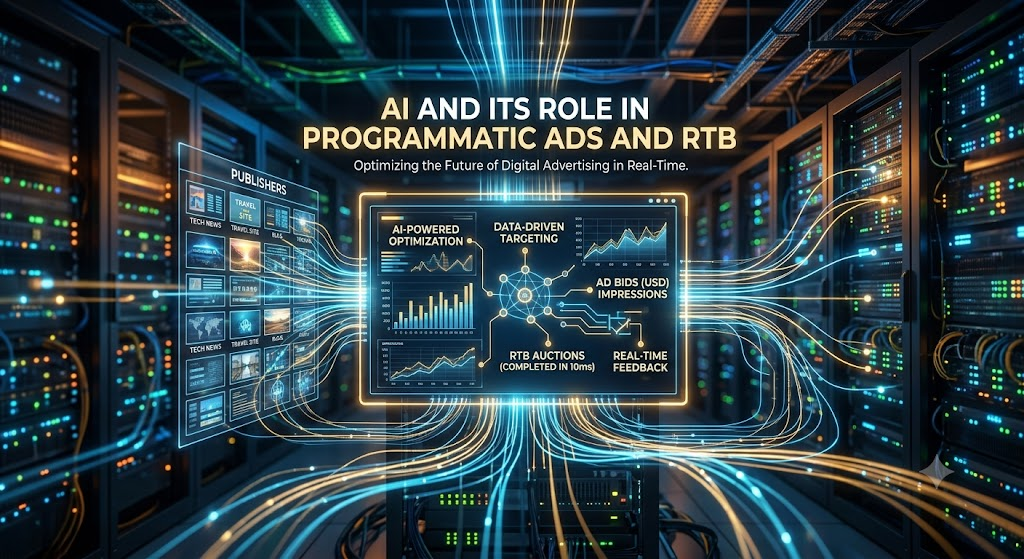
AI and its Role in Programmatic Advertising and RTB
The evolution of programmatic advertising brought a revolution in brand digital advertisement purchases. Now, instead of doing everything manually and trying to choose right places and times for advertising, one may employ different technologies to automatically purchase ad spaces and reach the needed audience. There is one particular aspect of programmatic advertising that is especially important. This is the aspect of real-time bidding (RTB).
So what is RTB? Whenever someone visits the website or opens the application, there is an ad opportunity that triggers an immediate auction. Advertisers use certain algorithms and bidding techniques to determine how much are they ready to pay in order to place their ad on the screen. The whole process occurs in the course of loading the website or application and lasts not longer than a few milliseconds.
As programmatic advertising grows, artificial intelligence starts playing a crucial role in the bidding process as it allows analysing large amounts of data instantly, thus identifying the opportunities and making better bids.
Programmatic Advertising and Real Time Bidding: A Strategic Opportunity
The significance of real-time bidding lies in the ability of the advertiser to understand which impressions they should buy and at what price. Each auction provides the possibility to target a potential consumer. At the same time, the same approach to all auctions can result in the wasted budget, increased costs and inefficient campaign performance.
For instance, one ad impression is more likely to result in the conversion than another. Thus, if the advertiser uses the same approach for both impressions, he or she spends money on consumers who are unlikely to convert. However, AI is capable of handling huge quantities of data and making bidding decisions much faster than any human team. Unlike humans who only react to the changes taking place, AI can use past and current data to anticipate which impressions will perform better.
Such technology can be beneficial to advertisers for optimising budget spending and increasing campaign efficiency.
Why is AI a Game Changer in Programmatic Bidding?
Programmatic buying includes hundreds of thousands or millions of auctions contains different data about the user, the device, the site, location, time, ad placement, etc. The main difference between AI and manual processing of the signals is that AI not only takes into account different criteria but can also predict which of the impressions will help you reach the goals of your campaign – purchases, registrations, visits, etc. AI can respond right away to any changes in the circumstances – if the cost of the inventory goes up or some audiences shoe themselves to be more effective.
Some of the benefits of using AI in programmatic bidding are:
- Improved optimisation: AI will be able to recognise which impressions have higher potential for delivering quality outcomes.
- Decision making in Real-Time: The AI system will be able to change bids based on user behaviour and competitive activity.
- Optimised budget spend: the budget could be allocated more efficiently to the successful target audience, media types or creative formats.
- High speed and efficiency: AI is capable of making decisions in real-time, involving thousands of auctions simultaneously.
In case of advertiser, all these advantages mean that there would be lower wastage and improved ROAS and CAC performance.
How AI Helps Improve the Outcomes of Real-Time Bidding
Optimal programmatic bidding is achieved through finding the perfect balance between winning the impression and bidding for it at an affordable price. If the price is too low, then the advertiser loses some of the impressions. If it is too high, then although the advertiser wins the impression, money is wasted.
With the use of AI, it is possible to find the perfect balance due to the analysis of numerous factors before placing the bid. Here are the areas where AI can make difference:
- Improved budget utilisation: With the use of AI, advertisers can analyse their previous and current auctions can enter the competition without spending more than necessary.
- Better target audiences: AI can analyse factors like user behaviour, device used, geographical location, time of the day and more in order to find more responsive users.
- Improved cross channel utilisation: AI can help advertisers control their campaigns on various channels such as display, video, CTV, audio and DOOH, thus optimising the budget on more effective ones.
It becomes possible to use data-based techniques for advertising. In addition to using certain fixed principles or decision-making, it will become possible to learn from campaigns and modify one’s strategy.
Future-Proofing your Bidding Strategy in a Post-Cookie Era
The digital marketing industry has been shifting towards a more privacy-oriented landscape. The use of third-party cookies in such an industry becomes limited or obsolete in some cases, which requires advertisers to develop other strategies to understand the audience and perform effective bidding. AI can assist advertisers in working with alternative sources of information and minimizing reliance on personal identifiers.
One of such strategies is contextual targeting. Advertisers may not target an individual on the basis of their browsing activity but rather analyse the web page they are currently visiting. To put it into practice, the ad for running shoes could be shown in conjunction with an article on fitness or running. Using AI, it is possible to analyse the contents and context of the page to see if it relates to the message of the ad. In addition, AI can assist advertisers in leveraging first party data. First-party data can mean the data that a company itself collects through its websites, customer databases or mobile applications. When such data is combined with machine learning, advertisers are better aware of their audience and bid intelligently.
However, while using audience data, advertisers have to take into account the issues related to privacy and consent. Thus, the development of programmatic ad is likely to depend on striking a proper balance between personalisation, performance and privacy concerns.
Preparing a Future Ready Programmatic Marketing Team
While AI revolutionizes the technology underlying programmatic advertising, people continue to play an important role in the process. Marketing teams should be trained on how the AI functions and how the findings of AI can be leveraged in the process of making the marketing campaign decisions. It means that collaboration of media planner, data analysts, marketers and creatives can become an even more important aspect.
In addition, AI does not have to take the place of human decision-making. On the contrary, AI can assist marketers more efficiently by process large amount of data and spotting patterns that can be hard to detect manually. For example, AI might identify some audience or time slot that shows a better performance. The marketer will be able to leverage that information to make large-scale strategy decisions.
The choice of appropriate technology also matters. Marketers should select appropriate programmatic platforms and data solutions that guarantee transparency, flexibility and insights into performance. Lastly, advertisers must develop a feedback loop. The information gathered through conversations. Engagement and customer lifetime value will help them in their future decision-making process. The more effective use of campaign data, the better understanding of their campaigns advertisers will have.
AI vs Humans: Is AI Taking over Advertising?
Advertising is becoming more advanced due to AI usage, but that doesn’t mean people are no longer needed. AI is great at analysing data, spotting patterns and making quick decisions. People are still needed to think strategically, be creative, understand customers, develop a message and make critical decisions. The most efficient advertising strategy will probably involve both of these things.
Next Era of Programmatic Advertising
With AI in play, programmatic advertising and real-time bidding are getting smarter and faster then ever before. Form choosing what to bid on impressions to selecting target audiences, AI can assist advertisers in optimising their budgets and improving their campaigns. Meanwhile, the industry is shifting towards being more privacy friendly. For this reason, it is becoming important for advertisers to have strategies that work well with less of the usual identifiers but still enable them to deliver effectives advertising. Programmatic advertising of the future will not only be about automated ad buying. It will be about making smart use of technology combined with human expertise.