

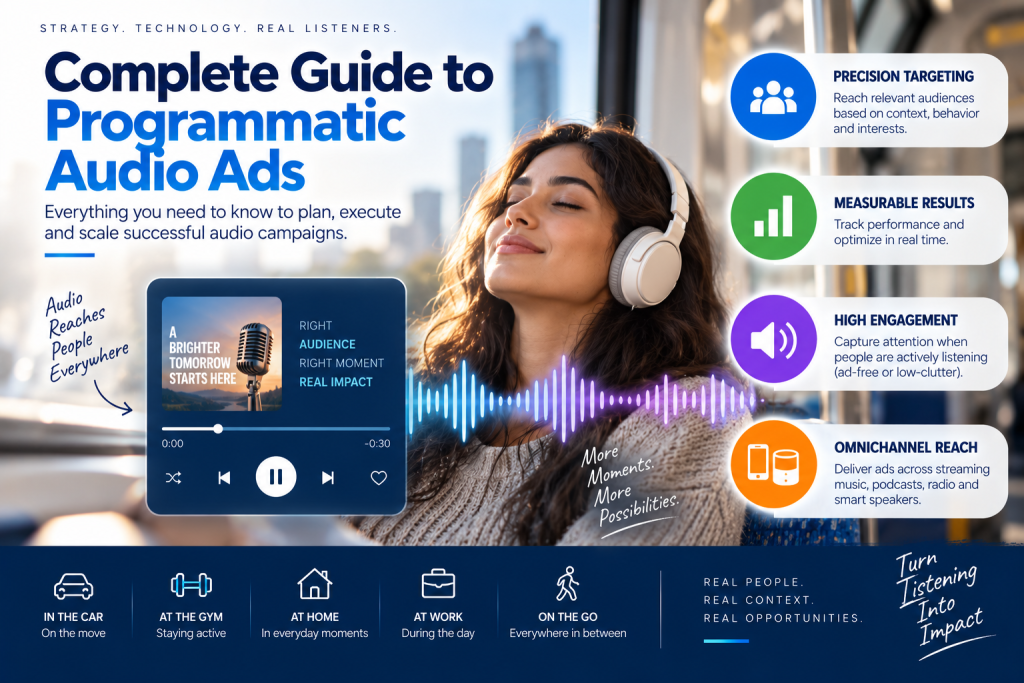
Audio has become an important part of the digital media experience.
People listen to music, podcasts, digital radio, audiobooks, and other audio content throughout the day. Unlike many digital formats, audio doesn’t always require someone’s eyes to be on a screen.
This creates a valuable opportunity for advertisers.
Programmatic audio advertising allows brands to use automated advertising technology to buy audio ad inventory and reach relevant audiences across digital listening environments.
Instead of manually purchasing individual audio placements, advertisers can use programmatic technology to automate the buying process and apply available audience, contextual, geographic, and other targeting signals.
This guide explains how programmatic audio works, where audio ads appear, their key benefits, and the best practices advertisers should follow when building an audio campaign.
What Is Programmatic Audio Advertising?
Programmatic audio advertising is the automated buying and delivery of advertising within digital audio content. It works in a similar way to other programmatic advertising channels such as display, video, and CTV.
An advertiser defines the campaign requirements, such as
- Target audience
- Budget
- Location
- Campaign dates
- Bidding strategy
- Creative
- Frequency controls
- Campaign objective
When an eligible audio advertising opportunity becomes available, programmatic technology evaluates the impression against the campaign requirements.
If the impression matches the campaign and the advertiser wins the available auction, the audio advertisement is delivered to the listener.
This entire process can happen in milliseconds.
How Does Programmatic Audio Advertising Work?
At a simple level, the process looks like this:
Advertiser $\rightarrow$ Programmatic Platform $\rightarrow$ Audio Inventory $\rightarrow$ Listener
The advertiser creates a campaign and provides the required targeting and creative information. The programmatic platform then looks for audio impressions that match those requirements.
When a suitable opportunity becomes available, an automated auction determines which advertiser gets the impression. The winning ad is then delivered to the listener.
After delivery, advertisers can use available campaign data to evaluate performance and make adjustments.
This automation makes it easier to manage audio advertising at scale without having to negotiate every individual placement manually.
Where Can Programmatic Audio Ads Appear?
Programmatic audio advertising can appear across a variety of digital listening environments, depending on the inventory and platform. Common environments include:
- Music streaming services
- Podcasts
- Digital radio
- Online audio platforms
- News and talk content
- Other digital audio experiences
Audio can also be consumed through different devices, including:
- Smartphones
- Tablets
- Desktops and laptops
- Smart speakers
- Connected devices
- In-car systems
The exact inventory, targeting options, and creative formats available will depend on the publisher, platform, device, and market.
Why Is Programmatic Audio Becoming Important?
The way people consume audio has changed significantly. Audio is no longer limited to traditional radio. Listeners can now choose from a wide range of digital content and access it across multiple devices and situations.
This creates several important opportunities for advertisers.
Digital Audio Is Part of Everyday Media Consumption
People can access digital audio whenever and wherever they want. They may listen to:
- A podcast during their commute
- Music while exercising
- Digital radio while working
- An audiobook while traveling
- News or talk content during household activities
This gives advertisers opportunities to connect with audiences throughout different parts of their day.
Audio Reaches Audiences Beyond the Screen
One of the biggest advantages of audio is that it doesn’t require visual attention. Someone can listen to an advertisement while:
- Walking
- Driving
- Cooking
- Exercising
- Commuting
- Working
- Relaxing
This makes audio particularly useful for reaching consumers during screen-free moments. Instead of competing for attention on a busy screen, an audio advertisement can communicate its message directly through sound.
Mobile and Connected Devices Expand Listening
Smartphones have made audio highly accessible, while connected devices have expanded the number of places where people can listen.
Audio can now be consumed through smartphones, smart speakers, connected TVs, in-car systems, and other connected devices. This creates more opportunities for advertisers to reach listeners across different environments.
However, advertisers should remember that targeting and measurement capabilities can vary depending on the device and inventory.
Audio Advertising Can Include Visual Elements
Audio is primarily a sound-based advertising format, but some environments can support companion display advertising.
A companion ad can appear on the listener’s screen while the audio advertisement plays. This gives advertisers two ways to communicate. Audio can deliver the story, voice, and emotional message. Visuals can reinforce the brand, product, offer or call to action.
When available, combining these elements can create a stronger advertising experience.
Audio Works for Both B2C and B2B Brands
Programmatic audio isn’t limited to consumer brands. B2B advertisers can also use audio to reach professional and business audiences through relevant content.
For example, a technology company could advertise around technology or business podcasts, while a financial services company could use content related to finance, investing, or entrepreneurship.
Audio can also help B2B brands communicate their personality and explain their products in a more conversational way.
What Are the Benefits of Programmatic Audio Advertising?
Programmatic audio offers several advantages that make it a useful addition to a modern advertising strategy.
Reach Audiences in Screen-Free Moments
Audio allows advertisers to reach people when they aren’t actively looking at a screen. This gives brands additional opportunities to communicate with consumers outside traditional display and video environments.
Use Audience and Contextual Targeting
Depending on the platform and available data, advertisers can use targeting signals such as:
- Demographics
- Location
- Interests
- Audience segments
- Content categories
- Context
- Device
- First-party data
- Behavioral signals
Contextual targeting can be especially useful.
For example, a fitness brand could advertise around fitness-related content, while a travel company could advertise around travel-related programming. This helps align the advertising message with the content the listener is already consuming.
Build Stronger Brand Awareness
Audio is a powerful storytelling format. Voice, music, sound effects, and tone can all contribute to how a listener experiences a brand.
A memorable voice or audio signature can help people recognize a brand even when they aren’t looking at a screen. This makes programmatic audio particularly useful for campaigns focused on:
- Brand awareness
- Brand recall
- Product awareness
- Consideration
Extend Your Multichannel Advertising Strategy
Programmatic audio can work alongside other advertising channels. For example, a brand could use:
- CTV for visual storytelling
- Display for product messaging
- Audio for screen-free reach
- Search for users actively looking for the product
Using multiple channels can help brands reach audiences at different stages and moments of the customer journey.
What Types of Programmatic Audio Ads Are Available?
Audio advertising can take several forms depending on the publisher and platform.
- Pre-Roll Ads: These ads play before the main audio content begins.
- Mid-Roll Ads: These ads appear during the main content, such as in the middle of a podcast episode.
- Post-Roll Ads: These ads play after the main content has finished.
- Companion Ads: These are visual ads that can appear alongside an audio advertisement when supported by the inventory.
The available formats, durations, and specifications can vary across publishers, so advertisers should always check the requirements before preparing creative assets.
How to Create Effective Programmatic Audio Ads
Creating an audio advertisement requires a different approach from creating a display or video ad. With audio, the listener may never see your brand while the advertisement is playing.
The message therefore needs to work through sound alone. A good audio advertisement should have:
- A Strong Opening: Capture attention quickly and introduce the main idea early.
- Clear Messaging: Focus on one key message rather than trying to explain everything about the product.
- A Natural Voice: Use a voice that fits the brand and sounds clear and conversational.
- Appropriate Sound Design: Music and sound effects should support the message rather than distract from it.
- A Clear Call to Action: Tell the listener exactly what they should do next. For example:
- Visit the website.
- Download the app.
- Learn more.
- Sign up today.
Programmatic Audio Advertising Best Practices
If you’re planning your first programmatic audio campaign, keep these best practices in mind:
- Keep the message short and focused.
- Introduce the brand early.
- Use a strong opening hook.
- Choose a voice that matches your brand personality.
- Make the call to action easy to understand.
- Use music and sound effects carefully.
- Create different versions of your creative for testing.
- Monitor performance and refresh creative when necessary.
- Avoid repeating the same message too frequently.
- Make sure the creative meets the technical requirements of the target inventory.
The most important rule is simple: Write for the ear, not the screen. A display advertisement can rely on text and visuals. An audio advertisement has to communicate its message through sound.
How to Measure Programmatic Audio Campaigns
Measurement depends on the platform, publisher, and campaign setup, but advertisers may be able to evaluate metrics such as:
- Impressions
- Reach
- Frequency
- Audio completion rate
- Click through activity where supported
- Cost metrics
- Conversion activity
- Audience performance
These metrics can help advertisers understand whether the campaign is reaching the intended audience and whether the creative and targeting strategy are performing as expected.
- For campaigns focused on awareness, metrics such as reach, frequency, and completion can be particularly useful.
- For performance-focused campaigns, advertisers may also look at downstream actions and conversions where reliable measurement is available.
How Does Programmatic Audio Fit Into a Multichannel Strategy?
Programmatic audio is often most effective when it works together with other channels. For example, consider a consumer electronics brand launching a new product. The brand could use:
- CTV: Show a video demonstrating the product.
- Display: Highlight product features and offers.
- Audio: Communicate the product’s key benefit while consumers are listening to music or podcasts.
- Search: Reach consumers who actively search for the product.
Each channel serves a different purpose while contributing to the same overall campaign.
The creative doesn’t need to be identical across every channel. Instead, the core brand message should remain consistent while the execution is adapted to each format.
Final Thoughts
Programmatic audio has become a valuable part of modern digital advertising. It allows brands to reach people through digital listening environments while using many of the targeting and automation capabilities available in programmatic advertising.
Its biggest advantage is that it gives advertisers access to audiences during moments when they may not be looking at a screen.
With the right combination of targeting, creative, measurement, and frequency management, programmatic audio can support both awareness and broader marketing objectives.
Whether you’re a B2C brand trying to build awareness or a B2B company looking to reach a niche professional audience, audio can be a useful addition to your media strategy.
The key is to remember that successful audio advertising isn’t simply about getting an ad played. It’s about creating a message that people can hear, understand, and remember.