

What is OTT?
OTT stand for Over-The-Top. It refers to television shows, movies and other video content that people watch over the internet instead of through traditional cable or satellite television.
In the past, if you wanted to watch TV, you usually needed a cable or satellite connection. Today, you can simply connect to the internet and stream content whenever you want.
Popular OTT platforms include:
- Netflix
- Amazon Prime Video
- Disney+
- Hulu
- Peacock
- YouTube
OTT content can be streamed on many different devices:
- Smart TVs
- Smartphones
- Tablets
- Laptops
- Desktop computers
- Gaming consoles
What is CTV?
CTV stands for Connect TV. A connected TV is a television that can connect to internet and stream digital content.
For example:
- Smart TV
- Amazon Fire TV
When you watch Netflix on a Smart TV, you are watching OTT content on a CTV device.
CTV vs. OTT: What’s the difference?
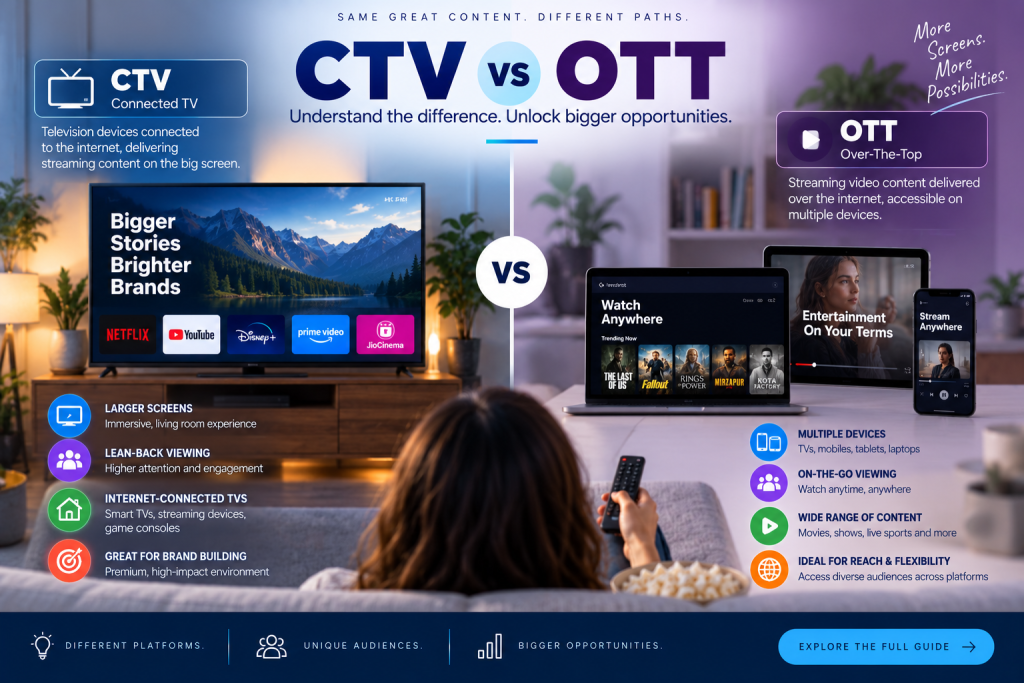
CTV and OTT are closely connected, but they are not exactly the same thing.
A simple way to remember is:
- OTT – the platform which streams content.
- CTV – device used to watch OTT content.
For example, watching the same Netflix movie in two different situations.
- Situation 1 – Watching OTT content on smartphone.
- Situation 2 – Watching the same OTT content on a smart TV.
So, CTV is essentially a part of the larger OTT ecosystem.
Comparing OTT & CTV
| OTT | CTV |
| Describes content delivered through the internet. | Describes a TV connected to internet. |
| Can be watched on phone, tablets, laptops and TVs. | Specifically refers to television screens. |
| Includes streaming services and digital video. | Includes smart TVs and TVs connected to streaming devices like amazon fire stick. |
| Focuses on how content is delivered. | Focuses on where the content is viewed. |
How do CTV and OTT work Together in Advertising?
This is where things become especially important for marketers and advertisers. When advertisers run ads on streaming television, they are often buying CTV advertising inventory, while the actual video content is being delivered Over-The-Top through the internet.
For example – A person watches a show on a smart TV, before the show begins, he sees an advertisement for a new smartphone.
The show delivered through on OTT streaming service, while the advertisement is shown on a CTV device. So, in advertising often CTV and OTT work together.
Advantages of CTV Advertising
CTV has become increasingly important for advertisers because it combines some of the strengths of traditional television with a targeting and measurement capabilities of digital advertising.
1. CTV Helps advertisers reach more Viewers.
More people are choosing streaming services instead of traditional cable and satellite TV. The change is often called cord-cutting. Cord-cutting happens when people cancel their traditional cable or satellite TV subscriptions and move towards streaming services.
Why are people moving from traditional to OTT? Instead of waiting for a particular program to come on at a particular time, viewers can choose:
- What they want to watch?
- When they want to watch it?
- Which device they want to use?
- Which streaming service they want to use?
As more people move from traditional television to streaming, CTV gives advertisers an opportunity to reach this growing audience.
2. CTV offers Better Targeting than Traditional TV
Traditional television advertising generally reaches a broad audience. For example, if a company places an advertisement during a popular tv show, everyone watching that show may see the advertisement.
CTV can provide advertisers with more advanced targeting options. Depending on the platform and available data, advertisers may be able to target audiences based on factors such as:
- Location
- Age
- Interests
- Viewing behaviour
- Household characteristics
- Previous interactions with brands
This means advertisers can try to show their ads to people who are more likely to be interested in their products or services. A sports brand can target viewers who frequently watch sports related content.
3. CTV provides better measurement and Optimisation
One major advantage of digital advertising is the ability to measure campaign performance. CTV brings some of these digital measurement capabilities to television advertising. However, CTV works differently from traditional display advertising.
With CTV, viewers are usually sitting several feet away from their television, so clicking directly on the advertisement isn’t practical. Because of this, advertisers often focus on metrics related to videos viewing and awareness.
Some important CTV metrics include:
Video Completion rate – VCR VCR tells what percentage of videos ads were watched until the end. A high VCR generally indicates that viewers are watching most or all of the advertisement. If 1,000 people watched an ad and 900 watch the entire video, the completion rate is 90%.
Cost Per Completed View – CPCV CPCV tells advertisers how much they are paying for each completed video view. This can help advertisers understand how efficiently their campaigns budget is being used.
4. CTV combines Strengths of TV and Digital Advertising
Traditional TV:
- Large reach
- High-quality video
- Strong brand awareness
- Big-screen viewing experience
Digital advertising:
- Audience targeting
- Campaign measurement
- Performance tracking
- Real time optimisation.
CTV combines many of these benefits. This is one of the reasons advertisers are increasingly interested in CTV advertising.
Conclusion
The shift from traditional television to streaming has created new opportunities for advertisers. OTT refers to television and video content delivered through the internet, while CTV refers specifically to televisions that can access and display the internet-based content. For advertisers CTV is particularly valuable because it combines the large screen experience of traditional television with many of the targeting, measurement and optimisation capabilities associated with digital advertising.
As more viewers move towards streaming and away from traditional cable and satellite television, CTV is becoming an increasingly important part of modern digital advertising strategies.