

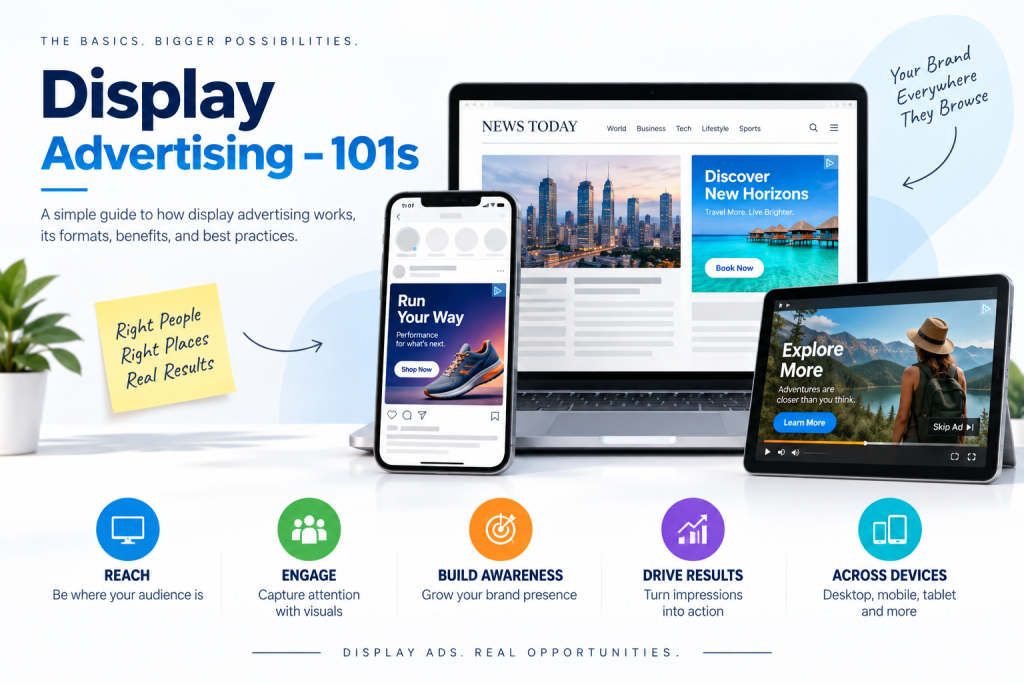
First Things First – What is Display Advertising?
Display Advertising is a form of advertising which uses images, animations, and text in the form of an ad to convey the message of brands to the end user. When a user clicks on these ads, it will take them to the landing page where they can get to know more about the product or services the brand is offering, make a purchase, sign-up, or subscribe to the newsletter.
Display advertising is one of the strongest forms of advertising and it is widely used across the globe. Global advertising spends reached $992 Billion in 2025, up 4.9% year on year, according to Dentsu’s Global Ad Spend Forecasts. Digital accounted for $678.7 billion of that – a 7.9% increase and 68.4% of all ads spends worldwide.
What is Display Advertising in the Programmatic Ecosystem?
Programmatic display advertising is an automated process of buying and selling display ads across apps and websites using real-time bidding (RTB) technology, artificial intelligence (AI), and machine learning (ML). It helps brands, agencies, and advertisers reach the right audience at the right time more effectively and efficiently than traditional methods.
The entire bidding process happens within the blink of an eye! This has resulted in programmatic buying becoming the default way to purchase display ad inventory.
Fun Fact: Did you know that close to 90% of Display Advertising worldwide happened via Programmatic channels in the year 2025 and it is expected to grow even more.
Wondering Where Exactly Display Ads are Shown?
In simple terms, Display Ads can be shown across a wide range of digital channels such as Desktop, Mobile, Tablets, Connected TVs, and Digital Out of The House devices, allowing advertisers and brands to reach their audiences wherever possible.
The most common placements are:
- Websites: Such as News, Articles, Celebrity gossips, Blogposts, etc.
- Mobile Apps: Such as News applications, Gaming applications, Streaming services like YouTube Music, Spotify, JioSaavn, etc.
- E-Commerce Marketplaces: Have you ever noticed while browsing through a product catalogue in Amazon, Myntra, Nykaa, etc., a similar product appears in the catalogue but has got the badge “Sponsored”? That’s exactly what these ads are; they appear alongside product listings or search results.
Display ads can show up as banner placements at the Top, Sides (Right or Left side), Mid-section, or bottom of the page. This can be in Rectangle, Leaderboard, Halfpage, etc.
How Does This Work?
Display Advertising works by placing advertisements across websites and applications to reach people with the right message as they browse content online.
In many cases, this happens programmatically with the ad inventory bought and sold in real time. In the backend, all these will be processed within milliseconds. When a user visits a website—let’s say you are browsing forbes.com—there will be multiple ad slots on the website. As soon as you load the page, an auction takes place in which advertisers and brands compete with each other via bidding to show their ads.
Here, a lot of factors come into play as to which ads will be shown to the user, such as targeting parameters set in the campaign, context, and the bid amount (CPM). If the targeting matches, then the highest bidder will win the slot and that ad will be displayed to the user.
Different Types of Display Advertising
There are many types of display advertising from standard static banners to rich media and video. Let’s deep dive into different types of ads:
- Static ads: This is a fixed digital ad that uses a single unchanging image, graphic, or text. Every viewer sees the exact same visual content, regardless of their location or browsing history. Example: JPG, PNG, etc.
- Animated ads: These use motion graphics and moving texts. They grab user attention faster than static images, making them very popular. Example: Gifs, HTML5, etc.
- In-banner video ads: In-banner video ads are digital advertisements that place a moving video player inside a standard display banner slot on a web page. Unlike regular video ads that play before or during a video stream, these standalone units sit quietly on the top, sides, or bottom of a normal website.
- Carousel ads: It is an interactive digital ad format that features multiple swipeable or clickable images or videos called “cards” within a single advertisement. Each individual card can have its own headline, description, and landing page URLs making it a flexible tool for storytelling.
- Interactive ads: In this ad, instead of just watching or reading passively, users tap, swipe, play, or answer questions directly inside the ad unit.
- Interstitial ads: Interstitial ads are full-screen advertisements that cover the entire interface of an app or website. They appear at natural transition points in the user flow, such as between game levels or after completing a task.
- Dynamic display ads: Dynamic display ads are online banner advertisements that automatically change their image, text, CTA button, and price in real time. They adjust content to match the specific interests, browsing history, or device data of each user.
Common Display Ad Sizes
Display ads come in a range of different sizes, most of which are defined and standardized by the Interactive Advertising Bureau (IAB).
Common Desktop Sizes:
- 300×250 – Medium rectangle
- 300×600 – Half page
- 728×90 – Leaderboard
- 160×600 – Skyscraper
- 970×250 – Billboard
Common Mobile Sizes:
- 300×50 and 320×50 – Mobile leaderboard
- 300×250 – Medium rectangle
- 480×320 – Mobile landscape interstitial
- 320×480 – Mobile interstitial
- 1080×1920 – Vertical fullscreen
Who Can Use Display Advertising?
Any business or individual wanting to build brand awareness, retarget previous website visitors, or promote products and services online can use display advertising. It is accessible through DSPs and can be used by everyone from small businesses to large enterprises.
Benefits of Display Advertising
Display advertising is a very powerful component of a marketing strategy, enabling superior engagement and measurable outcomes.
- Increased brand value: Display advertising contributes significantly to long-term brand building and firm value.
- Target customers with audience segmentation: This allows brands to reach their audience with precision. By activating custom audience segments built from first-party data, brands can target users based on real-time behaviours and intent, ensuring ads are seen by the most relevant users.
- Reach and frequency you can actually control: Buying programmatically across thousands of sites and apps lets you cap frequency at the user level and manage precise reach, which is something you can’t do stitching together direct site/app buys individually via traditional methods.
- Speed and flexibility: You can take a campaign live in a few hours, do creative swaps mid-flight, and shift budget between campaigns/line items with ease. Perfect for special product launches, seasonal pushes, limited-time deals, reactive campaigns, survey campaigns, and many more!
- Measurable against the right KPI: Be it eCPM, viewability, CPC, CTR, brand lift studies, or geo-attribution, all are available.
Display advertising isn’t just about chasing clicks or actions—it’s about being present, consistently and visibly, wherever your audience already spends their attention. Done well with the right inventory, sensible frequency caps, and creatives that actually tell the story, combined all, this builds the kind of familiarity that pays off long before anyone reaches a check-out page.
The brands that win at display are the ones that stop measuring it like performance marketing and start treating it as what it is: reach, scale, quality, and control.