

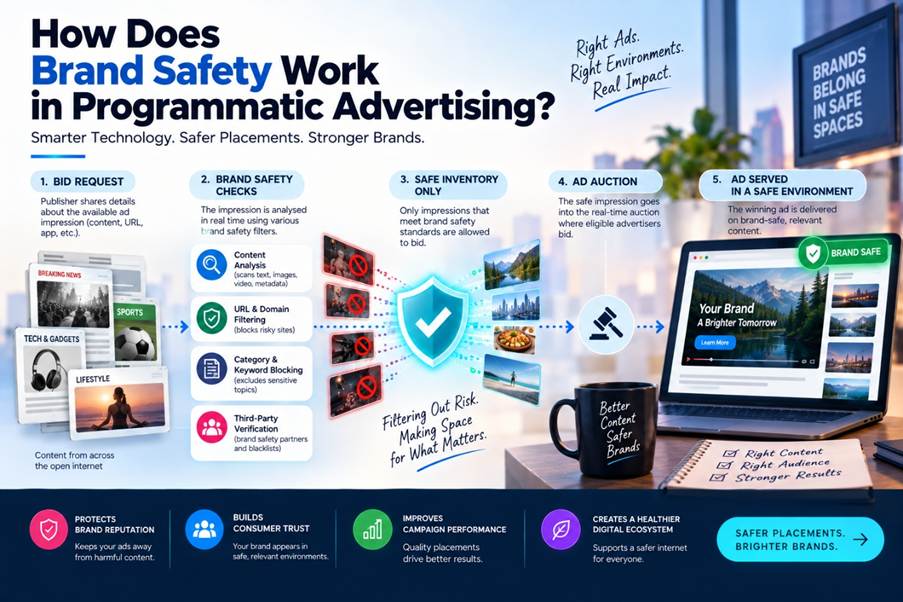
Programmatic advertising allows brands to reach audiences across millions of websites, apps, videos, CTV platforms, and other digital environments.
While this provides huge opportunities for advertisers, it also creates a challenge how can brands make sure their ads appear in safe and appropriate environments. This is where brand safety controls come into play.
What Is Brand Safety in Programmatic Advertising?
Brand safety in programmatic advertising is the process of preventing ads from appearing alongside content or in environments that could negatively affect a brand’s reputation. Unlike traditional advertising, where advertisers may have more control over individual placements, programmatic advertising involves automated buying and selling of impressions.
A single campaign can potentially reach thousands of publishers and platforms. Therefore, brand safety needs to be built into the automated ad-buying process.
How Does Brand Safety Work?
A simplified programmatic advertising flow looks like this, Advertiser → DSP → Ad Exchange/SSP → Publisher → User
When a user visits a website or opens an app, an ad opportunity can be sent into the programmatic ecosystem. Before the advertiser’s ad is served, various signals and safety controls can be used to determine whether that opportunity is suitable.
If the impression meets the advertiser’s requirements, the DSP can participate in the auction and potentially serve the ad. If the environment is considered unsafe or unsuitable, the impression can be excluded from the bidding process. This decision happens within milliseconds.
Key Brand Safety Controls
1. Blocklists
- A blocklist contains websites, apps, publishers, or other environments where an advertiser does not want its ads to appear.
- For example, a brand may block domains associated with adult content, hate speech, or other sensitive categories.
- Blocklists are useful for excluding known risks, but they need to be regularly updated as new websites and apps appear.
2. Whitelists
- An whitelistlist works in the opposite way. It contains websites, apps, or publishers that have been approved by the advertiser.
- The campaign can then be restricted to these approved environments.
- whitelists provide greater control and can be particularly useful for brands with strict advertising requirements. However, they can also reduce the available inventory and campaign reach.
3. Content and Category Controls
Advertisers can exclude specific types of content or sensitive categories from their campaigns. Common exclusions may include,
- Adult content
- Violence
- Hate speech
- Extremist content
- Illegal activities
- Misinformation
- Sensitive news
These controls help advertisers avoid broad categories of content without having to manually identify every individual website.
4. Keyword and Topic Exclusions
Advertisers can also use keywords or topics to identify content they want to avoid. For example, a brand may choose to exclude content related to certain sensitive subjects. However, keyword-based blocking has limitations. A keyword can appear in completely different contexts, so modern brand safety solutions increasingly consider the overall context of the content, rather than relying only on individual words.
The Role of AI and Contextual Technology
Modern brand safety increasingly uses AI and machine learning to understand digital content at scale. Instead of simply checking whether a page contains a particular keyword, technology can analyse the context and meaning of the content.
For example, a news article may contain the word “violence” while reporting responsibly on a current event. Automatically blocking every page containing that word could prevent ads from appearing on otherwise acceptable content. Contextual technology can help distinguish between content that discusses a sensitive topic and content that promotes it.
This allows advertisers to create more precise brand safety strategies while avoiding unnecessary restrictions.
Third-Party Brand Safety Solutions
Advertisers can also work with specialized third-party technology providers that evaluate websites, apps, video content, and other advertising environments. These solutions can provide additional signals about,
- Content classification
- Brand suitability
- Invalid traffic
- Publisher quality
- Risk levels
- Sensitive topics
These signals can then be used by advertisers and their programmatic partners to make better buying decisions.
Brand Safety and the Programmatic Auction
Brand safety can influence the programmatic auction before an advertiser actually bids on an impression. For example,
User visits website → Ad opportunity becomes available → Brand safety checks are applied → Unsafe impression is excluded → Safe impression enters bidding → Winning ad is served This approach helps advertisers avoid spending money on impressions that do not meet their brand safety requirements. It also makes brand safety more scalable because decisions can be made automatically across large volumes of inventory.
Brand Safety vs. Brand Suitability
It is also important to understand that brand safety and brand suitability are not exactly the same. Brand safety focuses on avoiding environments that are generally considered unsafe or inappropriate. Brand suitability goes further by considering what is appropriate for a specific brand.
For example, a news website covering a sensitive event may be acceptable for one advertiser but unsuitable for another. Each brand can define its own level of tolerance based on its audience, industry, and reputation.
Final Thoughts
Brand safety is an important part of programmatic advertising because automated buying gives advertisers access to a huge and constantly changing supply of inventory.
By using blocklists, allowlists, content controls, contextual technology, AI, and ongoing monitoring, advertisers can reduce the risk of their ads appearing in unsuitable environments. The key is finding the right balance. Overly strict controls can limit campaign reach, while weak controls can expose a brand to unnecessary risk.
A well-planned brand safety strategy allows advertisers to scale programmatic campaigns while maintaining control over where their brand appears.