

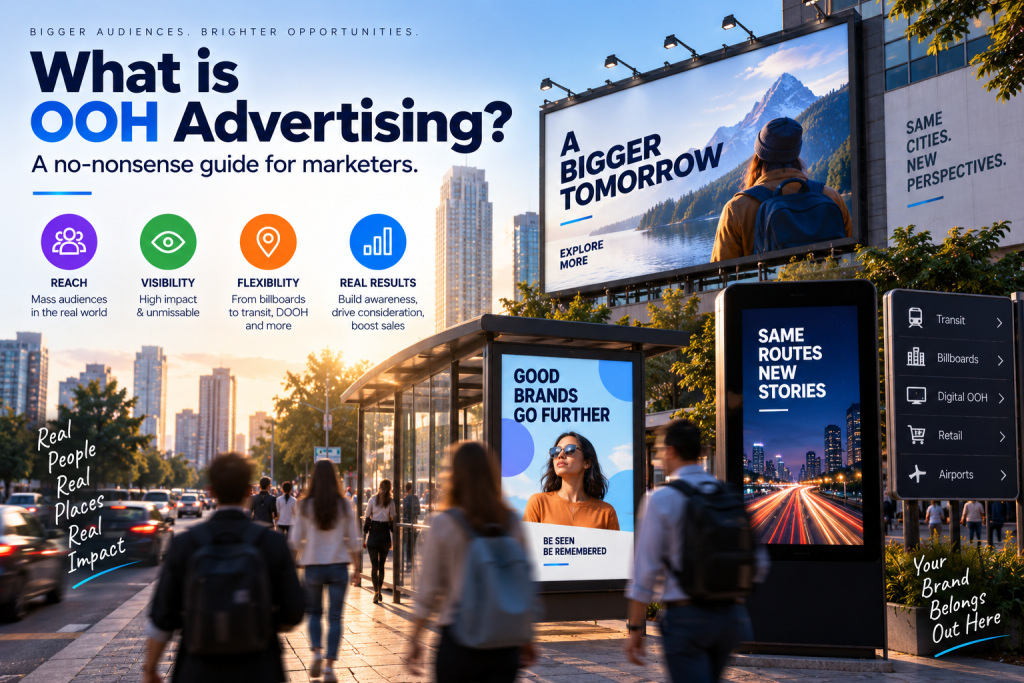
What Is Out-of-Home Advertising?
Out-of-home (OOH) advertising is advertising that reaches people while they are outside their homes.
Think about the advertisements you see while traveling to work, walking through a shopping area, waiting for public transportation, or visiting a mall. Billboards, bus shelter posters, digital screens, and transit advertisements are all examples of OOH advertising.
OOH has been around for a long time. Traditional advertising formats such as posters, painted signs, and billboards have been used to communicate messages to people in public spaces for generations. What has changed is the technology behind it.
Today, OOH is no longer limited to static posters and billboards. Digital out-of-home (DOOH) uses digital screens that can display videos, animations, and changing messages.
Programmatic technology has taken this one step further by allowing advertisers to buy and manage digital OOH inventory using automated advertising platforms.
This means OOH can now be part of a broader digital and omnichannel advertising strategy.
Traditional OOH vs. DOOH Advertising
OOH is the broader category of advertising that reaches audiences in public spaces. It includes both traditional OOH and digital OOH (DOOH).
Traditional OOH
Traditional OOH uses physical, non-digital advertisements such as,
- Static billboards
- Posters
- Bus shelter advertisements
- Transit wraps
- Street-level signage
- Printed displays
Once a traditional OOH advertisement is installed, changing the creative usually requires a physical replacement. This can make traditional OOH highly visible and consistent, but it can also make campaigns less flexible.
Digital OOH
DOOH uses digital screens to display advertisements. These can include
- Digital billboards
- Digital screens in malls
- Transit screens
- Airport displays
- Retail screens
- Place-based digital screens
The biggest difference is flexibility. Digital screens can display different advertisements at different times and can support dynamic creative. For example, an advertiser could show one message during the morning commute and another during the evening.
What Is Programmatic DOOH?
Programmatic DOOH brings programmatic advertising technology into digital out-of-home advertising. Instead of manually arranging individual screen placements, advertisers can use programmatic platforms to access available digital OOH inventory and automate parts of the buying process.
Depending on the platform and inventory, advertisers may be able to use signals such as,
- Location
- Time of day
- Audience characteristics
- Traffic conditions
- Weather
- Events
- Content or environment
For example, a food delivery brand could display a different message during lunchtime, while a retail brand could increase advertising around locations close to its stores. Programmatic DOOH also makes it easier to manage campaigns across multiple screens and locations.
The exact buying methods and targeting capabilities vary by market, media owner, and platform.
Types of OOH Advertising
OOH advertising can appear in many different environments. The main types include billboards, street furniture, transit, and place-based advertising.
1. Billboards
Billboards are one of the most recognizable forms of OOH advertising. They are typically placed in high-traffic locations such as
- Highways
- Major roads
- City centers
- Commuter routes
- Commercial areas
Because of their size and visibility, billboards are particularly useful for building awareness and increasing brand visibility. For example, a brand launching a new product could use large billboards across a city to create awareness among a broad audience.
Digital billboards can also add movement, video, and dynamic messaging to the traditional billboard format.
2. Street Furniture
Street furniture advertising places ads at the pedestrian level, often where people walk, wait, or shop. Common examples include,
- Bus shelters
- Benches
- Kiosks
- Newsstands
- Bicycle racks
- Pedestrian information panels
These placements can be useful for reaching people in busy urban areas. They can also work well for local and location-based campaigns.
For example, a restaurant could promote a nearby offer on a bus shelter or street-level display close to its location.
3. Transit Advertising
Transit advertising reaches people while they are traveling. It can appear on or around
- Buses
- Taxis
- Trains
- Subway systems
- Airports
- Transit stations
- Other transportation hubs
Transit advertising can provide repeated exposure because commuters may travel through the same routes regularly. It can be particularly useful for,
- Tourism brands
- Entertainment companies
- Retailers
- Local businesses
- Consumer brands
For example, a travel company could advertise in an airport to reach people who are already in a travel-related environment.
4. Place-Based Advertising
Place-based OOH reaches people in specific environments where they spend time.
Examples include
- Shopping malls
- Retail stores
- Gyms
- Stadiums
- Movie theatres
- Offices
- College campuses
- Gas stations
- Convenience stores
- Healthcare facilities
The biggest advantage of place-based advertising is context. The environment itself can provide information about the audience.
For example, a sports brand can advertise inside a gym, while a retail brand can reach consumers inside or near a shopping environment.
This can make the advertising message more relevant to the situation in which the audience sees it.
Benefits of OOH Advertising
OOH advertising offers several advantages that make it useful for both brand-building and broader marketing campaigns.
1. High Visibility
OOH advertising is designed to stand out in physical environments. Large billboards and digital displays can attract attention in busy streets, transportation hubs, shopping centers, and other high-traffic locations.
Unlike an online advertisement that can disappear when a user closes a webpage, a physical OOH placement remains visible to people passing through the area.
2. Broad Audience Reach
OOH can reach large and diverse audiences. A single billboard placed along a busy highway, for example, can potentially be seen by many people throughout the day. Different OOH environments can also help brands reach different types of audiences.
A transit campaign may reach commuters, while a retail campaign may reach shoppers closer to a purchase decision.
3. Continuous Visibility
OOH advertisements generally cannot be skipped in the same way as many digital advertisements.
A billboard or digital screen is simply part of the environment people move through. This gives brands repeated opportunities to build recognition and reinforce their message.
However, the actual level of exposure depends on factors such as location, traffic, visibility, screen rotation, and dwell time.
4. Local and Contextual Targeting
One of OOH’s biggest strengths is its connection to location. Advertisers can choose placements based on where their target audience is likely to be.
- A restaurant can advertise near its location.
- A retailer can advertise around shopping areas.
- A travel brand can advertise at airports.
- An entertainment company can advertise near event venues.
DOOH can make this even more flexible by allowing messages to change based on factors such as time, weather, traffic, or events when those capabilities are supported.
5. Creative Flexibility
OOH gives brands a large physical canvas. Advertisers can use
- Large visual designs
- Video
- Animation
- 3D creative
- Dynamic messaging
- Interactive experiences
- Large-scale installations
Digital OOH is particularly useful for dynamic creative because the message can be changed without physically replacing the display. This gives creative teams more opportunities to experiment with how a brand appears in the real world.
6. Greater Campaign Flexibility with Programmatic DOOH
Programmatic DOOH adds automation and flexibility to digital OOH campaigns. Depending on the platform, advertisers can adjust
- Budgets
- Creative
- Timing
- Locations
- Audience strategies
- Delivery
This can make DOOH easier to integrate into a broader digital advertising campaign. Instead of treating OOH as a completely separate channel, advertisers can use it alongside channels such as display, video, CTV, mobile, and social advertising.
7. Impact Near the Point of Purchase
OOH can be particularly valuable when an advertisement is placed close to where a consumer can take action.
For example,
- A retailer could display an advertisement near its store.
- A restaurant could promote an offer close to its location.
- A brand could advertise inside a shopping center where consumers are already browsing products.
This creates a natural connection between advertising exposure and potential action.
How Is OOH Advertising Measured?
Measurement has historically been one of the biggest challenges for OOH advertising. Traditional OOH measurement often relied on traffic counts and estimated audience numbers to understand how many people might have been exposed to a particular placement.
Technology has made measurement more sophisticated. Today, advertisers can use different methods to evaluate the effectiveness of OOH and DOOH campaigns.
The exact measurement capabilities depend on the campaign, market, data providers, and technology being used.
1. Footfall Attribution
Footfall attribution helps advertisers understand whether people who were potentially exposed to an OOH advertisement later visited a physical location.
For example, a retailer could compare store visits among audiences exposed to an OOH campaign with a relevant comparison group.
Privacy-safe, aggregated location data can be used to help estimate these visits. This can help connect an OOH campaign with real-world activity.
2. Brand Lift
Brand lift studies measure whether an advertising campaign changed how consumers perceive a brand. Depending on the study, advertisers may measure changes in
- Brand awareness
- Brand recall
- Brand consideration
- Purchase intent
This is particularly useful for campaigns focused on brand building rather than immediate conversions.
3. Sales Lift
Sales lift analysis looks at whether advertising exposure is associated with an increase in purchases.
For example, advertisers may compare sales activity before and after a campaign or compare exposed and non-exposed audiences where appropriate data is available.
Sales lift can help brands understand whether OOH advertising contributed to business outcomes.
How Brands Are Using OOH Advertising Today
OOH is increasingly being used as part of connected, multichannel campaigns rather than as a standalone awareness channel. For example, a brand might use DOOH to reach people in a specific location and then use digital channels to continue the conversation.
A campaign could combine DOOH → Mobile → Display → CTV → Website
The objective is to maintain a consistent message while adapting the creative to each channel. This approach can help brands connect the physical and digital parts of the customer journey.
For example, a retailer could use digital billboards near shopping locations, followed by online advertising that reinforces the same product message. The specific targeting and retargeting capabilities available will depend on the platforms and privacy frameworks involved.
Trends Shaping the Future of OOH Advertising
OOH is changing as advertising technology develops. Several trends are shaping how brands use the channel.
1. OOH and Digital Advertising Are Becoming More Connected
OOH is increasingly being integrated with digital advertising. Instead of running an OOH campaign independently, advertisers can use it as part of a broader media strategy.
For example, a brand could use DOOH to create awareness in a specific location and then continue communicating with audiences through digital channels. This makes OOH more relevant to advertisers looking for an omnichannel approach.
2. AI Is Making DOOH More Dynamic
Artificial intelligence is creating new opportunities for DOOH advertising. AI and automation can help advertisers process large amounts of information and make campaigns more responsive to changing conditions.
For example, a campaign could potentially adapt its creative based on
- Weather
- Traffic
- Time of day
- Local events
- Audience patterns
- Other contextual signals
AI can also support creative development, campaign analysis, and optimization. However, AI should be viewed as a tool that helps advertisers make better decisions-not as a replacement for strategy and creative thinking.
3. OOH Is Expanding into New Environments
OOH advertising is moving beyond traditional billboards and transit locations. Digital screens are increasingly appearing in environments such as
- Retail stores
- Shopping centers
- Gyms
- Healthcare locations
- Entertainment venues
- Electric vehicle charging stations
- Other high-dwell environments
This expansion gives advertisers more opportunities to reach consumers in specific contexts. Retail environments are particularly interesting because advertisements can reach consumers closer to the point of purchase.
4. Programmatic DOOH Is Becoming More Accessible
Programmatic buying is making digital OOH easier to integrate into modern media plans. Instead of managing every screen placement individually, advertisers can use programmatic technology to access available inventory across multiple media owners and locations.
This can simplify campaign activation and provide more flexibility around
- Planning
- Buying
- Budget allocation
- Creative changes
- Campaign management
- Measurement
As DOOH inventory continues to become more connected to programmatic platforms, advertisers can increasingly treat it as part of the same broader media strategy as other digital channels.
Does OOH Belong in Your Media Strategy?
OOH has changed significantly. What was once primarily a static billboard or poster is now becoming a more dynamic advertising channel supported by digital screens, automation, data, and programmatic technology.
Traditional OOH remains valuable for large-scale visibility and brand awareness. DOOH adds flexibility, dynamic creative, and more data-driven campaign management.
Programmatic DOOH takes this further by making it easier to buy and manage digital OOH inventory alongside other digital advertising channels.
For brands looking to connect with audiences in the real world, OOH can therefore play an important role in a modern media strategy.
Final Thoughts
Out-of-home advertising has been around for generations, but the way brands use it is changing. The combination of OOH, DOOH, programmatic buying, data, and AI are creating new opportunities for advertisers to connect physical-world experiences with digital campaigns.
The biggest strengths of OOH remain its visibility, reach, location-based relevance, and creative impact. At the same time, digital technology is making the channel more flexible and measurable.
The future of OOH is therefore not simply about bigger billboards.
It is about making physical advertising more relevant, dynamic, measurable, and connected to the rest of the customer journey.