
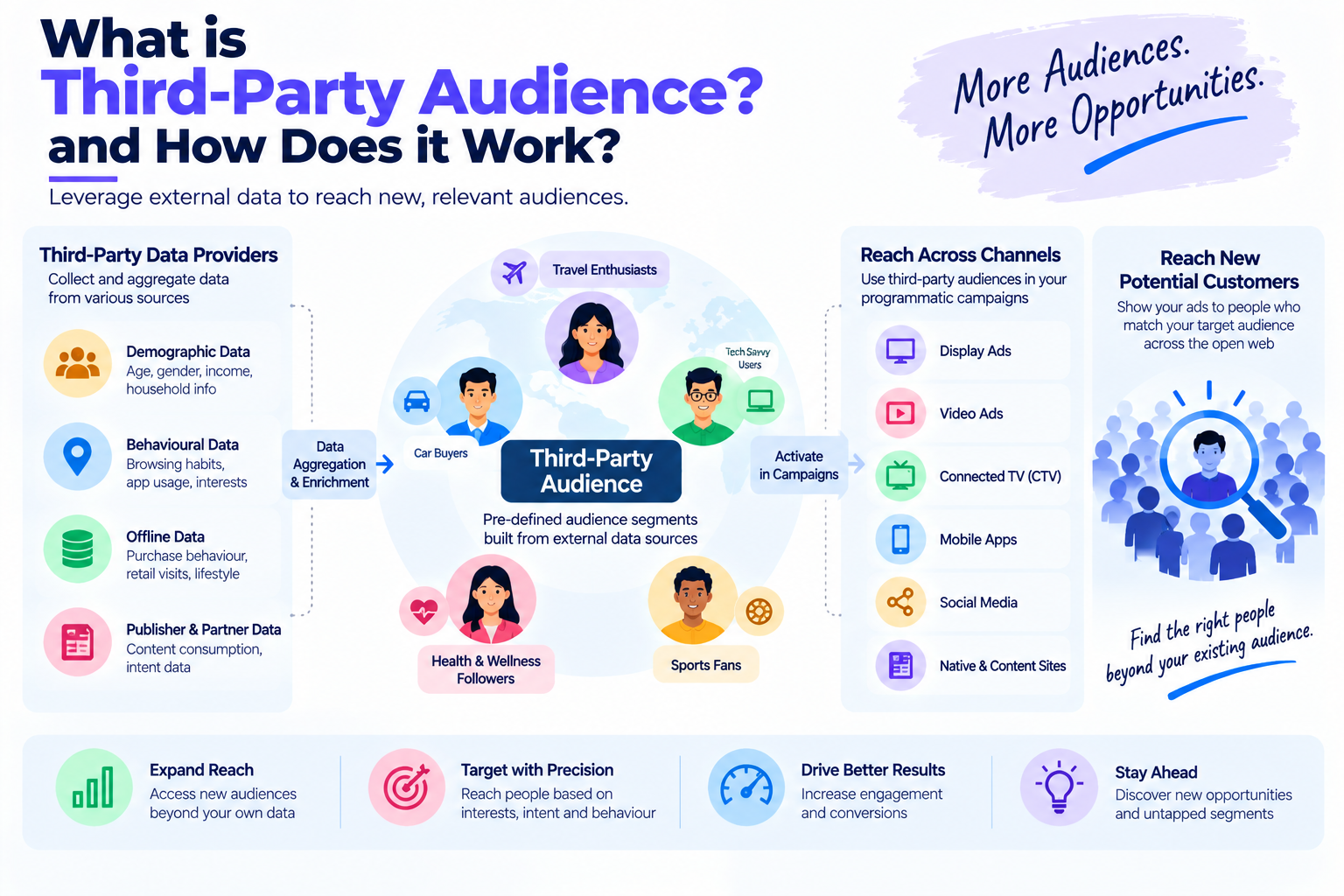
Third-party Audience: What Is It and How It Works

Third-party Audience is a group of users identified using data collected by a company or source other than the business running the marketing campaign.

How does a Third-Party Audience Work?

Let’s understand with the simple example. Suppose a new company sells running shoes. The company has just launched its website, so it does not have much customer data yet.

  1. An external company collects data A third-party data provider collects the information from various sources and uses it to create audience segments to applicable laws and permissions.
  2. The data is organized into audience groups The external provider may create different audience segments. Based on their interest and people who frequently shop online.
  3. The Business Select a Relevant Audience The company is trying to reach people who may have an interest in its products, even though those people may not have previously visited its website.
  4. The Audience Is Used in Marketing The goal is to make the campaign more relevant than simply showing the advertisement to a completely random audience.
  5. People See the Advertisement Potential customers may see advertisements for running shoes while browsing websites, apps or other digital platforms.

Third-Party Audience vs First-Party Audience

The information collected directly from this customer can be used to create first-party audience, subject to appropriate permissions and privacy requirements.

Now the company wants to reach people who have never visited its website. It may use an available third-party audience from an external source, where permitted

So:

  • First Party Audience: Data comes directly from your own interactions with customers or users.
  • Third Party Audience: Audience information comes from an external company or source

Why Do Marketers Use Third Party Audience?

Third Party audience have traditionally been useful for business that want to reach new potential customers.

  • Reaching New users: A business can potentially reach people who have never interacted with its website or app
  • Finding Relevant Audience: External audiences provide may offer segments based on interest, behaviors or other characteristics
  • Supporting Customer Acquisition: A business launching a new product may use external audience segments to help introduce the product to potential customers
  • Expanding Marketing Campaigns: If a company has a relatively small first-party audience, external audience sources may historically have helped expand its reach.
  • Data Quality: The accuracy and freshness of audience information can vary depending on the source.

Conclusion

A third-party audience is essentially an audience sourced from an external company or data source rather than collected directly by the business using it. It has traditionally helped marketers reach new potential customers based on interests, behaviors and other audience factors. It has traditionally helped you reach people you don’t directly know.
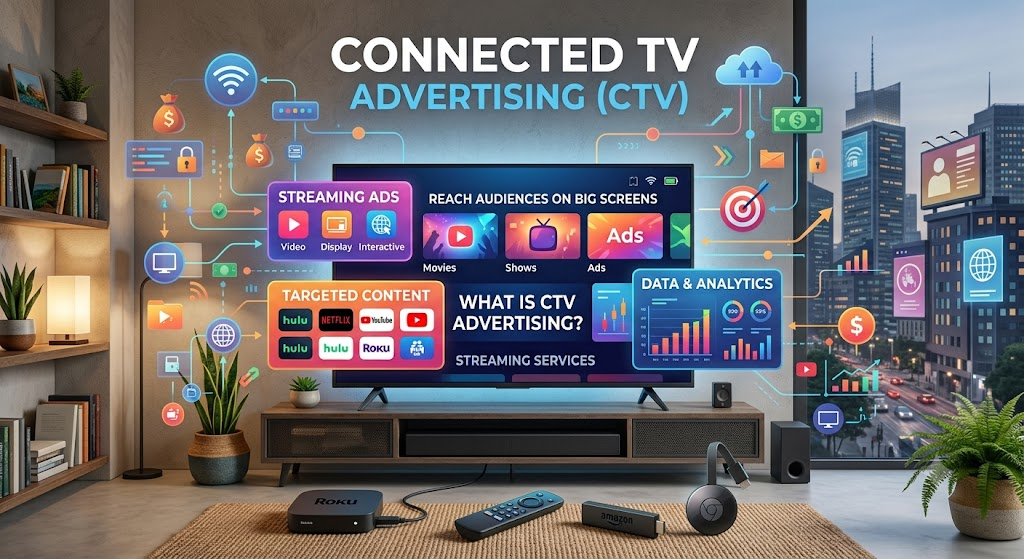

What is Connected TV Advertising

What is Connected TV advertising, and why is everyone using it?

What is Connected TV (CTV):

Connected TV means a television that can connect to the internet and stream content.

If you’re watching something on the internet through your TV Screen, you’re using CTV simple as that.

Simply:

CTV: Watching internet-based video on a TV screen.

CategoryExample
Smart TVsSamsung, LG – TVs with streaming apps built in
Streaming DevicesAmazon Fire Stick, Roku,Apple TV, Google Chromecast
Gaming ConsolePlayStation,Xbox

What Is CTV Advertising?

Showing ads to people while they watch shows on their internet-connected TV.

Those short ads you see when you’re streaming show on Netflix YouTube on your TV or in a free app.

CTV ads can appear:

  • Before a video – Called a pre-roll ad
  • During a video – Called a mid-roll ad
  • After a video – Called a post-roll ad
  • On top of the content – through banners, overlays, or other interactive formats

Some CTV ads are also interactive. For example, an advertisement might show a QR code that you can scan with your phone to visit a website or buy a product.

How Is This Different From Regular TV Ads?

Let’s say there’s a company that sells running shoes. Instead of showing the advertisement to everyone watching TV, the company can use digital advertising technology to find views who match its target audience.

On regular TV: Advertisements are displayed during the program and shown to everyone watching, regardless of their interests or purchasing intent

On CTV: They say, “Show my ad only a people aged 15-30 who watch sports content and live in XXX place”. Now, only the right people see the ad.

Result: The Shoe company spends less money and gets better results.

How Does CTV Advertising Work?

The process usually works like this:

  1. Someone starts watching contentA viewer opens a streaming service and start watching a movie, show, or live sport event.
  2. An advertising opportunity becomes available.The streaming platform has an available advertising space during the content.
  3. Advertisers compete for that space.Advertisers can use automated advertising systems to decide whether they want to show their advertisement to that viewer.
  4. The winning advertisement is shown.The selected advertisement is delivered to the viewer’s TV.
  5. The advertiser measures the result.The advertiser can then see information such as how many people watched the advertisement, how many people watched it completely, and whether people took action forward.

Why Is CTV Advertising Becoming So Popular?

The biggest reason is simple:

People are changing the way they watch TV.

Instead of sitting down at a fixed time to watch a program on cable television, people now prefer streaming.

They can watch what they want, whenever they want.

More viewers are also cancelling traditional cable subscription and moving towards streaming services.

Why Do People Like CTV?

One reason is that CTV fits the way people watch content today.

Viewers don’t always want to follow a fixed TV schedule.

They want to choose:

  • What they watch
  • When they watch it
  • Where they watch it

Streaming gives viewers this flexibility.

CTV advertising also tends to appear on large screens, which can create a more engaging viewing experience than advertisements shown on smaller devices.

Conclusion:

CTV advertising is changing the way business connect with TV viewers. Unlike traditional TV ads, CTV allows advertiser to reach more specific audiences, measure results, and adjust campaigns more easily. As more people choose streaming over traditional cable, CTV is becoming an important part of modern advertising.

Video Marketing Metrics: A simple Guide

How to measure and improve video advertising performance

Video advertising is a powerful way for brands to reach audience and tell their stories. But running video campaign is only the first step. To understand whether an ad is working, advertisers need to track the right Performance metrics.

Video marketing metrics helps advertisers understand views, engagement, completion, visibility, click, and conversions. By looking at these numbers together, advertisers can identify what is working and make better campaign decisions.

Why Are Video Metrics Important

Video matrices help advertisers

  • Understand how many people viewed the ad.
  • Measure how long viewers watched the video.
  • Check whether user completed the video.
  • Measure engagement and interaction
  • Monitor campaign efficiency and cost.
  • Optimize campaign for better results.

Keys video Marketing Metrics

  1. Impression Impressions show how many times your video ad was served to users. For example, if your ad was served 10,000 times, the campaign received 10,000 impressions.
  2. Video Starts Video starts show how many times users started watching your video. This helps you understand how many ad impression resulted in an actual video play.
  3. Video completion Rate (VCR) Video completion rate or VCR shows the percentage of video starts the reached the end of the video. Formula: VCR= Completed View / Video starts * 100
  4. Viewability Viewability measures whether the video ad was visible to the user according to the measurement standard being used. Higher viewability means more users had an opportunity to see the ad.
  5. Click-through Rate (CTR) CTR measure the percentage of impressions that resulted in a click. It can helps show whether the ad encourage users to take an action. Formula: CTR = Clicks / Impression * 100
  6. Cost per view (CPV) CPV tells advertisers how much they spend for each video view. It is useful for understanding the cost of generating video engagement. Formula: CPV = Total Spend / Total Video Views
  7. Conversions Conversions measures actions users take after interacting with an ad. Depending on the campaign, a conversion could be purchase from submission, sign-up, app download, or another valuable actions.

How To Read These Metrics Together

One metric does not tell the whole story. Reviewing several metrics together gives a clearer view of campaign performance.

  • High VCR + High viewability: The video is being seen and watched by a strong percentage of viewers.
  • High CTR + Low conversions: Users are interested enough to click, but the landing page, offers, or next step may need improvement.
  • Low VCR: Consider testing a shorter video, a strong opening, or a different creative.
  • High Impressions + Low Viewability: The ad may be served frequency, but fewer user may have a meaningful opportunity to see it.

Tips For Improving Video Campaign Performance

  • Keep the message clear and engaging from the beginning.
  • Test different video lengths and creative versions.
  • Monitor VCR and viewability to understand whether user is watching.
  • Use CTR and conversions to measure user actions.
  • Review cost matrices such as CPV to manage campaign efficiency.
  • Optimize targeting and creative based on campaign results.

Final Thoughts

Video marketing metrics make it easier to understand how a video campaign is performing. By monitoring impressions, video starts, VCR, viewability, CTR, CPV, and conversions, advertisers can make informed decisions and improve campaign performance.

The key is simple: measure the right metrics, understand what they tell you, and use those insights to improve your campaign.