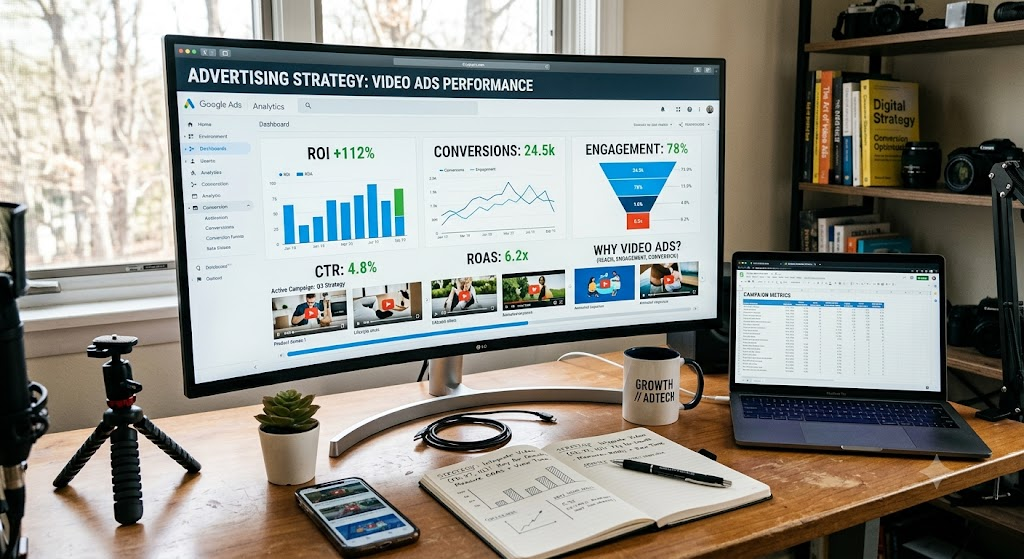
Today, Videos are everywhere. We watch them on YouTube, Instagram, Facebook, website, mobile apps and even while shopping online. Because people naturally enjoy watching and listening to stories, video ads can be a powerful way for businesses to introduce their products and connect with customers.
What Are Video Ads?
Video ads are advertisement that use moving images, text, sound, animations or a combination of these to promote a product, service or brand.
Why Are Video Ads Important?
Video can combine picture, movements, words music, and storytelling in one advertisement. This makes them more interesting and easier to remember. A good video ad can help your business:
Get people attention
Make your brand memorable
Explain a product or service quickly
Build trust with potential customers
Encourage people to visit your website
Generate leads and sales
Connect with customers emotionally
How to Create a Great Video Ad.
Creating a good video does not necessarily mean spending a lot of money. Here are some important things to remember.
Keep Your Video Short People have limited attention spans, especially when they are scrolling through social media. A long advertisement may cause people to skip or ignore it. Short videos are especially useful when you want to quickly introduce a product, highlight a benefit or encourage someone to take action.
Grab attention in the First Few Seconds. The beginning of your video extremely important. People can scroll away from your advertisement within seconds. So do not spend the first 5-10 mins slowly introducing your company
Use Captions Many people watch videos with the sound turned off, especially when they are in public places or scrolling through social media so closed captions and on-screen text are important.
Do not forget the Call to Action A video advertisement should usually tell viewers what to do next. This is called Call to Action (CTA) Examples:
Shop Now
Book Now
Order Today
Learn More
Sign UP
What If You Do not have a Video
You do not always need professional video footage to create a video advertisement. If you already have images, product photos, banners or graphics you can turn those assets into a video.
Establish the Right Goal for your Video Ad
Before creating a video ad, you need to decide what you want the advertisement to achieve Your goal could be:
Making more people aware of your brand
Introducing a new product
Getting people to visit your website
Getting more app downloads
Increasing product sale
Encouraging people to sign up for a service
Conclusion
Video advertising is a powerful way for businesses to connect with their audience build brand awareness and increase customer engagement. Unlike traditional ads, video can combine svisuals, text, sound and storytelling to communicate a message quickly and effective.
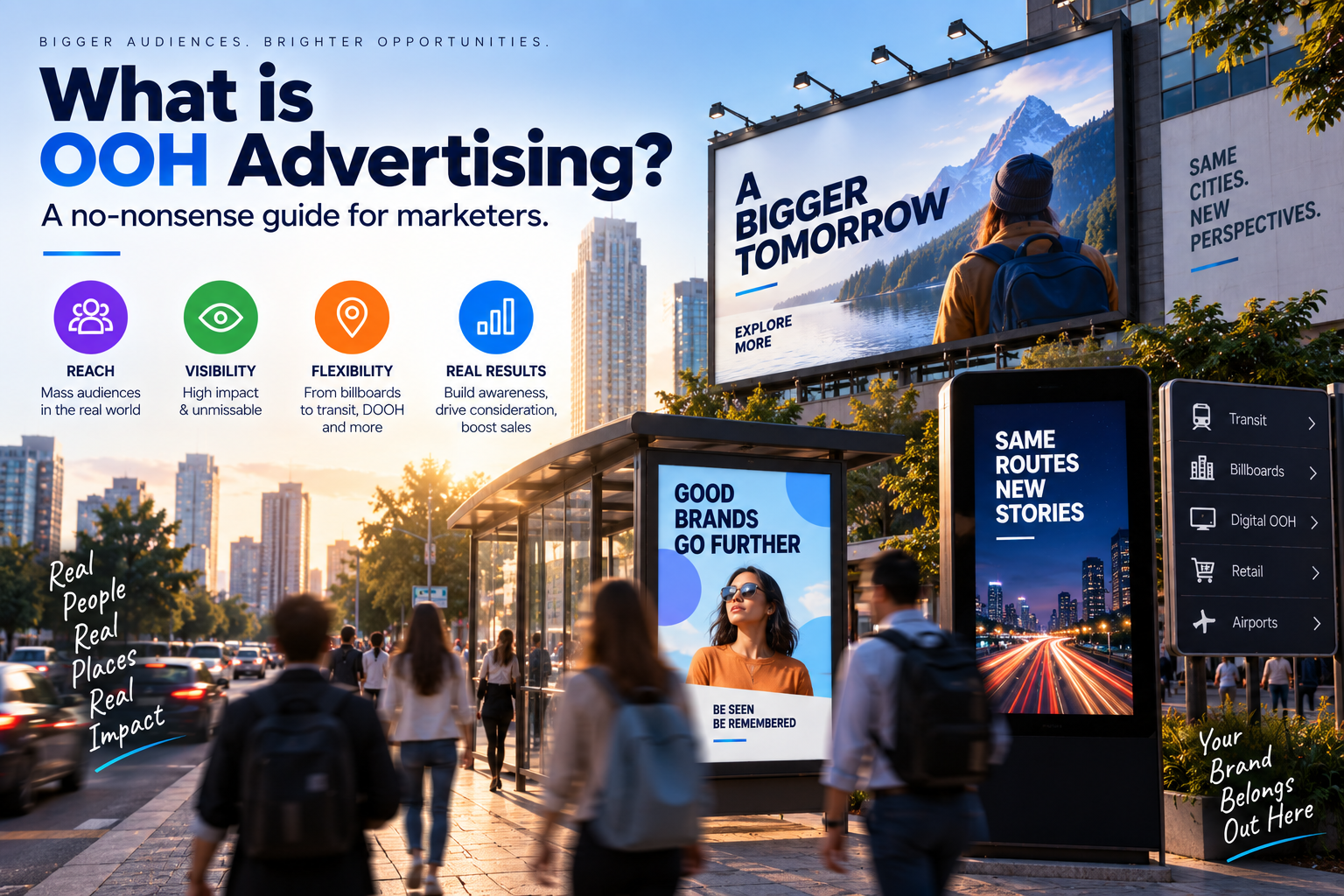
Out-of-home (OOH) advertising is advertising that reaches people while they are outside their homes.
Think about the advertisements you see while traveling to work, walking through a shopping area, waiting for public transportation, or visiting a mall. Billboards, bus shelter posters, digital screens, and transit advertisements are all examples of OOH advertising.
OOH has been around for a long time. Traditional advertising formats such as posters, painted signs, and billboards have been used to communicate messages to people in public spaces for generations. What has changed is the technology behind it.
Today, OOH is no longer limited to static posters and billboards. Digital out-of-home (DOOH) uses digital screens that can display videos, animations, and changing messages.
Programmatic technology has taken this one step further by allowing advertisers to buy and manage digital OOH inventory using automated advertising platforms.
This means OOH can now be part of a broader digital and omnichannel advertising strategy.
Traditional OOH vs. DOOH Advertising
OOH is the broader category of advertising that reaches audiences in public spaces. It includes both traditional OOH and digital OOH (DOOH).
Traditional OOH
Traditional OOH uses physical, non-digital advertisements such as,
Static billboards
Posters
Bus shelter advertisements
Transit wraps
Street-level signage
Printed displays
Once a traditional OOH advertisement is installed, changing the creative usually requires a physical replacement. This can make traditional OOH highly visible and consistent, but it can also make campaigns less flexible.
Digital OOH
DOOH uses digital screens to display advertisements. These can include
Digital billboards
Digital screens in malls
Transit screens
Airport displays
Retail screens
Place-based digital screens
The biggest difference is flexibility. Digital screens can display different advertisements at different times and can support dynamic creative. For example, an advertiser could show one message during the morning commute and another during the evening.
What Is Programmatic DOOH?
Programmatic DOOH brings programmatic advertising technology into digital out-of-home advertising. Instead of manually arranging individual screen placements, advertisers can use programmatic platforms to access available digital OOH inventory and automate parts of the buying process.
Depending on the platform and inventory, advertisers may be able to use signals such as,
Location
Time of day
Audience characteristics
Traffic conditions
Weather
Events
Content or environment
For example, a food delivery brand could display a different message during lunchtime, while a retail brand could increase advertising around locations close to its stores. Programmatic DOOH also makes it easier to manage campaigns across multiple screens and locations.
The exact buying methods and targeting capabilities vary by market, media owner, and platform.
Types of OOH Advertising
OOH advertising can appear in many different environments. The main types include billboards, street furniture, transit, and place-based advertising.
1. Billboards
Billboards are one of the most recognizable forms of OOH advertising. They are typically placed in high-traffic locations such as
Highways
Major roads
City centers
Commuter routes
Commercial areas
Because of their size and visibility, billboards are particularly useful for building awareness and increasing brand visibility. For example, a brand launching a new product could use large billboards across a city to create awareness among a broad audience.
Digital billboards can also add movement, video, and dynamic messaging to the traditional billboard format.
2. Street Furniture
Street furniture advertising places ads at the pedestrian level, often where people walk, wait, or shop. Common examples include,
Bus shelters
Benches
Kiosks
Newsstands
Bicycle racks
Pedestrian information panels
These placements can be useful for reaching people in busy urban areas. They can also work well for local and location-based campaigns.
For example, a restaurant could promote a nearby offer on a bus shelter or street-level display close to its location.
3. Transit Advertising
Transit advertising reaches people while they are traveling. It can appear on or around
Buses
Taxis
Trains
Subway systems
Airports
Transit stations
Other transportation hubs
Transit advertising can provide repeated exposure because commuters may travel through the same routes regularly. It can be particularly useful for,
Tourism brands
Entertainment companies
Retailers
Local businesses
Consumer brands
For example, a travel company could advertise in an airport to reach people who are already in a travel-related environment.
4. Place-Based Advertising
Place-based OOH reaches people in specific environments where they spend time.
Examples include
Shopping malls
Retail stores
Gyms
Stadiums
Movie theatres
Offices
College campuses
Gas stations
Convenience stores
Healthcare facilities
The biggest advantage of place-based advertising is context. The environment itself can provide information about the audience.
For example, a sports brand can advertise inside a gym, while a retail brand can reach consumers inside or near a shopping environment.
This can make the advertising message more relevant to the situation in which the audience sees it.
Benefits of OOH Advertising
OOH advertising offers several advantages that make it useful for both brand-building and broader marketing campaigns.
1. High Visibility
OOH advertising is designed to stand out in physical environments. Large billboards and digital displays can attract attention in busy streets, transportation hubs, shopping centers, and other high-traffic locations.
Unlike an online advertisement that can disappear when a user closes a webpage, a physical OOH placement remains visible to people passing through the area.
2. Broad Audience Reach
OOH can reach large and diverse audiences. A single billboard placed along a busy highway, for example, can potentially be seen by many people throughout the day. Different OOH environments can also help brands reach different types of audiences.
A transit campaign may reach commuters, while a retail campaign may reach shoppers closer to a purchase decision.
3. Continuous Visibility
OOH advertisements generally cannot be skipped in the same way as many digital advertisements.
A billboard or digital screen is simply part of the environment people move through. This gives brands repeated opportunities to build recognition and reinforce their message.
However, the actual level of exposure depends on factors such as location, traffic, visibility, screen rotation, and dwell time.
4. Local and Contextual Targeting
One of OOH’s biggest strengths is its connection to location. Advertisers can choose placements based on where their target audience is likely to be.
A restaurant can advertise near its location.
A retailer can advertise around shopping areas.
A travel brand can advertise at airports.
An entertainment company can advertise near event venues.
DOOH can make this even more flexible by allowing messages to change based on factors such as time, weather, traffic, or events when those capabilities are supported.
5. Creative Flexibility
OOH gives brands a large physical canvas. Advertisers can use
Large visual designs
Video
Animation
3D creative
Dynamic messaging
Interactive experiences
Large-scale installations
Digital OOH is particularly useful for dynamic creative because the message can be changed without physically replacing the display. This gives creative teams more opportunities to experiment with how a brand appears in the real world.
6. Greater Campaign Flexibility with Programmatic DOOH
Programmatic DOOH adds automation and flexibility to digital OOH campaigns. Depending on the platform, advertisers can adjust
Budgets
Creative
Timing
Locations
Audience strategies
Delivery
This can make DOOH easier to integrate into a broader digital advertising campaign. Instead of treating OOH as a completely separate channel, advertisers can use it alongside channels such as display, video, CTV, mobile, and social advertising.
7. Impact Near the Point of Purchase
OOH can be particularly valuable when an advertisement is placed close to where a consumer can take action.
For example,
A retailer could display an advertisement near its store.
A restaurant could promote an offer close to its location.
A brand could advertise inside a shopping center where consumers are already browsing products.
This creates a natural connection between advertising exposure and potential action.
How Is OOH Advertising Measured?
Measurement has historically been one of the biggest challenges for OOH advertising. Traditional OOH measurement often relied on traffic counts and estimated audience numbers to understand how many people might have been exposed to a particular placement.
Technology has made measurement more sophisticated. Today, advertisers can use different methods to evaluate the effectiveness of OOH and DOOH campaigns.
The exact measurement capabilities depend on the campaign, market, data providers, and technology being used.
1. Footfall Attribution
Footfall attribution helps advertisers understand whether people who were potentially exposed to an OOH advertisement later visited a physical location.
For example, a retailer could compare store visits among audiences exposed to an OOH campaign with a relevant comparison group.
Privacy-safe, aggregated location data can be used to help estimate these visits. This can help connect an OOH campaign with real-world activity.
2. Brand Lift
Brand lift studies measure whether an advertising campaign changed how consumers perceive a brand. Depending on the study, advertisers may measure changes in
Brand awareness
Brand recall
Brand consideration
Purchase intent
This is particularly useful for campaigns focused on brand building rather than immediate conversions.
3. Sales Lift
Sales lift analysis looks at whether advertising exposure is associated with an increase in purchases.
For example, advertisers may compare sales activity before and after a campaign or compare exposed and non-exposed audiences where appropriate data is available.
Sales lift can help brands understand whether OOH advertising contributed to business outcomes.
How Brands Are Using OOH Advertising Today
OOH is increasingly being used as part of connected, multichannel campaigns rather than as a standalone awareness channel. For example, a brand might use DOOH to reach people in a specific location and then use digital channels to continue the conversation.
A campaign could combine DOOH → Mobile → Display → CTV → Website
The objective is to maintain a consistent message while adapting the creative to each channel. This approach can help brands connect the physical and digital parts of the customer journey.
For example, a retailer could use digital billboards near shopping locations, followed by online advertising that reinforces the same product message. The specific targeting and retargeting capabilities available will depend on the platforms and privacy frameworks involved.
Trends Shaping the Future of OOH Advertising
OOH is changing as advertising technology develops. Several trends are shaping how brands use the channel.
1. OOH and Digital Advertising Are Becoming More Connected
OOH is increasingly being integrated with digital advertising. Instead of running an OOH campaign independently, advertisers can use it as part of a broader media strategy.
For example, a brand could use DOOH to create awareness in a specific location and then continue communicating with audiences through digital channels. This makes OOH more relevant to advertisers looking for an omnichannel approach.
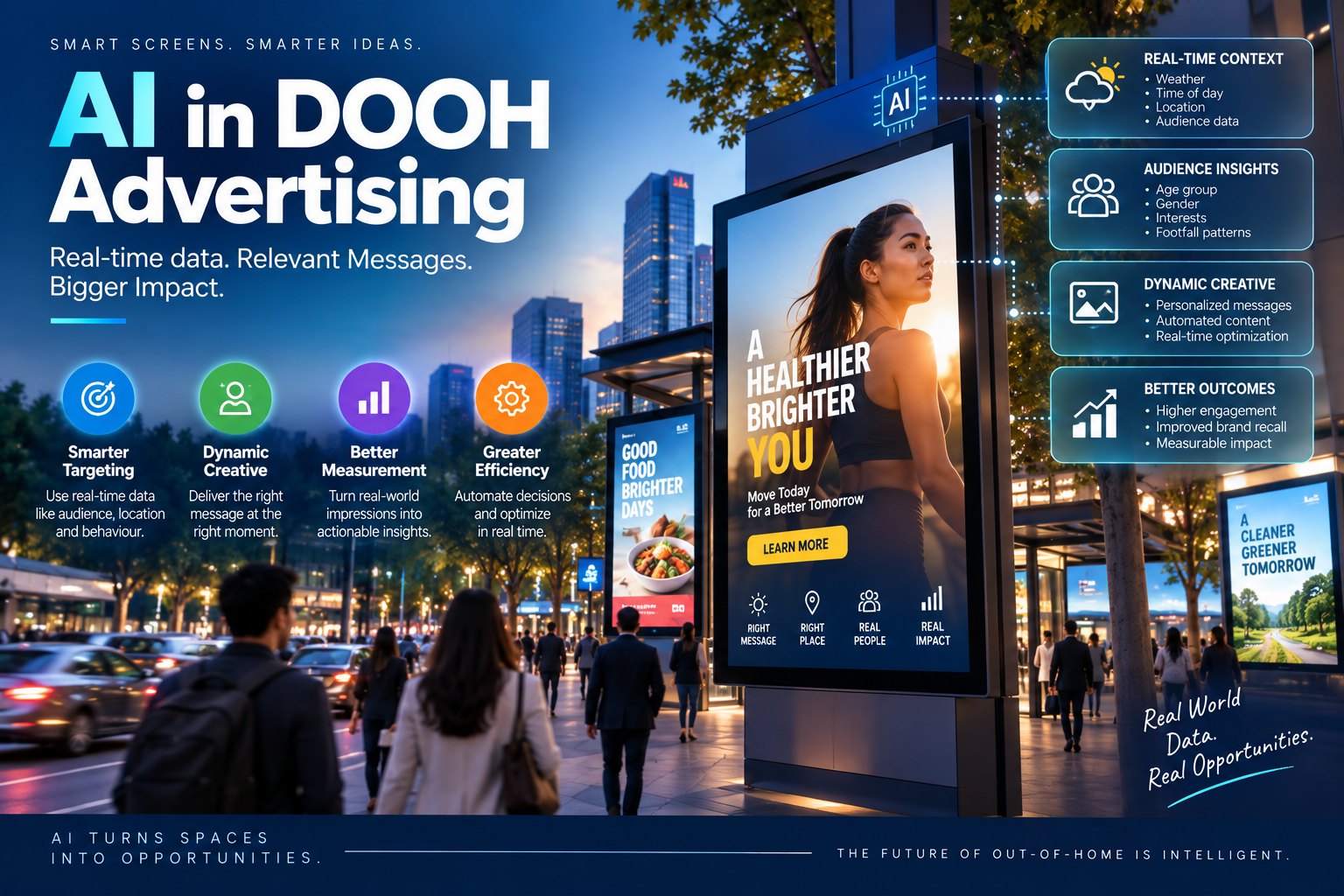
2. AI Is Making DOOH More Dynamic
Artificial intelligence is creating new opportunities for DOOH advertising. AI and automation can help advertisers process large amounts of information and make campaigns more responsive to changing conditions.
For example, a campaign could potentially adapt its creative based on
Weather
Traffic
Time of day
Local events
Audience patterns
Other contextual signals
AI can also support creative development, campaign analysis, and optimization. However, AI should be viewed as a tool that helps advertisers make better decisions-not as a replacement for strategy and creative thinking.
3. OOH Is Expanding into New Environments
OOH advertising is moving beyond traditional billboards and transit locations. Digital screens are increasingly appearing in environments such as
Retail stores
Shopping centers
Gyms
Healthcare locations
Entertainment venues
Electric vehicle charging stations
Other high-dwell environments
This expansion gives advertisers more opportunities to reach consumers in specific contexts. Retail environments are particularly interesting because advertisements can reach consumers closer to the point of purchase.
4. Programmatic DOOH Is Becoming More Accessible
Programmatic buying is making digital OOH easier to integrate into modern media plans. Instead of managing every screen placement individually, advertisers can use programmatic technology to access available inventory across multiple media owners and locations.
This can simplify campaign activation and provide more flexibility around
Planning
Buying
Budget allocation
Creative changes
Campaign management
Measurement
As DOOH inventory continues to become more connected to programmatic platforms, advertisers can increasingly treat it as part of the same broader media strategy as other digital channels.
Does OOH Belong in Your Media Strategy?
OOH has changed significantly. What was once primarily a static billboard or poster is now becoming a more dynamic advertising channel supported by digital screens, automation, data, and programmatic technology.
Traditional OOH remains valuable for large-scale visibility and brand awareness. DOOH adds flexibility, dynamic creative, and more data-driven campaign management.
Programmatic DOOH takes this further by making it easier to buy and manage digital OOH inventory alongside other digital advertising channels.
For brands looking to connect with audiences in the real world, OOH can therefore play an important role in a modern media strategy.
Final Thoughts
Out-of-home advertising has been around for generations, but the way brands use it is changing. The combination of OOH, DOOH, programmatic buying, data, and AI are creating new opportunities for advertisers to connect physical-world experiences with digital campaigns.
The biggest strengths of OOH remain its visibility, reach, location-based relevance, and creative impact. At the same time, digital technology is making the channel more flexible and measurable.
The future of OOH is therefore not simply about bigger billboards.
It is about making physical advertising more relevant, dynamic, measurable, and connected to the rest of the customer journey.
Linear TV vs. Connected TV: What’s the Difference?
Television advertising has changed significantly over the last few years.
For decades, linear TV was the primary way brands reached large audiences. People watched scheduled programs through cable, satellite, or broadcast television, and advertisers purchased commercial spots around those programs.
Today, viewers have many more choices. Instead of watching only scheduled programming, they can stream movies, TV shows, live events, news, and other content whenever they want. This has made Connected TV (CTV) an important part of modern advertising.
While linear TV and CTV both appear on television screens, the way audiences consume content-and the way advertisers buy and measure advertising-can be very different.
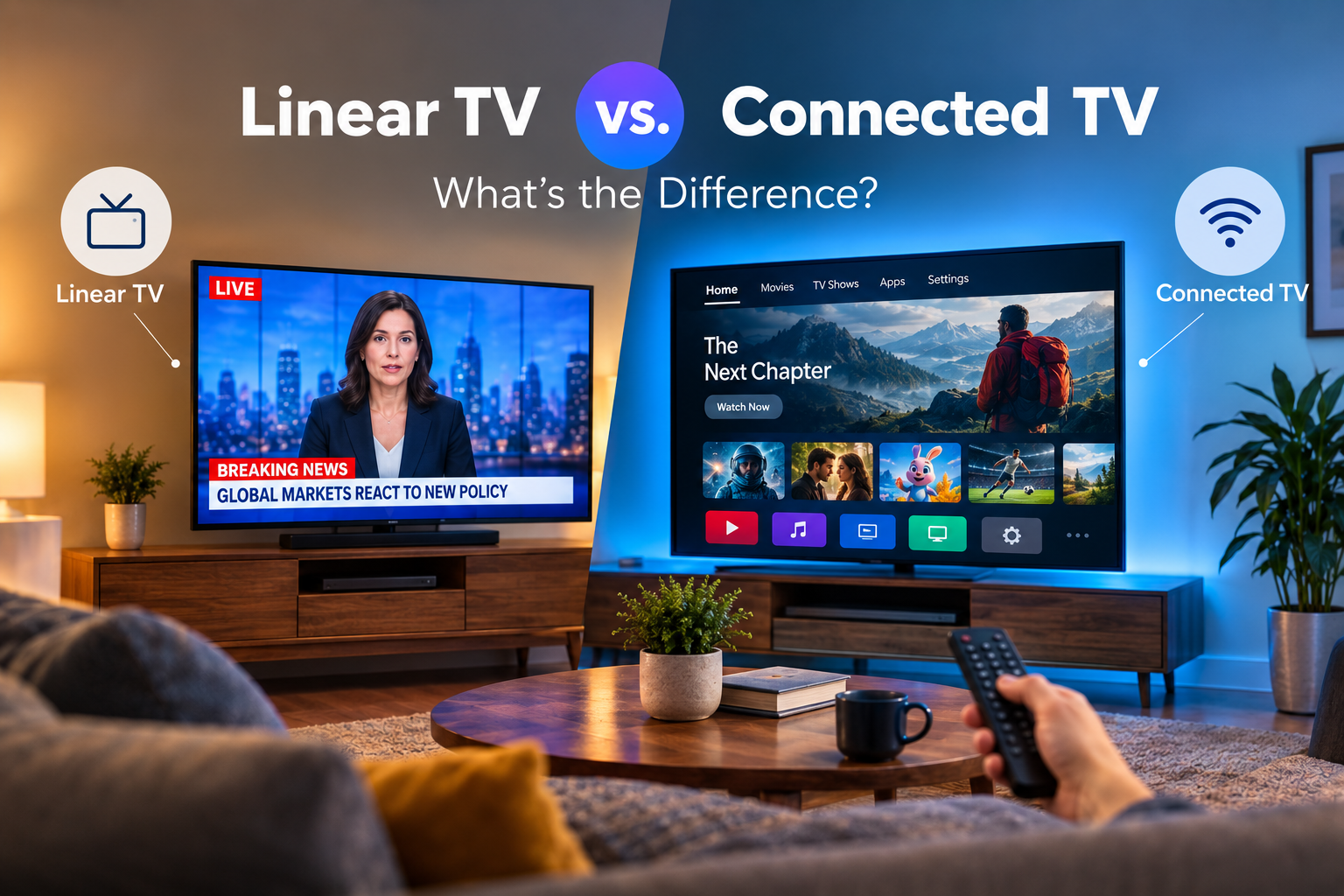
The simple way to think about it is
Linear TV = scheduled television programming.
CTV = television content delivered through an internet-connected device.
Both have their own advantages. The right choice depends on the campaign’s goals, audience, budget, and the type of reach an advertiser needs.
What Is Linear TV?
Linear TV refers to traditional television where viewers watch scheduled programming through broadcast, cable, or satellite services. The content follows a fixed schedule determined by the television network or channel.
For example, if a news program starts at 8:00 PM, viewers need to tune in at that time to watch it live.
The same principle applies to advertising. Advertisers purchase commercial spots within specific programs, channels, or time slots. The ads are then shown to the audience watching that programming.
Examples of linear TV environments include:
Broadcast television
Cable television
Satellite television
Scheduled news programming
Live sports
Live events
Traditional TV channels
Linear TV is still relevant, particularly for campaigns that require large-scale reach, live programming, and broad audience exposure.
Benefits of Linear TV Advertising
1. Reach Large Audiences Through Live Programming
One of the biggest strengths of linear TV is its ability to deliver large audiences around live and highly anticipated programming. Examples include:
Live sports
Breaking news
Awards shows
Major entertainment events
Political events
Special broadcasts
Live programming remains valuable because viewers often want to watch events as they happen rather than wait for them to become available on demand.
For advertisers, these environments can create opportunities to reach a large number of viewers at the same time.
However, live content is no longer exclusive to traditional television. Many major events are now distributed across both traditional and streaming platforms.
This means advertisers increasingly need to consider both linear TV and CTV when planning campaigns around major live events.
2. Reach Audiences That Still Prefer Traditional TV
Although streaming continues to grow, not every viewer has moved completely away from traditional television.
Some audiences-particularly older demographics-continue to spend significant time watching broadcast and cable television.
This makes linear TV useful for brands that want to reach audiences who are more likely to consume traditional TV content.
For example, a brand targeting an older consumer segment may find linear TV valuable because those viewers may have stronger traditional-TV viewing habits.
At the same time, audience behavior is changing across generations. Younger audiences are also watching television content, but they are increasingly doing so through streaming services.
Therefore, advertisers should avoid treating age as the only deciding factor. Actual audience behavior and campaign objectives should guide the media strategy.
3. Plan Campaigns Around Channels and Time Slots
Linear TV provides advertisers with a relatively predictable way to plan campaigns. Advertisers can select:
Specific channels
Programs
Time slots
Dayparts
Live events
Geographic markets
Different programs attract different types of viewers.
For example, a brand targeting families may choose programming that is popular among family audiences. A financial services company may prefer news or business-related programming.
Prime-time programming can also provide broad exposure and help brands build awareness.
The key advantage is that advertisers can plan around where and when their desired audience is likely to be watching.
What Is Connected TV?
Connected TV, or CTV, refers to television content that is delivered through an internet-connected TV or device. This can include:
Smart TVs
Streaming devices
Gaming consoles
Connected set-top boxes
Other internet-connected television devices
CTV allows viewers to watch content through streaming services instead of relying exclusively on traditional cable or satellite television.
Examples of CTV environments include streaming movies, TV shows, live channels, news, sports, and other digital content.
CTV advertising can appear before, during, or after video content. Depending on the publisher and platform, advertisers may also have access to different interactive or advanced video ad formats.
The major difference from traditional TV is the technology behind the advertising.
Instead of relying primarily on broad program or channel-based audiences, CTV advertising can use digital audience and contextual signals to make targeting more precise.
Benefits of Connected TV Advertising
1. More Precise Audience Targeting
One of the biggest advantages of CTV is its ability to bring digital-style targeting to the television environment.
Depending on the platform, publisher, and available data, advertisers may be able to target audiences using signals such as:
Demographics
Geographic location
Interests
Content preferences
First-party data
Audience segments
Contextual signals
Device information
Behavioral signals
For example, instead of showing an advertisement to everyone watching a particular TV channel, an advertiser may be able to focus on a specific audience segment within CTV inventory.
This can help advertisers reduce wasted impressions and make their campaigns more relevant.
Contextual targeting is also important: CTV doesn’t have to rely only on information about the viewer. Advertisers can also consider the content being watched.
For example:
A sports brand can advertise around sports content.
A travel company can advertise around travel-related programming.
A financial company can advertise around business or financial content.
A food brand can advertise around cooking or lifestyle content.
This combination of audience and contextual targeting gives CTV advertisers more flexibility than traditional TV buying.
2. Better Measurement and Optimization
Measurement is another major difference between traditional TV and CTV. Traditional TV campaigns often depend on estimated audience data and post-campaign reporting. CTV works more like other digital advertising channels.
Depending on the platform and measurement setup, advertisers can receive detailed campaign metrics such as:
Impressions
Video completion rate
Completed views
Reach
Frequency
Cost metrics
Conversion metrics
Audience performance
This allows advertisers to understand how campaigns are performing and identify opportunities for optimization.
For example, if one audience segment is performing better than another, an advertiser can adjust the campaign strategy based on available data.
Similarly, advertisers can compare different creatives, audiences, publishers, or inventory sources. This creates a more data-driven approach to TV advertising.
It’s important to remember that measurement capabilities are not identical across every CTV platform. Available metrics depend on the publisher, device, measurement partner, and campaign setup.
3. Engaging Digital Viewing Experience
CTV combines the large-screen viewing experience of television with the technology of digital advertising.
Viewers can watch content on a large screen, often in high-quality video, while advertisers can use digital buying and targeting capabilities.
CTV is particularly useful for video storytelling because advertisers can use:
Full-screen video
Sound
Motion
Brand visuals
Strong calls to action
Interactive experiences where supported
Because the ad appears within a television viewing environment, CTV can be particularly effective for brand awareness and consideration campaigns.
However, CTV is not only an awareness channel. With the right measurement and audience strategy, it can also support consideration and performance-focused campaigns.
Linear TV vs. CTV: Key Differences
Factor
Linear TV
Connected TV
Content delivery
Broadcast, cable, or satellite
Internet-based streaming
Viewing model
Mostly scheduled programming
On-demand and live streaming
Targeting
Primarily channel, program, time, and demographic based
Audience, contextual, geographic, and other digital signals
Reach
Strong broad reach, especially through traditional TV
Growing reach across streaming audiences
Live content
Strong for traditional live broadcasts
Increasingly important as live sports and events move to streaming
Measurement
Often based on estimated audience data
More granular digital-style measurement, depending on setup
Optimization
Limited once the media buy is placed
More flexible during a campaign
Creative
Primarily traditional TV commercials
Video ads and other supported digital TV formats
Buying approach
Traditionally planned and purchased in advance
Can be purchased through direct, programmatic, or hybrid approaches
Best suited for
Broad awareness and large-scale reach
Targeted reach, measurable campaigns, and incremental audiences
The important point is that linear TV and CTV are not competing formats in every situation. They can complement each other.
How to Use Linear TV and CTV Together
Instead of asking, “Should I use linear TV or CTV?”, advertisers can often ask, “How can I use both to reach more of the right audience?”
A combined strategy can help brands take advantage of the strengths of both channels.
Here are three approaches.
1. Extend Existing TV Campaigns to CTV
If a brand already has a TV commercial, the same core creative can often be adapted for CTV. This can make it easier to extend an existing campaign into streaming environments.
For example, a brand running a 30-second commercial on traditional television could also use an appropriate version of that creative in CTV inventory. However, simply copying the same creative isn’t always the best approach.
CTV is a digital environment, so advertisers should also consider:
Mobile and TV screen differences
Clear branding
Strong opening seconds
Captions where appropriate
Simple messaging
Clear calls to action
Different viewing environments
The goal is to make the creative work well on a large screen in a streaming environment, not simply reuse an asset without considering the context.
2. Use Linear TV and CTV to Increase Overall Reach
Using only one TV channel can limit the audiences a campaign reaches. A combined strategy can help advertisers reach people who still watch traditional television as well as audiences who primarily stream content.
For example: Linear TV can help reach traditional TV viewers and large audiences around scheduled programming.
CTV can help reach streaming audiences, including people who have reduced or completely stopped using traditional cable TV. Together, they can provide broader coverage across different viewing habits.
This is particularly useful as audiences become increasingly fragmented across broadcast channels, cable networks, streaming services, and digital platforms.
3. Build Cross-Channel Campaigns
CTV can also work as part of a broader digital advertising strategy. For example, a brand could:
Show a CTV video ad to introduce the brand.
Reach exposed audiences through display or native advertising.
Retarget eligible audiences where the platform and privacy framework support it.
Measure downstream actions such as website visits or conversions.
This creates a connected customer journey instead of treating every advertising channel as a separate campaign.
However, cross-device and cross-channel targeting should always follow the privacy, consent, identity, and measurement rules supported by the relevant platforms and markets.
Which One Should Advertisers Choose?
There isn’t one universal answer. The right choice depends on several factors, including:
Choose Linear TV when:
You need broad traditional TV reach.
Your audience strongly watches broadcast or cable TV.
You want to advertise around major live programming.
Your campaign is focused heavily on mass awareness.
Channel and program selection are important to your strategy.
Consider CTV when:
You need more precise audience targeting.
Your audience spends significant time streaming.
You want more detailed campaign measurement.
You want greater flexibility in campaign optimization.
You want to reach cord-cutters and streaming-first audiences.
You want to integrate TV advertising with your broader digital strategy.
Consider using both when:
You want broad reach and precise targeting.
Your audience is spread across traditional TV and streaming.
You want to increase incremental reach.
You want to connect TV exposure with digital campaigns.
You want to build a more complete video advertising strategy.
Final Thoughts
The television advertising landscape is no longer simply about choosing between traditional TV and streaming.
Viewers now move between broadcast television, cable, smart TVs, streaming services, connected devices, and live digital content depending on what they want to watch and when they want to watch it.
Linear TV continues to provide value through broad reach, scheduled programming, and live events. CTV brings many digital advertising capabilities to the television screen, including more flexible targeting, measurement, and optimization.
For many advertisers, the strongest strategy is therefore not linear TV vs. CTV, but linear TV + CTV.
By understanding where their audience watches content and matching each channel to the campaign objective, advertisers can build a more effective and flexible TV advertising strategy.
Audio has become an important part of the digital media experience.
People listen to music, podcasts, digital radio, audiobooks, and other audio content throughout the day. Unlike many digital formats, audio doesn’t always require someone’s eyes to be on a screen.
This creates a valuable opportunity for advertisers.
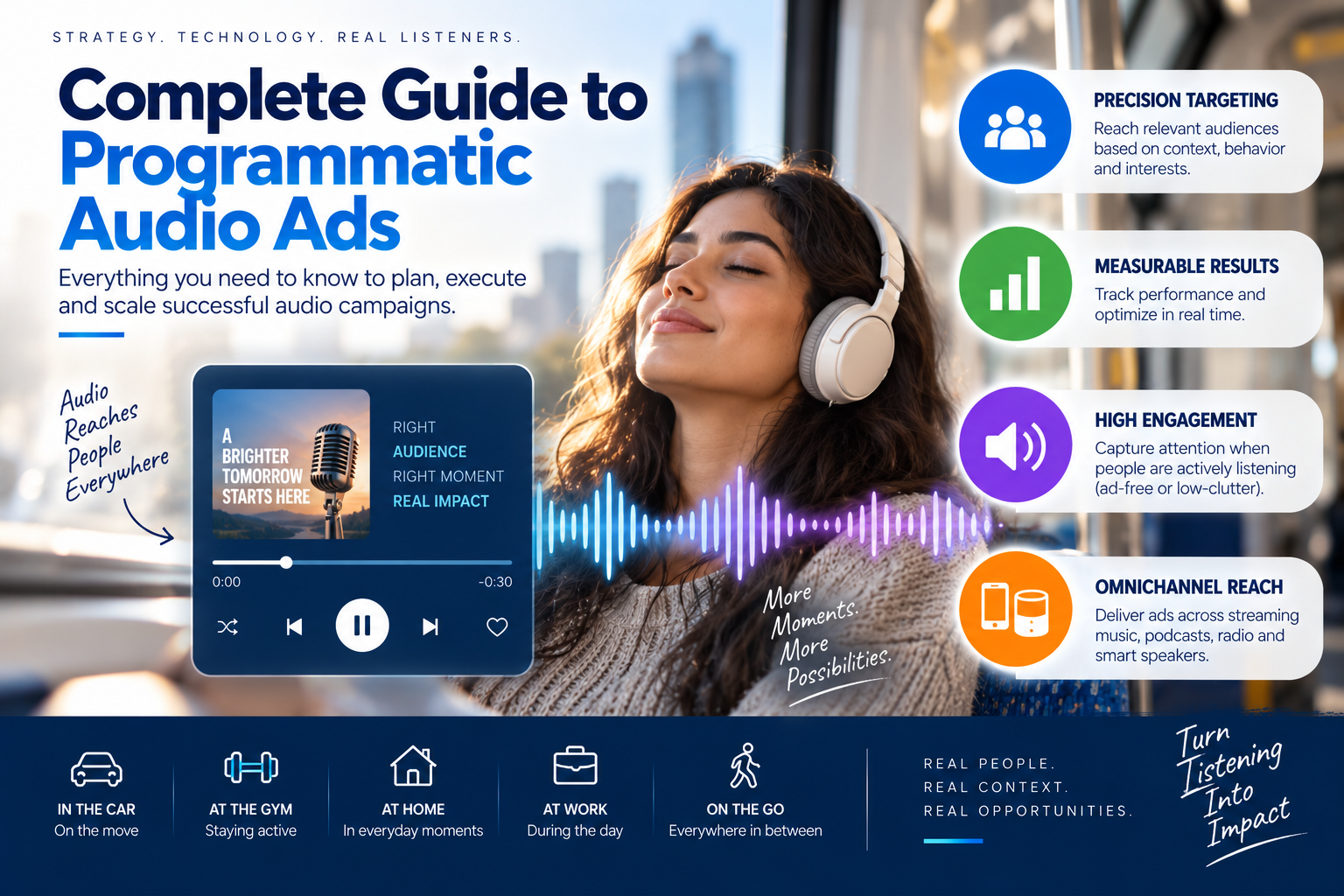
Programmatic audio advertising allows brands to use automated advertising technology to buy audio ad inventory and reach relevant audiences across digital listening environments.
Instead of manually purchasing individual audio placements, advertisers can use programmatic technology to automate the buying process and apply available audience, contextual, geographic, and other targeting signals.
This guide explains how programmatic audio works, where audio ads appear, their key benefits, and the best practices advertisers should follow when building an audio campaign.
What Is Programmatic Audio Advertising?
Programmatic audio advertising is the automated buying and delivery of advertising within digital audio content. It works in a similar way to other programmatic advertising channels such as display, video, and CTV.
An advertiser defines the campaign requirements, such as
Target audience
Budget
Location
Campaign dates
Bidding strategy
Creative
Frequency controls
Campaign objective
When an eligible audio advertising opportunity becomes available, programmatic technology evaluates the impression against the campaign requirements.
If the impression matches the campaign and the advertiser wins the available auction, the audio advertisement is delivered to the listener.
The advertiser creates a campaign and provides the required targeting and creative information. The programmatic platform then looks for audio impressions that match those requirements.
When a suitable opportunity becomes available, an automated auction determines which advertiser gets the impression. The winning ad is then delivered to the listener.
After delivery, advertisers can use available campaign data to evaluate performance and make adjustments.
This automation makes it easier to manage audio advertising at scale without having to negotiate every individual placement manually.
Where Can Programmatic Audio Ads Appear?
Programmatic audio advertising can appear across a variety of digital listening environments, depending on the inventory and platform. Common environments include:
Music streaming services
Podcasts
Digital radio
Online audio platforms
News and talk content
Other digital audio experiences
Audio can also be consumed through different devices, including:
Smartphones
Tablets
Desktops and laptops
Smart speakers
Connected devices
In-car systems
The exact inventory, targeting options, and creative formats available will depend on the publisher, platform, device, and market.
Why Is Programmatic Audio Becoming Important?
The way people consume audio has changed significantly. Audio is no longer limited to traditional radio. Listeners can now choose from a wide range of digital content and access it across multiple devices and situations.
This creates several important opportunities for advertisers.
Digital Audio Is Part of Everyday Media Consumption
People can access digital audio whenever and wherever they want. They may listen to:
A podcast during their commute
Music while exercising
Digital radio while working
An audiobook while traveling
News or talk content during household activities
This gives advertisers opportunities to connect with audiences throughout different parts of their day.
Audio Reaches Audiences Beyond the Screen
One of the biggest advantages of audio is that it doesn’t require visual attention. Someone can listen to an advertisement while:
Walking
Driving
Cooking
Exercising
Commuting
Working
Relaxing
This makes audio particularly useful for reaching consumers during screen-free moments. Instead of competing for attention on a busy screen, an audio advertisement can communicate its message directly through sound.
Mobile and Connected Devices Expand Listening
Smartphones have made audio highly accessible, while connected devices have expanded the number of places where people can listen.
Audio can now be consumed through smartphones, smart speakers, connected TVs, in-car systems, and other connected devices. This creates more opportunities for advertisers to reach listeners across different environments.
However, advertisers should remember that targeting and measurement capabilities can vary depending on the device and inventory.
Audio Advertising Can Include Visual Elements
Audio is primarily a sound-based advertising format, but some environments can support companion display advertising.
A companion ad can appear on the listener’s screen while the audio advertisement plays. This gives advertisers two ways to communicate. Audio can deliver the story, voice, and emotional message. Visuals can reinforce the brand, product, offer or call to action.
When available, combining these elements can create a stronger advertising experience.
Audio Works for Both B2C and B2B Brands
Programmatic audio isn’t limited to consumer brands. B2B advertisers can also use audio to reach professional and business audiences through relevant content.
For example, a technology company could advertise around technology or business podcasts, while a financial services company could use content related to finance, investing, or entrepreneurship.
Audio can also help B2B brands communicate their personality and explain their products in a more conversational way.
What Are the Benefits of Programmatic Audio Advertising?
Programmatic audio offers several advantages that make it a useful addition to a modern advertising strategy.
Reach Audiences in Screen-Free Moments
Audio allows advertisers to reach people when they aren’t actively looking at a screen. This gives brands additional opportunities to communicate with consumers outside traditional display and video environments.
Use Audience and Contextual Targeting
Depending on the platform and available data, advertisers can use targeting signals such as:
Demographics
Location
Interests
Audience segments
Content categories
Context
Device
First-party data
Behavioral signals
Contextual targeting can be especially useful.
For example, a fitness brand could advertise around fitness-related content, while a travel company could advertise around travel-related programming. This helps align the advertising message with the content the listener is already consuming.
Build Stronger Brand Awareness
Audio is a powerful storytelling format. Voice, music, sound effects, and tone can all contribute to how a listener experiences a brand.
A memorable voice or audio signature can help people recognize a brand even when they aren’t looking at a screen. This makes programmatic audio particularly useful for campaigns focused on:
Brand awareness
Brand recall
Product awareness
Consideration
Extend Your Multichannel Advertising Strategy
Programmatic audio can work alongside other advertising channels. For example, a brand could use:
CTV for visual storytelling
Display for product messaging
Audio for screen-free reach
Search for users actively looking for the product
Using multiple channels can help brands reach audiences at different stages and moments of the customer journey.
What Types of Programmatic Audio Ads Are Available?
Audio advertising can take several forms depending on the publisher and platform.
Pre-Roll Ads: These ads play before the main audio content begins.
Mid-Roll Ads: These ads appear during the main content, such as in the middle of a podcast episode.
Post-Roll Ads: These ads play after the main content has finished.
Companion Ads: These are visual ads that can appear alongside an audio advertisement when supported by the inventory.
The available formats, durations, and specifications can vary across publishers, so advertisers should always check the requirements before preparing creative assets.
How to Create Effective Programmatic Audio Ads
Creating an audio advertisement requires a different approach from creating a display or video ad. With audio, the listener may never see your brand while the advertisement is playing.
The message therefore needs to work through sound alone. A good audio advertisement should have:
A Strong Opening: Capture attention quickly and introduce the main idea early.
Clear Messaging: Focus on one key message rather than trying to explain everything about the product.
A Natural Voice: Use a voice that fits the brand and sounds clear and conversational.
Appropriate Sound Design: Music and sound effects should support the message rather than distract from it.
A Clear Call to Action: Tell the listener exactly what they should do next. For example:
Visit the website.
Download the app.
Learn more.
Sign up today.
Programmatic Audio Advertising Best Practices
If you’re planning your first programmatic audio campaign, keep these best practices in mind:
Keep the message short and focused.
Introduce the brand early.
Use a strong opening hook.
Choose a voice that matches your brand personality.
Make the call to action easy to understand.
Use music and sound effects carefully.
Create different versions of your creative for testing.
Monitor performance and refresh creative when necessary.
Avoid repeating the same message too frequently.
Make sure the creative meets the technical requirements of the target inventory.
The most important rule is simple: Write for the ear, not the screen. A display advertisement can rely on text and visuals. An audio advertisement has to communicate its message through sound.
How to Measure Programmatic Audio Campaigns
Measurement depends on the platform, publisher, and campaign setup, but advertisers may be able to evaluate metrics such as:
Impressions
Reach
Frequency
Audio completion rate
Click through activity where supported
Cost metrics
Conversion activity
Audience performance
These metrics can help advertisers understand whether the campaign is reaching the intended audience and whether the creative and targeting strategy are performing as expected.
For campaigns focused on awareness, metrics such as reach, frequency, and completion can be particularly useful.
For performance-focused campaigns, advertisers may also look at downstream actions and conversions where reliable measurement is available.
How Does Programmatic Audio Fit Into a Multichannel Strategy?
Programmatic audio is often most effective when it works together with other channels. For example, consider a consumer electronics brand launching a new product. The brand could use:
CTV: Show a video demonstrating the product.
Display: Highlight product features and offers.
Audio: Communicate the product’s key benefit while consumers are listening to music or podcasts.
Search: Reach consumers who actively search for the product.
Each channel serves a different purpose while contributing to the same overall campaign.
The creative doesn’t need to be identical across every channel. Instead, the core brand message should remain consistent while the execution is adapted to each format.
Final Thoughts
Programmatic audio has become a valuable part of modern digital advertising. It allows brands to reach people through digital listening environments while using many of the targeting and automation capabilities available in programmatic advertising.
Its biggest advantage is that it gives advertisers access to audiences during moments when they may not be looking at a screen.
With the right combination of targeting, creative, measurement, and frequency management, programmatic audio can support both awareness and broader marketing objectives.
Whether you’re a B2C brand trying to build awareness or a B2B company looking to reach a niche professional audience, audio can be a useful addition to your media strategy.
The key is to remember that successful audio advertising isn’t simply about getting an ad played. It’s about creating a message that people can hear, understand, and remember.
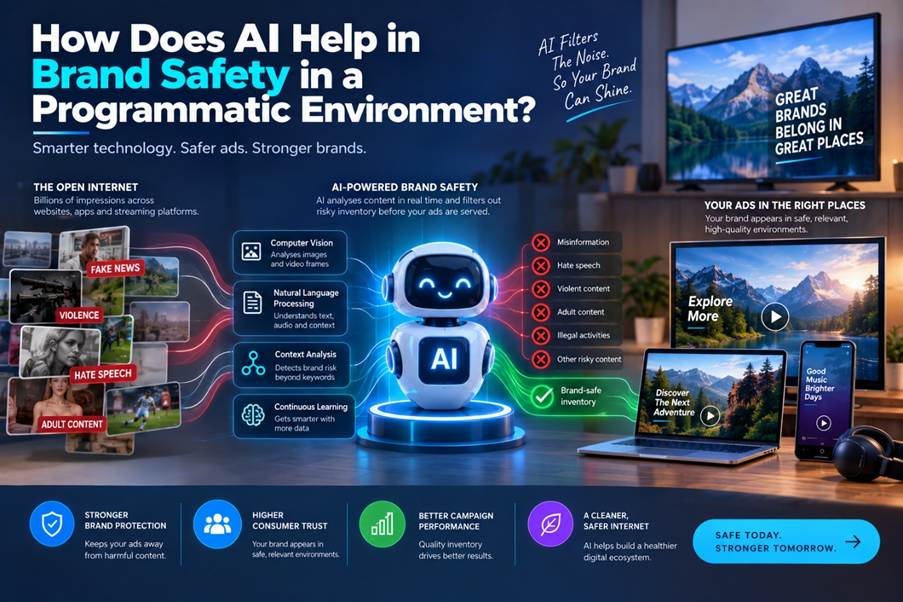
Programmatic advertising allows brands to reach large audiences across websites, apps, video platforms, CTV, and other digital channels. However, with millions of ad impressions being processed automatically, it can be difficult to manually check every environment where an ad may appear.
This is where Artificial Intelligence (AI) plays an important role in brand safety.
AI can analyse large volumes of content in real time, identify potential risks, and help advertisers decide whether an ad placement is appropriate before the impression is purchased.
How Does AI Support Brand Safety?
In a programmatic environment, AI can analyse different signals associated with an ad opportunity and determine whether the placement meets the advertiser’s brand safety requirements. A simplified process looks like this Content à AI Analysis à Risk Assessment à Brand Safety Decision à Ad Auction
If the environment is considered suitable, the impression can continue through the buying process. If it presents a significant brand safety risk, it can be excluded. Because programmatic auctions happen within milliseconds, AI helps perform these checks at a scale and speed that would not be possible through manual review.
1. Understanding Content Context
One of the biggest advantages of AI is its ability to understand the context of content. Traditional keyword-based systems may block a page simply because it contains a sensitive word. AI-based systems can look at the surrounding content and determine what the topic actually means. For example, an article may contain the word “violence” while reporting on a news event.
That does not necessarily mean the content is promoting violence or is unsuitable for every advertiser. AI can analyse the broader context and make a more informed assessment. This helps advertisers avoid both unsafe placements and unnecessary blocking.
2. Detecting Sensitive Content
AI can identify content related to categories that advertisers may want to avoid, such as
Hate speech
Violence
Adult content
Extremist content
Illegal activities
Misinformation
Sensitive news events
Instead of manually reviewing individual pages, AI can classify content automatically and apply the advertiser’s predefined safety rules. This is particularly useful for campaigns running across a large number of websites and apps.
3. Analysing Images and Video
Brand safety is no longer limited to written content. Advertising campaigns increasingly run across online video, CTV, social platforms, and image-heavy environments. AI can analyse visual and video content to identify potentially unsuitable material. For example, AI-powered systems can examine frames, scenes, objects, and other visual signals to identify content that may not be appropriate for a particular brand. This provides an additional layer of protection beyond analysing page text alone.
4. Detecting Changes in Content
Digital content can change quickly. A website that was considered suitable earlier may later publish sensitive or controversial material. AI can continuously analyse content and identify these changes. This is particularly valuable for,
Breaking news
User-generated content
Live content
Video platforms
Frequently updated websites
Instead of depending only on an old classification, AI can help provide a more current assessment of the environment.
5. Identifying Low-Quality and Risky Environments
AI can also help identify patterns associated with low-quality or potentially risky inventory. It can analyse signals such as
Website and app behaviour
Content quality
Unusual traffic patterns
Publisher characteristics
Historical signals
Other contextual information
This can help advertisers reduce exposure to environments that may create brand or media-quality concerns. However, brand safety and ad fraud or invalid traffic detection are separate areas, even though they can complement each other within a broader advertising quality strategy.
6. Improving Brand Suitability
AI can help advertisers move beyond a simple “safe” or “unsafe” decision. Different brands have different levels of tolerance for sensitive content. A news publisher may be comfortable advertising around certain topics, while a children’s brand may want to avoid them completely. AI can help classify content based on different levels of suitability, allowing advertisers to create rules that better match their brand values and audience. This gives advertisers more control without unnecessarily limiting campaign reach.
Why AI Is Important in Programmatic Advertising
The scale of programmatic advertising makes AI particularly useful. An advertiser may have thousands of websites, apps, videos, and other environments available for a campaign. Reviewing each one manually is not practical. AI can process these environments automatically and help make decisions at the speed required for programmatic buying. Its key advantages include
Speed: Analyses content within the programmatic buying process.
Scale: Can evaluate large volumes of impressions.
Context: Looks beyond individual keywords.
Adaptability: Can respond to changing content.
Precision: Helps reduce unnecessary exclusions.
Is AI Enough for Brand Safety?
AI is a powerful tool, but it should not be the only layer of protection. Advertisers should combine AI with
Clear brand safety guidelines
Blocklists and allowlists
Content and category exclusions
Trusted publishers and inventory sources
Regular campaign monitoring
Human oversight where necessary
AI can make the process faster and more scalable, but the final brand safety strategy should still be based on the advertiser’s specific requirements.
Final Thoughts
AI is making brand safety more intelligent and scalable in programmatic advertising. Instead of relying only on basic keyword blocking, AI can analyse context, text, images, video, and other signals to determine whether an advertising environment is appropriate. This helps advertisers reduce the risk of harmful placements while also avoiding unnecessary restrictions that can limit campaign reach.
As programmatic advertising continues to expand across video, CTV, apps, audio, and other digital environments, AI will become an increasingly important layer in helping brands protect their reputation while reaching the right audiences at scale.
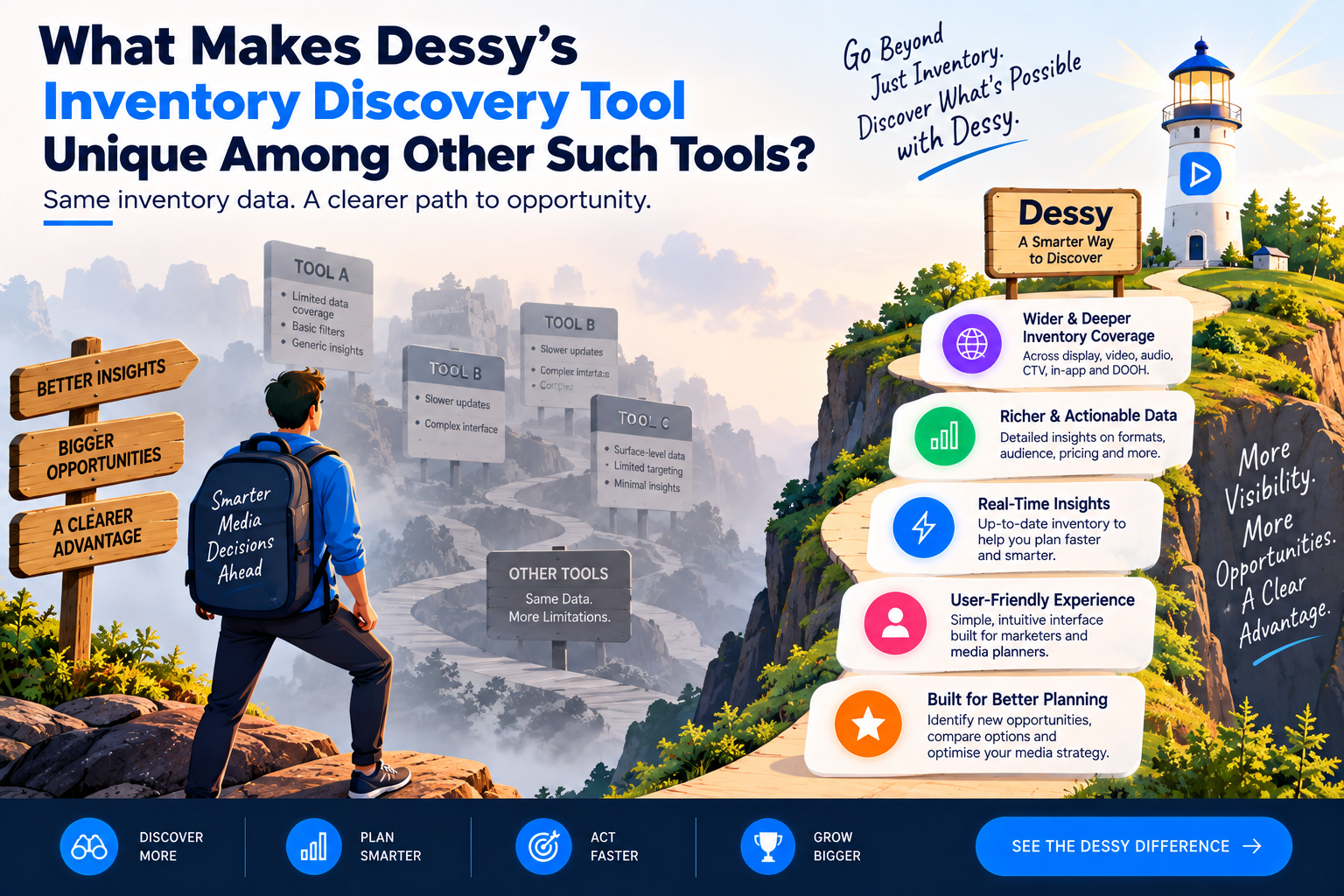
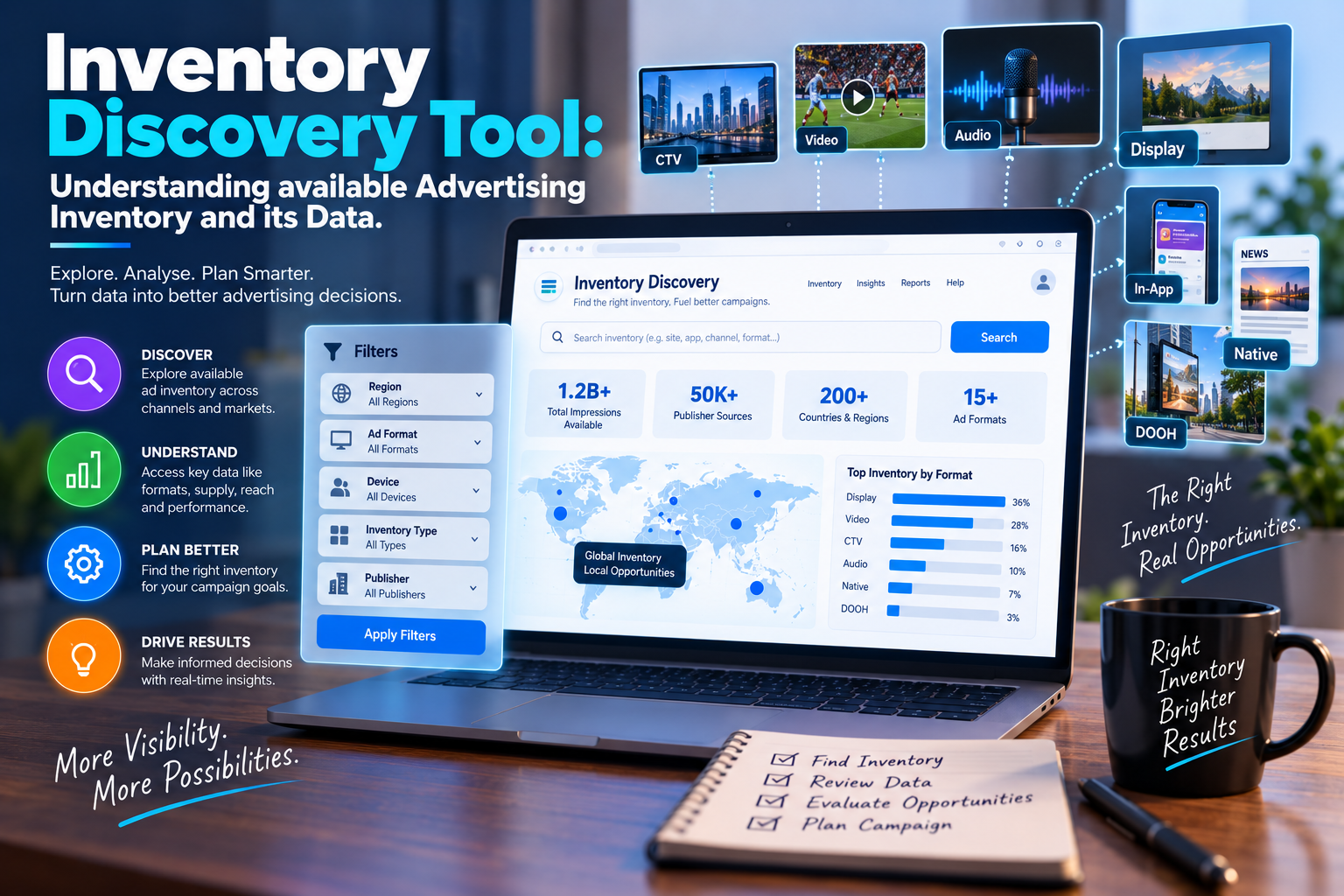
Media planning has become even more data-intensive than ever before. Advertisers are purchasing media inventories on websites, applications, connected television, out-of-home media, and other media formats. Therefore, the task of searching for media inventory is not easy. Media planners must know where and how they can place their ads, what audience they can reach via such placement, and if the inventory source meets their campaign requirements. Here comes the role of the inventory discovery tools. Not all such tools provide enough transparency and usability. The DESSY’s Inventory Discovery Tool is meant to change it.
What Is an Inventory Discovery Tool?
Inventory discovery tool is designed to assist media planners to discover and assess the available inventory prior to running their campaigns.
Depending on the particular tool used, planners will have access to various pieces of information on available inventory like: inventory type, publisher, ad formats, device, geography, demographic information, etc. The main objective here is to allow media planners to make more informed decisions regarding their inventory choice before investing money in a specific campaign.
How Is DESSY’s Inventory Discovery Tool Unique?
1. More Structured Inventory Research With the help of DESSY’s Inventory Discovery Tool, one gets access to the structured inventory data, enabling media planners to filter out possible opportunities using certain criteria. In this way, it is not necessary to manually go through all the spreadsheets, websites, and sources while researching inventory.
2. Improved Visibility Before Campaign Activation One of the problems that media planners might face is a lack of visibility with regard to the available inventory before finalizing the campaign plan. The inventory discovery tool allows one to have insight into the potential placements and inventory properties before activation of the campaign. For instance, if a planner is building up a mobile campaign, the media planner would like to know something about the mobile inventory, its formats, the list of the publishers and other properties.
3. Facilitates Comparison of Opportunities for Media Planners Having discovered one suitable source of inventory is good but finding out which among several inventory sources would fit better is what media planning is all about. DESSY’s data would help in this by enabling planners to examine several opportunities for inventory using inventory attributes related to those opportunities. This is done without having to consider every opportunity individually since all necessary data will be available. It will come in handy if a campaign has different requirements such as particular devices, ads, geographies or media environments.
4. Saves Manual Labor Inventory research is known to require much labour on the part of media planners. A planner has to go through different websites, collect data, put it into spreadsheets and then make comparisons. That is time-consuming and may lead to inconsistencies. Incorporation of inventory discovery process into the tool allows for saving some time.
5. Enables Informed Decisions About Media The good discovery tool should be able to answer the following questions:
What inventory exists?
Where will the campaign run?
What type of ads is supported?
What devices/environments are available?
What inventory options fit campaign’s needs?
How can those opportunities be compared?
It is in such a context that the Inventory Discovery Tool by DESSY was designed, to bring those questions into the planning process so that users could make their decisions based on available inventory information.
Importance of Inventory Discovery for Modern Media Planning
Since digital marketing has become more fragmented, media planners have increased options when choosing an inventory. Although multiple choices could be an advantage, such a situation complicates the planning process. With the help of inventory discovery tools, media planners get an opportunity to facilitate the inventory exploration process.
The goal of DESSY’s Inventory Discovery Tool is to make inventory exploration process more manageable for media planners discovering, exploring, comparing, and understanding inventory prior to campaign execution.
Conclusion
Inventory discovery has become an integral component of modern media planning. Whereas many tools can provide information on inventory, the actual value of the tool is its applicability in the context of planning.
DESSY’s Inventory Discovery Tool is developed based on the needs of media planners helping them with structured inventory exploration, increased visibility, comparison, and minimized manual research efforts. In other words, for media planners, inventory research will be not only a search through different information sources but also discovery of opportunities for a campaign and their efficient evaluation.
Digital out-of-home (DOOH) advertising is changing the way brands connect with consumers in the physical world.
Instead of relying only on traditional billboards, advertisers can now use digital screens across locations such as city streets, airports, shopping centers, subway stations, retail stores, and other high-traffic environments.
The growth of programmatic DOOH has made this even more flexible. Advertisers can use programmatic technology to buy digital screen inventory, manage campaigns across multiple locations, and make adjustments based on available data and campaign performance.
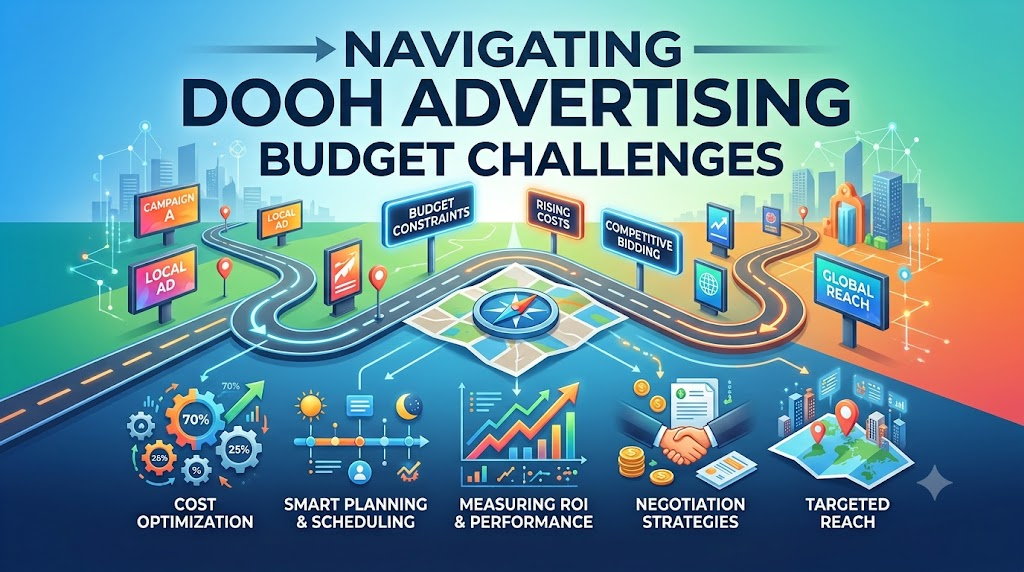
However, budget is still one of the biggest concerns for advertisers considering DOOH.
Premium locations can be expensive, measurement can be more complex than digital channels, and advertisers may not always know which screens will provide the best value.
The good news is that DOOH doesn’t always require a large budget.
By choosing the right locations, pricing model, campaign timing, and buying strategy, advertisers can make their DOOH investment more efficient.
What Factors Affect DOOH Advertising Costs?
There isn’t one fixed price for DOOH advertising. The cost of a campaign can vary significantly depending on several factors, including:
Location
Audience and traffic volume
Screen size and type
Campaign duration
Time of day
Seasonality
Demand for the inventory
Buying method
Understanding these factors can help advertisers make better decisions when planning their DOOH budgets.
Location and Traffic Volume
Location is one of the biggest factors affecting DOOH pricing. Screens in busy city centers, major highways, airports, train stations, and other high-traffic locations generally cost more because they can provide greater exposure.
For example, a large digital billboard in a major city center will typically cost more than a smaller screen inside a suburban retail location. However, the most expensive location isn’t necessarily the best option for every campaign.
A smaller screen in a highly relevant location may deliver better value if it reaches the right audience.
Audience and Demographics
The audience associated with a location can also influence its value. Screens located in business districts, shopping areas, affluent neighborhoods, or other areas with a desirable audience may command higher prices.
Advertisers should therefore look beyond the number of people who may see an advertisement.
The more important question is – Are the people seeing the advertisement relevant to the campaign?
A lower-cost placement that reaches the right audience can sometimes provide better value than an expensive placement with a much larger but less relevant audience.
Screen Size and Type
The type and size of the screen also affect pricing. Large digital billboards and high-impact displays usually cost more than smaller screens in places such as,
Subway stations
Retail stores
Gas stations
Shopping centers
Office buildings
Large-format screens can provide strong visual impact, while smaller screens can offer more targeted exposure in specific environments. The right choice depends on the campaign objective.
Campaign Duration and Timing
How long a campaign runs can also affect its overall cost. Longer campaigns may provide better efficiency depending on the inventory and pricing arrangement.
Timing matters as well. For example, advertising during:
Morning and evening commuting hours
Major sporting events
Holidays
Shopping seasons
Large local events
may cost more because demand for advertising inventory can increase during these periods.
Seasonality
DOOH pricing can also change depending on the time of year. Demand may increase around major shopping periods, holidays, sporting events, festivals, and other important events.
Seasonality can also vary by industry. For example, travel-related advertising may have stronger demand during popular travel periods, while retail advertising may become more competitive during major shopping seasons.
Planning campaigns in advance can help advertisers manage these fluctuations.
DOOH Advertising Pricing Models
Advertisers can purchase DOOH inventory using different pricing models. Three common approaches are:
CPM-based pricing
Flat-rate pricing
Auction-based pricing
The right model depends on the campaign’s goals, budget, inventory, and buying method.
1. CPM-Based Pricing
With CPM (cost per thousand impressions) pricing, advertisers pay based on the number of impressions delivered.
For example, if the CPM is $10, the advertiser pays $10 for every 1,000 impressions.
CPM pricing can make it easier to compare inventory and manage campaigns based on expected exposure.
Pros and Cons of CPM Pricing
Pros
Cons
Costs are connected to the number of impressions delivered.
The number of impressions does not automatically mean the audience is highly relevant.
Can work for both smaller and larger campaigns.
Final costs can vary if impression delivery changes.
Makes it easier to compare different inventory options.
Impression estimates and measurement methods can vary between providers.
Can provide a scalable approach to campaign planning.
A low CPM does not always mean better campaign performance.
2. Flat-Rate Pricing
With flat-rate pricing, an advertiser pays a fixed amount to display an advertisement for a specific period. This approach is common for premium or high-visibility placements where advertisers want guaranteed access to a particular location or screen.
For example, an advertiser may pay a fixed amount to run an advertisement on a specific digital billboard for a defined period.
Pros and Cons of Flat-Rate Pricing
Pros
Cons
Advertisers know the cost before the campaign begins.
The advertiser pays the agreed rate even if actual exposure varies.
Makes budgeting easier.
Premium locations can be expensive.
Useful when a specific screen or location is important to the campaign.
It can be less flexible than impression-based buying.
Straightforward for advertisers who want a fixed placement.
Comparing value across different placements can be more difficult.
3. Auction-Based Pricing
Auction-based pricing allows advertisers to compete for available advertising opportunities through a bidding process. This approach is commonly associated with programmatic DOOH.
Instead of paying a fixed amount for a particular placement, advertisers can bid based on campaign requirements, available inventory, and market demand.
Pros and Cons of Auction-Based Pricing
Pros
Cons
Can provide more flexibility in how budgets are allocated.
Prices can increase when demand is high.
Advertisers can adjust campaigns based on available performance data and inventory.
Final costs can be less predictable.
Can provide access to a wider range of inventory.
Smaller budgets may have difficulty competing for highly sought-after inventory.
Can support more data-driven campaign buying.
Buying and optimization can require a better understanding of programmatic technology.
Which DOOH Pricing Model Is Best?
There isn’t a single pricing model that works for every campaign.
CPM pricing may be suitable when:
You want to manage spending based on impressions.
You need a scalable campaign.
You want to compare inventory using a common cost metric.
Flat-rate pricing may be suitable when:
A particular location is strategically important.
You want predictable upfront costs.
You want guaranteed access to a specific placement.
Auction-based pricing may be suitable when:
You want greater flexibility.
You are using programmatic DOOH.
You want to adjust buying based on demand and available inventory.
The most important thing is to compare value, not just price. A cheaper screen isn’t necessarily better if it reaches fewer relevant people.
How Much Does DOOH Advertising Cost?
DOOH pricing can vary significantly by market, inventory type, location, audience, campaign timing, and buying model. Because of this, there is no universal DOOH rate that applies to every campaign.
CPM can be useful as a benchmark when comparing different inventory options, but advertisers should also consider:
Estimated reach
Audience relevance
Location quality
Screen visibility
Frequency
Campaign duration
Time of day
Inventory availability
Measurement capabilities
For example, a premium digital billboard may have a higher CPM but provide exceptional visibility. A smaller screen in a retail environment may have a lower CPM but reach consumers closer to the point of purchase.
The best investment depends on what the campaign is trying to achieve.
Common Budget Challenges in DOOH Advertising
Although DOOH offers flexibility, advertisers can still face several budget challenges.
1. The Perception That DOOH Is Expensive
Large digital billboards in premium locations can create the impression that DOOH is only suitable for brands with large advertising budgets. That’s not necessarily the case.
DOOH inventory is available across different screen sizes, locations, and price points. Advertisers can start with smaller or more targeted placements and expand the campaign based on results.
The key is to select inventory based on audience relevance and campaign objectives, rather than choosing the most expensive screen available.
2. Measuring ROI Can Be More Complex
Measuring the impact of OOH advertising has traditionally been more difficult than measuring digital channels.
A display or search campaign can often be connected directly to online actions. OOH happens in the physical world, so connecting an advertisement to a specific consumer action can be more challenging.
However, measurement capabilities have improved significantly. Depending on the campaign and available data, advertisers can now evaluate:
Reach
Frequency
Foot traffic
Brand lift
Sales lift
Online activity
Other attribution measures
Advertisers should define their measurement approach before launching the campaign so they know what success looks like.
3. Competition With Other Marketing Channels
Marketing budgets are often divided across many channels. Advertisers may need to decide how much to invest in:
Search
Social
Display
Video
CTV
Audio
OOH
DOOH
Channels with direct conversion tracking can sometimes appear more attractive because their results are easier to measure.
However, DOOH can play an important role in building awareness and reaching audiences in the physical world.
The right approach is to evaluate DOOH based on how it contributes to the overall marketing strategy, rather than expecting every channel to deliver the same type of result.
4. Seasonal Budget Changes
DOOH costs can increase when demand for inventory is high. This can happen around:
Holidays
Major sporting events
Festivals
Large conferences
Shopping seasons
Local events
Advertisers should account for these periods when planning their annual media budgets. Booking early and being flexible about locations and timing can help manage costs.
5. Limited Flexibility in Traditional Buying
Traditional OOH buying can involve fixed placements and longer commitments. Once a static advertisement is installed, changing the creative requires a physical replacement.
Programmatic DOOH provides more flexibility because digital inventory can be managed through technology and, where supported, campaigns can be adjusted based on available data and inventory.
This makes programmatic DOOH particularly useful for advertisers who want to change budgets, timing, locations, or creative during a campaign.
Strategies to Overcome DOOH Budget Constraints
A limited budget doesn’t necessarily mean DOOH is out of reach. Here are some practical ways advertisers can make their budget work harder.
1. Educate Stakeholders
Before asking for more budget, explain what DOOH can actually deliver. Show stakeholders how different screen types and locations provide different levels of reach, relevance, and cost.
Instead of focusing only on premium billboards, demonstrate the range of available inventory. This can make it easier to create a realistic test budget.
2. Focus on Relevant Placements
Don’t choose a location simply because it has a large number of impressions. Consider whether the people passing through that location match your target audience.
For example, a B2B company may benefit more from screens near business districts or conference venues than from a high-traffic location with little relevance to its audience.
Likewise, a retail brand may prioritize screens near stores or shopping areas. Relevance can be more valuable than scale alone.
3. Use Programmatic DOOH to Improve Budget Efficiency
Programmatic DOOH can make campaign management more flexible. Depending on the platform and inventory, advertisers can manage multiple placements through a centralized buying process and adjust campaign parameters based on available data.
This can help reduce manual work and make it easier to manage budgets across different locations.
Programmatic buying can also make it easier to test different placements before committing more budget to the strongest-performing areas.
4. Combine Traditional OOH and DOOH
Advertisers don’t have to choose between traditional OOH and digital OOH. A hybrid strategy can use both. For example:
Traditional OOH: Provide consistent visibility through static billboards.
DOOH: Add dynamic messaging and flexible digital placements.
This approach can help balance reach, creative flexibility, and budget.
5. Use Day-Parting
Day-parting means showing advertisements during specific times of the day. For example, a brand targeting commuters could concentrate its budget around:
Morning commute
Evening commute
A restaurant could focus on lunch and dinner periods. This allows advertisers to prioritize the times when their target audience is most likely to be present.
Rather than running continuously throughout the day, advertisers can focus their budget on the most relevant time periods where the inventory supports this type of scheduling.
6. Negotiate With Media Owners
For direct OOH purchases, advertisers may be able to negotiate pricing with media owners, especially when planning larger or longer campaigns.
Depending on the media owner, advertisers may be able to negotiate:
Volume discounts
Longer-term rates
Added-value placements
Flexible campaign terms
Additional inventory
This approach is particularly useful when an advertiser has a clear long-term plan or intends to purchase multiple placements.
How Agencies Can Pitch DOOH Advertising to Clients
Agencies introducing DOOH to clients should focus on the business value, rather than presenting it simply as another advertising format.
Clients may have questions about cost, measurement, and whether DOOH can deliver meaningful results.
A clear pitch should address these concerns.
1. Explain What Makes DOOH Different
Start by explaining where DOOH can reach consumers. People see OOH advertising while they are:
Commuting
Shopping
Traveling
Working
Attending events
Visiting public spaces
This allows brands to reach consumers in real-world environments that digital advertising alone cannot fully replicate.
2. Address Cost and ROI Questions
Don’t position DOOH as an expensive premium channel. Instead, explain that there are different types of inventory available at different price points.
Show clients how they can start with a focused campaign and expand based on the results. Where measurement is available, use metrics such as:
Reach
Frequency
Brand lift
Foot traffic
Website activity
Sales lift
This gives clients a clearer way to evaluate the investment.
3. Create Campaigns Around Specific Objectives
A DOOH proposal becomes stronger when it solves a specific marketing problem.
For example:
Product launch: Use high-visibility screens in key markets.
Retail campaign: Use screens near stores to reach consumers closer to purchase.
Event promotion: Advertise around venues and transportation hubs.
B2B campaign: Target locations around business districts and industry events.
The campaign should start with the objective and then determine the appropriate locations and inventory.
4. Use Data and Programmatic Technology
Programmatic DOOH can make campaigns more flexible and data-driven. Depending on the platform, advertisers can use available information to select inventory, manage budgets, adjust campaigns, and evaluate performance.
This can make DOOH easier to integrate into broader programmatic strategies.
5. Position DOOH as Part of an Omnichannel Strategy
DOOH works best when it is not treated as an isolated channel. It can complement:
CTV
Display
Video
Mobile
Audio
Social
Search
For example, a brand could use DOOH to build awareness in a particular location and then use digital channels to continue communicating with the audience.
This creates a more connected experience between physical and digital advertising.
6. Start With a Small Test
If a client is unsure about DOOH, a smaller campaign can be a practical starting point. Instead of immediately investing in premium, high-cost screens, consider testing:
A limited geographic area
A smaller number of screens
A specific audience
A short campaign period
A particular time of day
The goal is to learn what works before increasing the investment. This reduces risk and gives the client real campaign data to use when deciding whether to scale.
Programmatic DOOH: Benefits and Scalability
Programmatic DOOH gives advertisers more flexibility in how they use their budgets. Campaigns can potentially run across different environments, from premium digital billboards to smaller screens in retail locations, transportation hubs, and other high-traffic spaces.
This means advertisers don’t have to put their entire budget into one expensive placement.
They can distribute spending across multiple locations and adjust the campaign based on the available inventory and campaign objectives.
Programmatic technology can also make campaign management more efficient by bringing buying, optimization, and reporting into a more centralized workflow.
The result is a DOOH strategy that can start small and scale as advertisers gain confidence in the channel.
Final Thoughts
DOOH advertising doesn’t have to be an expensive, one-size-fits-all investment. The cost depends on factors such as location, audience, screen type, timing, seasonality, inventory demand, and buying model.
The most important thing is to focus on the value of the placement rather than simply looking for the lowest price.
A premium billboard may be the right choice for a major product launch, while a network of smaller screens may be more effective for a targeted local campaign.
Programmatic DOOH adds another layer of flexibility by helping advertisers manage digital screen inventory, adjust campaigns, and integrate OOH into broader digital strategies.
For advertisers working with limited budgets, the best approach is to start with a clear objective, choose relevant locations, test different inventory, measure what matters, and scale what works.
DOOH is no longer just about buying a billboard.
It is becoming a flexible part of the modern media mix, connecting brands with consumers in the real world while bringing more of the data, automation, and flexibility associated with digital advertising.
Digital-Out-of-Home (DOOH) advertising uses digital screens in places such as streets, shopping malls, airports, and transit stations.
With Artificial Intelligence (AI), DOOH campaign can become smarter and more responsive, AI helps advertisers use data to decide when, where, and what message to show.
What is AI in DOOH?
AI in DOOH uses artificial intelligence to make digital outdoors advertising smarter and more effective.
It analyses real – time data such as location, weather, traffic, time, and audience behaviour. AI can automatically change ad content based on the surrounding environment and audience.
It helps advertisers optimize targeting, budget, frequency, and campaign performance. Overall, AI makes DOOH advertising more dynamic, personalized, efficient, and measurable.
How AI Helps DOOH?
AI can analyse different signals and helps advertisers make better campaign decisions.
Key benefits:
Smarter targeting: Reach relevant audience and locations
Real time optimization: Adjust campaign based on changing conditions.
Better creative: show message that much the situation.
Efficient budget: Focus spending on better opportunities.
Faster decisions: Analyse large amounts of data quickly.
Making DOOH More Dynamic
Using contextual data
AI can use signals such as:
Time of day
Locations
Weather
Traffic
Events
Audience patterns
These signals allow advertisers to change their message based on the environment.
AI + Programmatic DOOH
Programmatic DOOH allows advertisers to buy digital screen inventory using technology. AI can help identify relevant opportunities and optimize campaign based on data.
Set a clear goal Decide whether the campaign is focused on awareness, reach.
Use Relevant Data Use reliable data such as location, time, weather, and audience signals.
Keep creative simple DOOH ads are viewed quickly, use clear visuals, short messages, strong branding, and a simple call to action.
Test and optimize Test diffident locations, creative, message, and time periods to understand what works best.
Measure Performance Important matrices are included
Impression
Reach
Frequency
The Future of AI in DOOH
AI is helping DOOH move from static advertising to dynamic, data – driven advertising.
By combining AI, data, programmatic buying, creative, and measurement, advertisers can deliver more relevant messages and make better use of their media budgets.
Final Takeaway
AI makes DOOH smarter, More flexible, and more relevant, helping brands deliver the right message at the right place and time.
Inventory Discovery Tool: Understanding available Advertising Inventory and its Data
In programmatic advertising, there are a lot of digital advertising inventory that includes web pages, mobile apps, connected TV (CTV), videos, audio and other types of digital platforms that advertisers can work with. Nevertheless, simply having inventory is not enough. Advertisers also need to know how it is possible to reach users through these platforms and what advertising opportunities they may provide.
That is where a tool for inventory discovery comes in handy. It is used by advertisers and media buyers in order to analyse available advertising inventory and get valuable information about it.
What is an Inventory Discovery Tool?
An inventory discovery tool is an advertising system or feature that enables advertisers to search through and analyse the advertising inventory that is currently available. It can be explained simply as a search engine for advertising. Rather than looking through thousands of websites and applications manually, the advertiser is able to use this feature to discover the inventory in accordance with certain criteria.
Depending on the platform used, the inventory discovery tool may enable the user to browse through inventory that is available via the following criteria:
Website or application
Country or location
Device type
Ad format and size
Content Category
Audience
Publisher
Supply Source
Impressions Estimate
The list of criteria will differ depending in the platform, but the core purpose of the tool remains the same.
Why is inventory Discovery Important?
The programmatic ads world has millions of advertising opportunities. Without an inventory discovery tool, it is hard for advertisers to get acquainted with the actual possibilities. Before starting a campaign, an advertiser may want to know
What applications provide this kind of inventory?
What amount of inventory is there?
What locations can be covered?
On which devices and OS is it possible to reach the target audience?
What kind of content is available?
This will help them conduct their media planning process more thoughtfully. Inventory discovery may also allow buyers to learn about some new publishers and sources of supply that they were unaware of before.
What type of Data Could One Obtain from Inventory Discovery?
Publisher inventory Data
Some tools could provide information about the websites where advertising inventory is being offered. The information includes:
Website domain
Name of the mobile app
Publisher’s name
Category of publisher
Supply source
Inventory type
Geographical Information
Geography plays an important role in the planning of campaigns. The discovery of inventory reveals the geographical areas from which inventory comes. Based on the platform, the following geographical data can be obtained:
Country
State/region
City
Market
Language
This makes it easier to find the matching supply to the geographical criteria of the campaign.
Device and Entertainment
Advertising inventory can be found in various devices and environments. The inventory discovery process helps the advertisers learn about the availability of their ads. The following information can be obtained from inventory discovery process:
Desktop
Mobile web
Mobile app
Tablet
Connected TV
Operating system
Browser
Device type
Ad Format and Creative Sizes
It is important for advertisers to know if their creatives can be placed within available inventories. It lists ad formats like:
Display (sizes like: 300×250, 300×600, etc)
Video
Native
Audio
CTV
Rich media
This enables advertisers to know whether their current creatives can be placed, or additional creative sizes will be needed.
Estimated Impression and Inventory Volume
It includes information like
Estimated impressions
Available impressions
Daily inventory volume
Traffic estimates
Historical supply information
It enables buyers to see if there is enough volume. Actual number of impressions may vary depending on such factors as targeting, competition, bidding, budget and frequency.
Content and category details
Common categories in discovery tools are News, sports, entertainment, finance, technology, travel, automotive, gaming, lifestyle. This allows advertisers to identify relevant environments for their campaigns and whether the inventory suits their brans needs.
Audience Details
In addition, some inventory discovery platforms also give the audience details. They can include:
Demographic details
Interests
Affinity categories
Behavioural segments
Reach of the audience
The estimates of the audience do not guarantee that every impression will be delivered to the same audience. This is dependent on the platform, data availability and campaign settings.
Conclusion
Inventory discovery tool assists advertisers in having an enhanced understanding of the programmatic advertising ecosystem. This tool assists advertisers in knowing the source of inventory, what kind of formats and devices the inventory is compatible with. Location and content categories and the total amount of potential inventory that might be available.
With the use of such information prior to initiating a campaign, advertisers will be able to make sound decisions regarding their choices of supply, targeting, creatives and media planning. In the highly complicated programmatic ecosystem, inventory discovery tool offers visibility to convert huge opportunities for advertisements into media planning.
AI and its Role in Programmatic Advertising and RTB
The evolution of programmatic advertising brought a revolution in brand digital advertisement purchases. Now, instead of doing everything manually and trying to choose right places and times for advertising, one may employ different technologies to automatically purchase ad spaces and reach the needed audience. There is one particular aspect of programmatic advertising that is especially important. This is the aspect of real-time bidding (RTB).
So what is RTB? Whenever someone visits the website or opens the application, there is an ad opportunity that triggers an immediate auction. Advertisers use certain algorithms and bidding techniques to determine how much are they ready to pay in order to place their ad on the screen. The whole process occurs in the course of loading the website or application and lasts not longer than a few milliseconds.
As programmatic advertising grows, artificial intelligence starts playing a crucial role in the bidding process as it allows analysing large amounts of data instantly, thus identifying the opportunities and making better bids.
Programmatic Advertising and Real Time Bidding: A Strategic Opportunity
The significance of real-time bidding lies in the ability of the advertiser to understand which impressions they should buy and at what price. Each auction provides the possibility to target a potential consumer. At the same time, the same approach to all auctions can result in the wasted budget, increased costs and inefficient campaign performance.
For instance, one ad impression is more likely to result in the conversion than another. Thus, if the advertiser uses the same approach for both impressions, he or she spends money on consumers who are unlikely to convert. However, AI is capable of handling huge quantities of data and making bidding decisions much faster than any human team. Unlike humans who only react to the changes taking place, AI can use past and current data to anticipate which impressions will perform better.
Such technology can be beneficial to advertisers for optimising budget spending and increasing campaign efficiency.
Why is AI a Game Changer in Programmatic Bidding?
Programmatic buying includes hundreds of thousands or millions of auctions contains different data about the user, the device, the site, location, time, ad placement, etc. The main difference between AI and manual processing of the signals is that AI not only takes into account different criteria but can also predict which of the impressions will help you reach the goals of your campaign – purchases, registrations, visits, etc. AI can respond right away to any changes in the circumstances – if the cost of the inventory goes up or some audiences shoe themselves to be more effective.
Some of the benefits of using AI in programmatic bidding are:
Improved optimisation: AI will be able to recognise which impressions have higher potential for delivering quality outcomes.
Decision making in Real-Time: The AI system will be able to change bids based on user behaviour and competitive activity.
Optimised budget spend: the budget could be allocated more efficiently to the successful target audience, media types or creative formats.
High speed and efficiency: AI is capable of making decisions in real-time, involving thousands of auctions simultaneously.
In case of advertiser, all these advantages mean that there would be lower wastage and improved ROAS and CAC performance.
How AI Helps Improve the Outcomes of Real-Time Bidding
Optimal programmatic bidding is achieved through finding the perfect balance between winning the impression and bidding for it at an affordable price. If the price is too low, then the advertiser loses some of the impressions. If it is too high, then although the advertiser wins the impression, money is wasted.
With the use of AI, it is possible to find the perfect balance due to the analysis of numerous factors before placing the bid. Here are the areas where AI can make difference:
Improved budget utilisation: With the use of AI, advertisers can analyse their previous and current auctions can enter the competition without spending more than necessary.
Better target audiences: AI can analyse factors like user behaviour, device used, geographical location, time of the day and more in order to find more responsive users.
Improved cross channel utilisation: AI can help advertisers control their campaigns on various channels such as display, video, CTV, audio and DOOH, thus optimising the budget on more effective ones.
It becomes possible to use data-based techniques for advertising. In addition to using certain fixed principles or decision-making, it will become possible to learn from campaigns and modify one’s strategy.
Future-Proofing your Bidding Strategy in a Post-Cookie Era
The digital marketing industry has been shifting towards a more privacy-oriented landscape. The use of third-party cookies in such an industry becomes limited or obsolete in some cases, which requires advertisers to develop other strategies to understand the audience and perform effective bidding. AI can assist advertisers in working with alternative sources of information and minimizing reliance on personal identifiers.
One of such strategies is contextual targeting. Advertisers may not target an individual on the basis of their browsing activity but rather analyse the web page they are currently visiting. To put it into practice, the ad for running shoes could be shown in conjunction with an article on fitness or running. Using AI, it is possible to analyse the contents and context of the page to see if it relates to the message of the ad. In addition, AI can assist advertisers in leveraging first party data. First-party data can mean the data that a company itself collects through its websites, customer databases or mobile applications. When such data is combined with machine learning, advertisers are better aware of their audience and bid intelligently.
However, while using audience data, advertisers have to take into account the issues related to privacy and consent. Thus, the development of programmatic ad is likely to depend on striking a proper balance between personalisation, performance and privacy concerns.
Preparing a Future Ready Programmatic Marketing Team
While AI revolutionizes the technology underlying programmatic advertising, people continue to play an important role in the process. Marketing teams should be trained on how the AI functions and how the findings of AI can be leveraged in the process of making the marketing campaign decisions. It means that collaboration of media planner, data analysts, marketers and creatives can become an even more important aspect.
In addition, AI does not have to take the place of human decision-making. On the contrary, AI can assist marketers more efficiently by process large amount of data and spotting patterns that can be hard to detect manually. For example, AI might identify some audience or time slot that shows a better performance. The marketer will be able to leverage that information to make large-scale strategy decisions.
The choice of appropriate technology also matters. Marketers should select appropriate programmatic platforms and data solutions that guarantee transparency, flexibility and insights into performance. Lastly, advertisers must develop a feedback loop. The information gathered through conversations. Engagement and customer lifetime value will help them in their future decision-making process. The more effective use of campaign data, the better understanding of their campaigns advertisers will have.
AI vs Humans: Is AI Taking over Advertising?
Advertising is becoming more advanced due to AI usage, but that doesn’t mean people are no longer needed. AI is great at analysing data, spotting patterns and making quick decisions. People are still needed to think strategically, be creative, understand customers, develop a message and make critical decisions. The most efficient advertising strategy will probably involve both of these things.
Next Era of Programmatic Advertising
With AI in play, programmatic advertising and real-time bidding are getting smarter and faster then ever before. Form choosing what to bid on impressions to selecting target audiences, AI can assist advertisers in optimising their budgets and improving their campaigns. Meanwhile, the industry is shifting towards being more privacy friendly. For this reason, it is becoming important for advertisers to have strategies that work well with less of the usual identifiers but still enable them to deliver effectives advertising. Programmatic advertising of the future will not only be about automated ad buying. It will be about making smart use of technology combined with human expertise.