
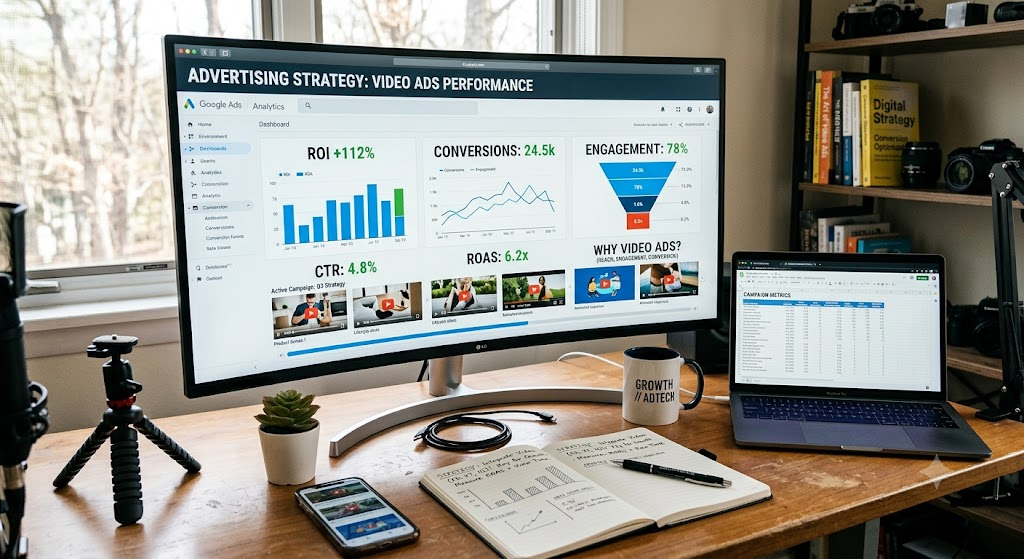
Why You Need Video Ads in Your Advertising Strategy

Today, Videos are everywhere. We watch them on YouTube, Instagram, Facebook, website, mobile apps and even while shopping online. Because people naturally enjoy watching and listening to stories, video ads can be a powerful way for businesses to introduce their products and connect with customers.

What Are Video Ads?

Video ads are advertisement that use moving images, text, sound, animations or a combination of these to promote a product, service or brand.

Why Are Video Ads Important?

Video can combine picture, movements, words music, and storytelling in one advertisement. This makes them more interesting and easier to remember. A good video ad can help your business:

  • Get people attention
  • Make your brand memorable
  • Explain a product or service quickly
  • Build trust with potential customers
  • Encourage people to visit your website
  • Generate leads and sales
  • Connect with customers emotionally

How to Create a Great Video Ad.

Creating a good video does not necessarily mean spending a lot of money. Here are some important things to remember.

  1. Keep Your Video Short People have limited attention spans, especially when they are scrolling through social media. A long advertisement may cause people to skip or ignore it. Short videos are especially useful when you want to quickly introduce a product, highlight a benefit or encourage someone to take action.
  2. Grab attention in the First Few Seconds. The beginning of your video extremely important. People can scroll away from your advertisement within seconds. So do not spend the first 5-10 mins slowly introducing your company
  3. Use Captions Many people watch videos with the sound turned off, especially when they are in public places or scrolling through social media so closed captions and on-screen text are important.
  4. Do not forget the Call to Action A video advertisement should usually tell viewers what to do next. This is called Call to Action (CTA) Examples:
    • Shop Now
    • Book Now
    • Order Today
    • Learn More
    • Sign UP

What If You Do not have a Video

You do not always need professional video footage to create a video advertisement. If you already have images, product photos, banners or graphics you can turn those assets into a video.

Establish the Right Goal for your Video Ad

Before creating a video ad, you need to decide what you want the advertisement to achieve Your goal could be:

  • Making more people aware of your brand
  • Introducing a new product
  • Getting people to visit your website
  • Getting more app downloads
  • Increasing product sale
  • Encouraging people to sign up for a service

Conclusion

Video advertising is a powerful way for businesses to connect with their audience build brand awareness and increase customer engagement. Unlike traditional ads, video can combine svisuals, text, sound and storytelling to communicate a message quickly and effective.
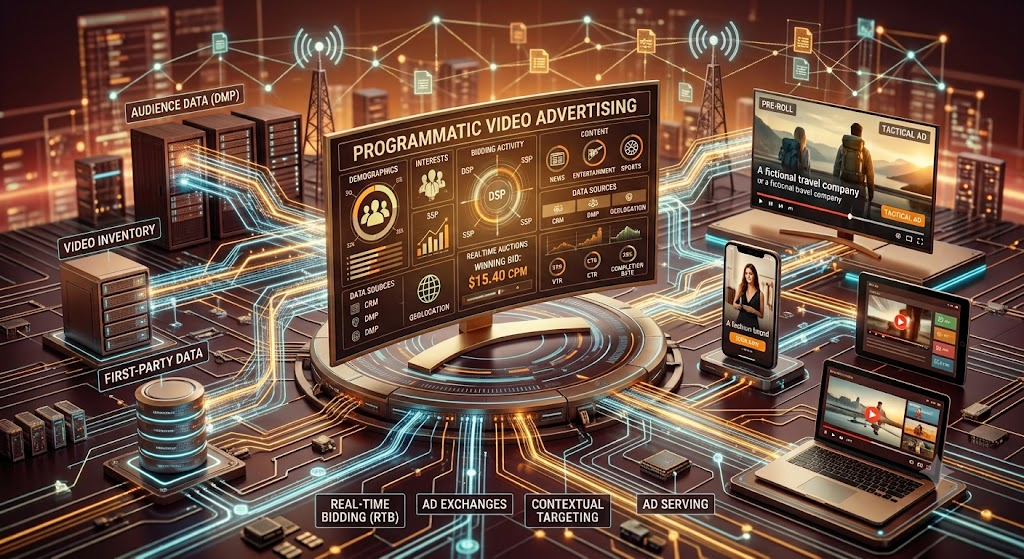

Programmatic Video Advertising

Programmatic Video Advertising:

Programmatic Video Advertising uses technology and data to automatically find the right audience and show them the right video advertisement. It is becoming an important part of digital advertising because people spend a large amount of time watching videos on smartphones, websites, streaming services, apps and other digital platforms.

How It Is Different from Traditional Advertising?

In traditional advertising, a company might contact a publisher or media company and purchase advertising space directly. In programmatic advertising automatically evaluates available advertising opportunities and decides where an advertisement should appear based on the advertiser goal and targeting settings. Video is powerful because people can see and hear a message instead of simply reading it.

Benefits of Programmatic Video Advertising

  1. Reach the Right Audience. One of the biggest advantages is targeting Businesses do not necessarily want to advertise to everyone. They want to reach people who are more likely to become customers. Depending on factors such as:
    • Age group
    • Location
    • Interests
    • Online behavior
    • Device
    • Content preferences
  2. Save Time Traditional advertising can involve a lot of manual work Advertisers may need to communicate with different publishers, negotiate advertising space, arrange campaigns, and manage placements. In programmatic, Advertiser can set their campaigns goals, budget, audience, and other requirements through a platform, and the technology handles much of the buying process.
  3. Make Better Use of Your Budget Programmatic advertising can help advertisers control how much they spend. System can use that budget according to the campaign settings and available advertising opportunity.
  4. Measure Results Another important advantage is measurement. They can look the things such as:
    • How many people saw the advertisement
    • How many people watched the video
    • How many watched the entire video
    • How many clicked on the advertisement
    • How many people completed the desired actions
    This information helps marketers understand what is working and what needs to be improved
  5. Use the Same Video in Different Places A company may create one video and use it across several advertising channels. For Example, the same video could potentially be adapted for:
    • Websites/ applications
    • Connected TV
    • Online video platforms
    • Digital billboards
    • Display advertising

Types of Programmatic Video Ads

  1. In-stream Video Ads These are the video ads you commonly see before, during, and after another video.
    • Advertisements that appear before a video are called pre-roll ad
    • Advertisements that appear during a video are called Mid-roll ad
    • Advertisements that appear after a video are called post-roll ad
  2. Native ads Native ads are designed to fit naturally into the website or app where they appear. Instead of looking like a large, separate advertisement, they are designed to match the surrounding content.
  3. Interstitial ads Interstitial ads are usually full-screen advertisements.
  4. Outstream Video Ads Video advertisements that play automatically in non-video environment, such as within written articles, social media feeds or standard banner spaces.

Conclusion

Programmatic video advertising helps businesses connect with the right audience at the right time with the right message, making it a valuable part of a modern advertising strategy.

Video Marketing Metrics: A simple Guide

How to measure and improve video advertising performance

Video advertising is a powerful way for brands to reach audience and tell their stories. But running video campaign is only the first step. To understand whether an ad is working, advertisers need to track the right Performance metrics.

Video marketing metrics helps advertisers understand views, engagement, completion, visibility, click, and conversions. By looking at these numbers together, advertisers can identify what is working and make better campaign decisions.

Why Are Video Metrics Important

Video matrices help advertisers

  • Understand how many people viewed the ad.
  • Measure how long viewers watched the video.
  • Check whether user completed the video.
  • Measure engagement and interaction
  • Monitor campaign efficiency and cost.
  • Optimize campaign for better results.

Keys video Marketing Metrics

  1. Impression Impressions show how many times your video ad was served to users. For example, if your ad was served 10,000 times, the campaign received 10,000 impressions.
  2. Video Starts Video starts show how many times users started watching your video. This helps you understand how many ad impression resulted in an actual video play.
  3. Video completion Rate (VCR) Video completion rate or VCR shows the percentage of video starts the reached the end of the video. Formula: VCR= Completed View / Video starts * 100
  4. Viewability Viewability measures whether the video ad was visible to the user according to the measurement standard being used. Higher viewability means more users had an opportunity to see the ad.
  5. Click-through Rate (CTR) CTR measure the percentage of impressions that resulted in a click. It can helps show whether the ad encourage users to take an action. Formula: CTR = Clicks / Impression * 100
  6. Cost per view (CPV) CPV tells advertisers how much they spend for each video view. It is useful for understanding the cost of generating video engagement. Formula: CPV = Total Spend / Total Video Views
  7. Conversions Conversions measures actions users take after interacting with an ad. Depending on the campaign, a conversion could be purchase from submission, sign-up, app download, or another valuable actions.

How To Read These Metrics Together

One metric does not tell the whole story. Reviewing several metrics together gives a clearer view of campaign performance.

  • High VCR + High viewability: The video is being seen and watched by a strong percentage of viewers.
  • High CTR + Low conversions: Users are interested enough to click, but the landing page, offers, or next step may need improvement.
  • Low VCR: Consider testing a shorter video, a strong opening, or a different creative.
  • High Impressions + Low Viewability: The ad may be served frequency, but fewer user may have a meaningful opportunity to see it.

Tips For Improving Video Campaign Performance

  • Keep the message clear and engaging from the beginning.
  • Test different video lengths and creative versions.
  • Monitor VCR and viewability to understand whether user is watching.
  • Use CTR and conversions to measure user actions.
  • Review cost matrices such as CPV to manage campaign efficiency.
  • Optimize targeting and creative based on campaign results.

Final Thoughts

Video marketing metrics make it easier to understand how a video campaign is performing. By monitoring impressions, video starts, VCR, viewability, CTR, CPV, and conversions, advertisers can make informed decisions and improve campaign performance.

The key is simple: measure the right metrics, understand what they tell you, and use those insights to improve your campaign.