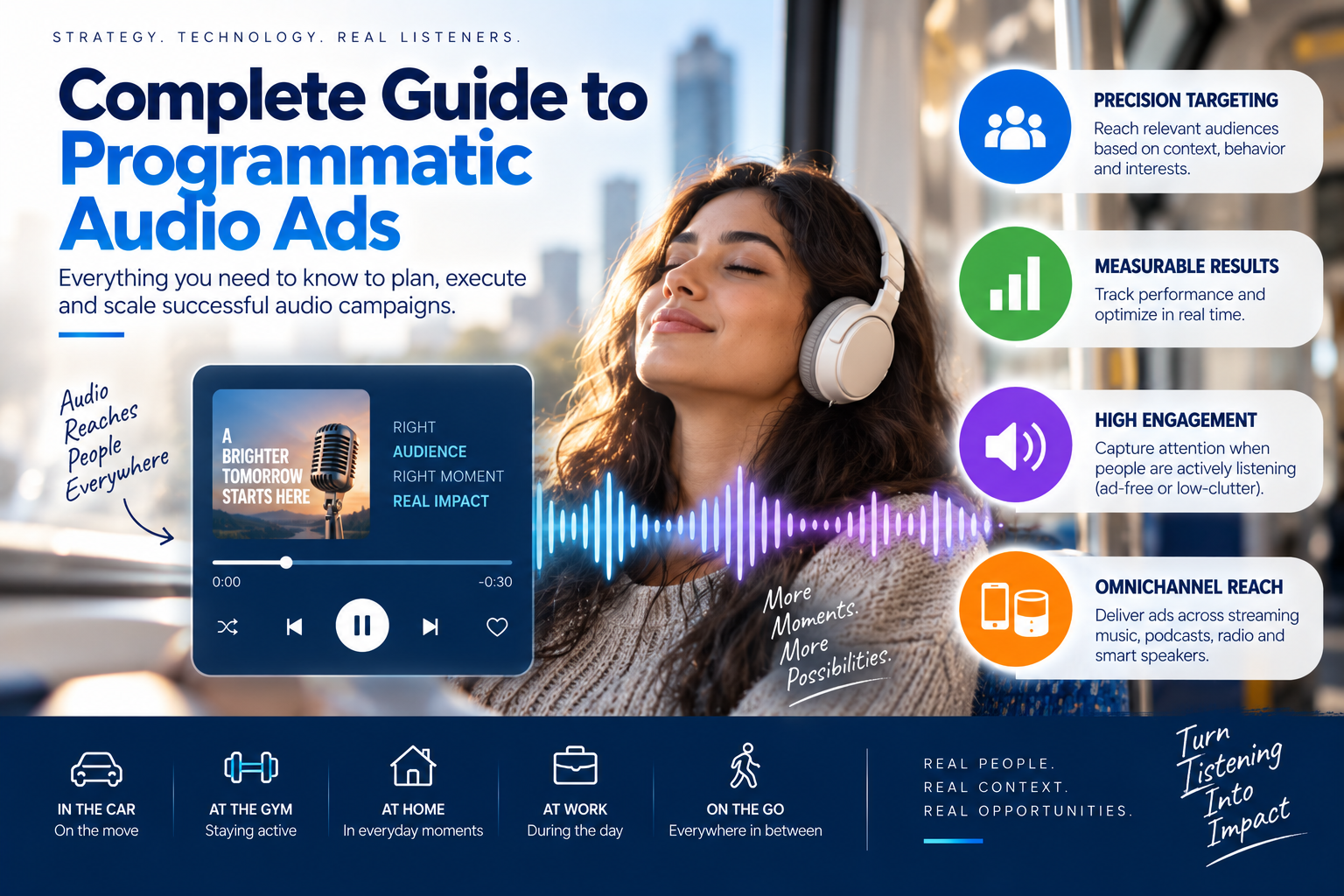
Complete Guide to Programmatic Audio Ads

Audio has become an important part of the digital media experience.

People listen to music, podcasts, digital radio, audiobooks, and other audio content throughout the day. Unlike many digital formats, audio doesn’t always require someone’s eyes to be on a screen.

This creates a valuable opportunity for advertisers.

Programmatic audio advertising allows brands to use automated advertising technology to buy audio ad inventory and reach relevant audiences across digital listening environments.

Instead of manually purchasing individual audio placements, advertisers can use programmatic technology to automate the buying process and apply available audience, contextual, geographic, and other targeting signals.

This guide explains how programmatic audio works, where audio ads appear, their key benefits, and the best practices advertisers should follow when building an audio campaign.

What Is Programmatic Audio Advertising?

Programmatic audio advertising is the automated buying and delivery of advertising within digital audio content. It works in a similar way to other programmatic advertising channels such as display, video, and CTV.

An advertiser defines the campaign requirements, such as

  • Target audience
  • Budget
  • Location
  • Campaign dates
  • Bidding strategy
  • Creative
  • Frequency controls
  • Campaign objective

When an eligible audio advertising opportunity becomes available, programmatic technology evaluates the impression against the campaign requirements.

If the impression matches the campaign and the advertiser wins the available auction, the audio advertisement is delivered to the listener.

This entire process can happen in milliseconds.

How Does Programmatic Audio Advertising Work?

At a simple level, the process looks like this:

Advertiser $\rightarrow$ Programmatic Platform $\rightarrow$ Audio Inventory $\rightarrow$ Listener

The advertiser creates a campaign and provides the required targeting and creative information. The programmatic platform then looks for audio impressions that match those requirements.

When a suitable opportunity becomes available, an automated auction determines which advertiser gets the impression. The winning ad is then delivered to the listener.

After delivery, advertisers can use available campaign data to evaluate performance and make adjustments.

This automation makes it easier to manage audio advertising at scale without having to negotiate every individual placement manually.

Where Can Programmatic Audio Ads Appear?

Programmatic audio advertising can appear across a variety of digital listening environments, depending on the inventory and platform. Common environments include:

  • Music streaming services
  • Podcasts
  • Digital radio
  • Online audio platforms
  • News and talk content
  • Other digital audio experiences

Audio can also be consumed through different devices, including:

  • Smartphones
  • Tablets
  • Desktops and laptops
  • Smart speakers
  • Connected devices
  • In-car systems

The exact inventory, targeting options, and creative formats available will depend on the publisher, platform, device, and market.

Why Is Programmatic Audio Becoming Important?

The way people consume audio has changed significantly. Audio is no longer limited to traditional radio. Listeners can now choose from a wide range of digital content and access it across multiple devices and situations.

This creates several important opportunities for advertisers.

Digital Audio Is Part of Everyday Media Consumption

People can access digital audio whenever and wherever they want. They may listen to:

  • A podcast during their commute
  • Music while exercising
  • Digital radio while working
  • An audiobook while traveling
  • News or talk content during household activities

This gives advertisers opportunities to connect with audiences throughout different parts of their day.

Audio Reaches Audiences Beyond the Screen

One of the biggest advantages of audio is that it doesn’t require visual attention. Someone can listen to an advertisement while:

  • Walking
  • Driving
  • Cooking
  • Exercising
  • Commuting
  • Working
  • Relaxing

This makes audio particularly useful for reaching consumers during screen-free moments. Instead of competing for attention on a busy screen, an audio advertisement can communicate its message directly through sound.

Mobile and Connected Devices Expand Listening

Smartphones have made audio highly accessible, while connected devices have expanded the number of places where people can listen.

Audio can now be consumed through smartphones, smart speakers, connected TVs, in-car systems, and other connected devices. This creates more opportunities for advertisers to reach listeners across different environments.

However, advertisers should remember that targeting and measurement capabilities can vary depending on the device and inventory.

Audio Advertising Can Include Visual Elements

Audio is primarily a sound-based advertising format, but some environments can support companion display advertising.

A companion ad can appear on the listener’s screen while the audio advertisement plays. This gives advertisers two ways to communicate. Audio can deliver the story, voice, and emotional message. Visuals can reinforce the brand, product, offer or call to action.

When available, combining these elements can create a stronger advertising experience.

Audio Works for Both B2C and B2B Brands

Programmatic audio isn’t limited to consumer brands. B2B advertisers can also use audio to reach professional and business audiences through relevant content.

For example, a technology company could advertise around technology or business podcasts, while a financial services company could use content related to finance, investing, or entrepreneurship.

Audio can also help B2B brands communicate their personality and explain their products in a more conversational way.

What Are the Benefits of Programmatic Audio Advertising?

Programmatic audio offers several advantages that make it a useful addition to a modern advertising strategy.

Reach Audiences in Screen-Free Moments

Audio allows advertisers to reach people when they aren’t actively looking at a screen. This gives brands additional opportunities to communicate with consumers outside traditional display and video environments.

Use Audience and Contextual Targeting

Depending on the platform and available data, advertisers can use targeting signals such as:

  • Demographics
  • Location
  • Interests
  • Audience segments
  • Content categories
  • Context
  • Device
  • First-party data
  • Behavioral signals

Contextual targeting can be especially useful.

For example, a fitness brand could advertise around fitness-related content, while a travel company could advertise around travel-related programming. This helps align the advertising message with the content the listener is already consuming.

Build Stronger Brand Awareness

Audio is a powerful storytelling format. Voice, music, sound effects, and tone can all contribute to how a listener experiences a brand.

A memorable voice or audio signature can help people recognize a brand even when they aren’t looking at a screen. This makes programmatic audio particularly useful for campaigns focused on:

  • Brand awareness
  • Brand recall
  • Product awareness
  • Consideration

Extend Your Multichannel Advertising Strategy

Programmatic audio can work alongside other advertising channels. For example, a brand could use:

  • CTV for visual storytelling
  • Display for product messaging
  • Audio for screen-free reach
  • Search for users actively looking for the product

Using multiple channels can help brands reach audiences at different stages and moments of the customer journey.

What Types of Programmatic Audio Ads Are Available?

Audio advertising can take several forms depending on the publisher and platform.

  • Pre-Roll Ads: These ads play before the main audio content begins.
  • Mid-Roll Ads: These ads appear during the main content, such as in the middle of a podcast episode.
  • Post-Roll Ads: These ads play after the main content has finished.
  • Companion Ads: These are visual ads that can appear alongside an audio advertisement when supported by the inventory.

The available formats, durations, and specifications can vary across publishers, so advertisers should always check the requirements before preparing creative assets.

How to Create Effective Programmatic Audio Ads

Creating an audio advertisement requires a different approach from creating a display or video ad. With audio, the listener may never see your brand while the advertisement is playing.

The message therefore needs to work through sound alone. A good audio advertisement should have:

  • A Strong Opening: Capture attention quickly and introduce the main idea early.
  • Clear Messaging: Focus on one key message rather than trying to explain everything about the product.
  • A Natural Voice: Use a voice that fits the brand and sounds clear and conversational.
  • Appropriate Sound Design: Music and sound effects should support the message rather than distract from it.
  • A Clear Call to Action: Tell the listener exactly what they should do next. For example:
    • Visit the website.
    • Download the app.
    • Learn more.
    • Sign up today.

Programmatic Audio Advertising Best Practices

If you’re planning your first programmatic audio campaign, keep these best practices in mind:

  • Keep the message short and focused.
  • Introduce the brand early.
  • Use a strong opening hook.
  • Choose a voice that matches your brand personality.
  • Make the call to action easy to understand.
  • Use music and sound effects carefully.
  • Create different versions of your creative for testing.
  • Monitor performance and refresh creative when necessary.
  • Avoid repeating the same message too frequently.
  • Make sure the creative meets the technical requirements of the target inventory.

The most important rule is simple: Write for the ear, not the screen. A display advertisement can rely on text and visuals. An audio advertisement has to communicate its message through sound.

How to Measure Programmatic Audio Campaigns

Measurement depends on the platform, publisher, and campaign setup, but advertisers may be able to evaluate metrics such as:

  • Impressions
  • Reach
  • Frequency
  • Audio completion rate
  • Click through activity where supported
  • Cost metrics
  • Conversion activity
  • Audience performance

These metrics can help advertisers understand whether the campaign is reaching the intended audience and whether the creative and targeting strategy are performing as expected.

  • For campaigns focused on awareness, metrics such as reach, frequency, and completion can be particularly useful.
  • For performance-focused campaigns, advertisers may also look at downstream actions and conversions where reliable measurement is available.

How Does Programmatic Audio Fit Into a Multichannel Strategy?

Programmatic audio is often most effective when it works together with other channels. For example, consider a consumer electronics brand launching a new product. The brand could use:

  • CTV: Show a video demonstrating the product.
  • Display: Highlight product features and offers.
  • Audio: Communicate the product’s key benefit while consumers are listening to music or podcasts.
  • Search: Reach consumers who actively search for the product.

Each channel serves a different purpose while contributing to the same overall campaign.

The creative doesn’t need to be identical across every channel. Instead, the core brand message should remain consistent while the execution is adapted to each format.

Final Thoughts

Programmatic audio has become a valuable part of modern digital advertising. It allows brands to reach people through digital listening environments while using many of the targeting and automation capabilities available in programmatic advertising.

Its biggest advantage is that it gives advertisers access to audiences during moments when they may not be looking at a screen.

With the right combination of targeting, creative, measurement, and frequency management, programmatic audio can support both awareness and broader marketing objectives.

Whether you’re a B2C brand trying to build awareness or a B2B company looking to reach a niche professional audience, audio can be a useful addition to your media strategy.

The key is to remember that successful audio advertising isn’t simply about getting an ad played. It’s about creating a message that people can hear, understand, and remember.
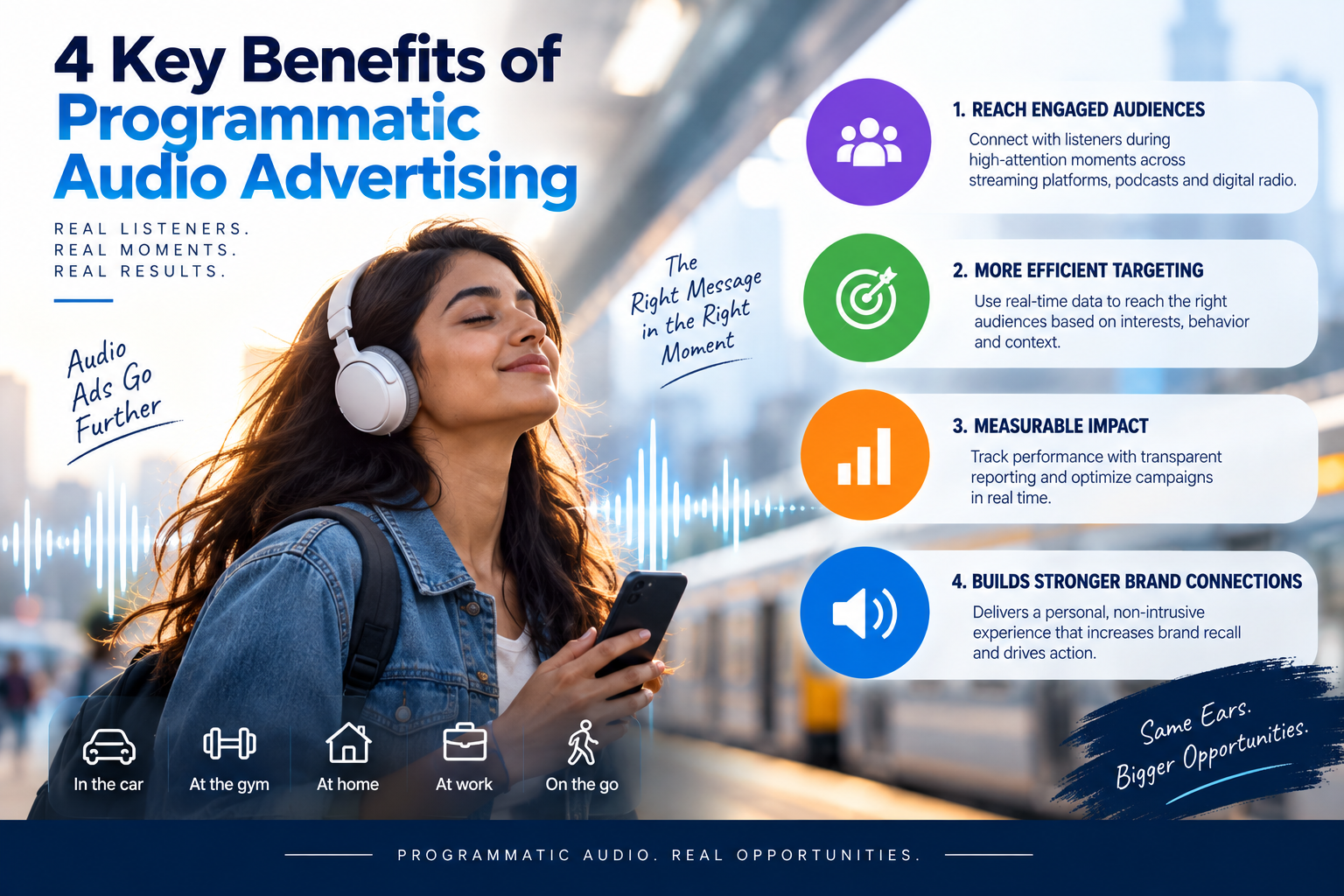
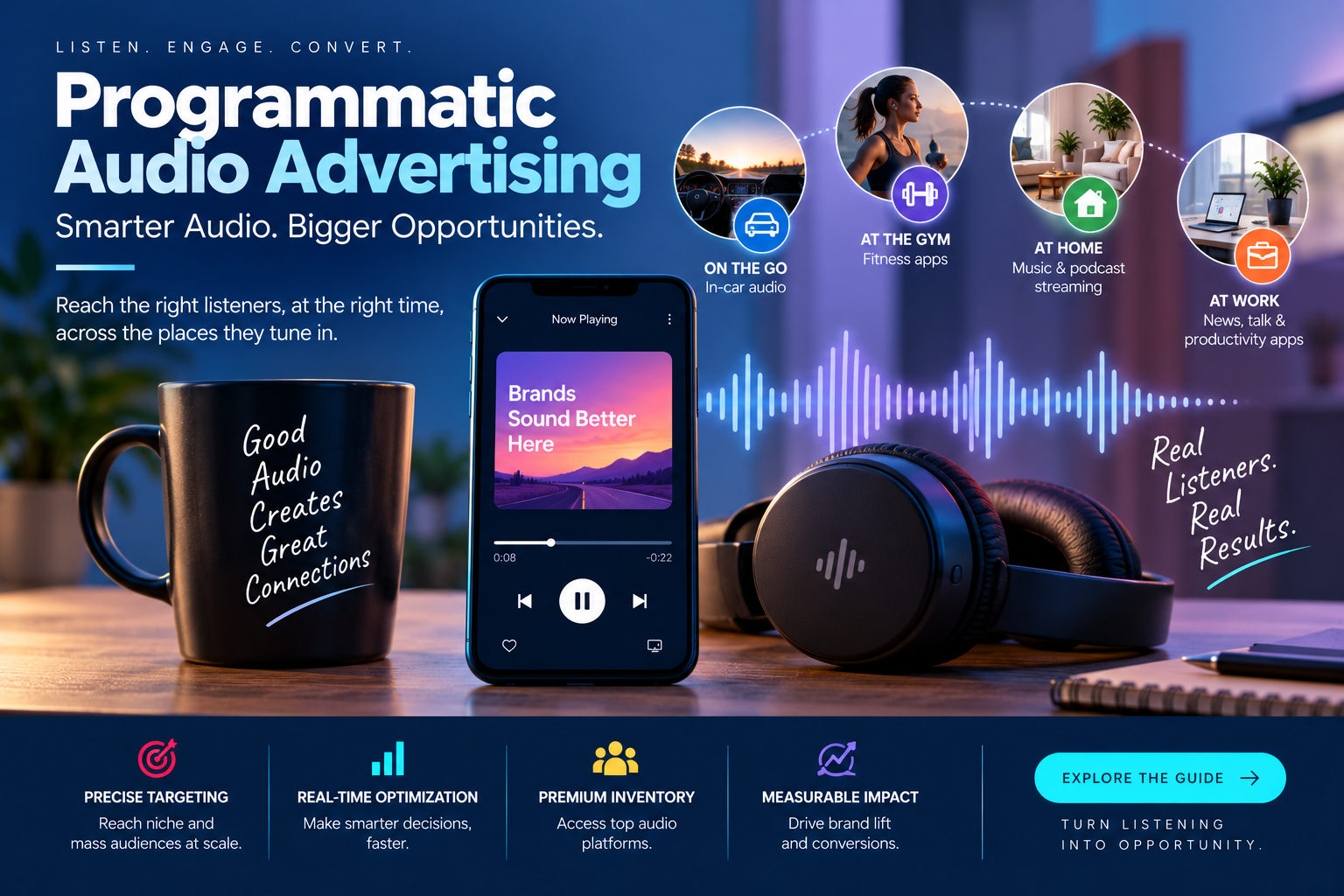
4 Key Benefits of Programmatic Audio Advertising

What is Programmatic Audio Advertising?

Audio has become an essential medium for digital content consumption. Music streaming, podcasts, internet radio, audiobooks, and other audio platforms give people opportunities to listen throughout the day.

Unlike display, video, or social advertising, audio does not require the user to look at a screen. People listen while commuting, exercising, cooking, working, or relaxing.

Programmatic audio advertising allows advertisers to automatically purchase audio ad placements using technology-driven bidding and targeting. Instead of manually selecting individual placements, advertisers use audience, contextual, geographic, device, and behavioural signals to reach listeners at scale.

1. Audio Creates a Strong Emotional Connection

Sound has a unique ability to influence how people feel. A familiar voice, piece of music, sound effect, or intentional tone can evoke an emotional response within seconds. This gives audio advertising an advantage when making a brand feel personal and memorable.

For example, a travel company can use calming music and an inspiring voiceover to create a feeling of relaxation and adventure. Similarly, a food delivery brand can use energetic sound design and conversational delivery to generate excitement.

A well-crafted audio ad coordinates five foundational elements:

  • Voice: The persona and pacing representing the brand.
  • Music: The melodic backing track setting the mood.
  • Sound Effects: Environmental cues that build immersive context.
  • Tone & Emotion: The feeling conveyed to the listener.
  • Brand Messaging: The core proposition and call to action.

Why this matters: Visual banners are frequently scrolled past or ignored, but a distinctive voice, sound signature, or sonic logo stays with the listener long after the audio stream finishes.

2. Reaching Audiences During Screen-Free Moments

Digital audio does not require visual attention. Listeners engage with audio in scenarios where looking at a screen is impossible or unsafe:

  • During morning and evening commutes
  • While driving
  • During gym workouts and runs
  • While cooking or preparing meals
  • During household chores
  • While working, designing, or studying
  • During leisure and relaxation time

These screen-free moments allow advertisers to maintain continuity outside conventional visual environments. Someone jogging cannot browse social feeds, but they remain engaged with a podcast or streaming playlist.

Complementing Existing Channels

Programmatic audio works alongside your multi-channel digital mix:

  1. Display Advertising: Reinforces brand recall through visual impressions.
  2. Video Advertising: Delivers high-impact initial product showcases.
  3. Connected TV (CTV): Anchors living room awareness on big screens.
  4. Native Advertising: Drives contextual in-article discovery.
  5. Social Campaigns: Captures active feed engagement.
  6. Search Campaigns: Captures high-intent conversion traffic.

3. Precise, Multi-Signal Targeting Capabilities

Modern programmatic audio platforms leverage rich data signals to reach relevant audiences without relying on visual real estate:

  • Demographics: Age, gender, and household metrics.
  • Geographic Location: Country, region, city, zip code, and radial geofencing.
  • Device Profiles: Mobile handsets, smart speakers, desktop apps, and in-car systems.
  • Interests & Affinities: Content categories, genres, and recreational preferences.
  • Contextual Alignment: Matching ad copy to specific genres (e.g., placing finance ads next to business podcasts, or athletic apparel next to workout playlists).
  • First-Party & Behavioral Data: Custom segments, CRM matching, and cross-channel retargeting pools.

Combining audience data with contextual relevance minimizes wasted impressions and ensures messaging lands when listeners are most receptive.

4. Building a Distinct Sonic Brand Identity

Branding extends beyond typography, hex palettes, and logos. Sound establishes immediate, sub-conscious brand recognition.

A recognizable voice talent, a tailored sonic signature, or recurring musical motifs enable listeners to identify a company instantly—even with their phone tucked away in a pocket.

Through audio storytelling, a 30-second spot can introduce a friction point, deliver an emotional hook, and resolve it with the brand’s solution. Voice delivery can shape brand perception across various dimensions:

  • Friendly and approachable
  • Authoritative and professional
  • Energetic and urgent
  • Inspirational and narrative-driven
  • Lighthearted and humorous

Final Thoughts

Programmatic audio provides access to consumers when they are listening rather than looking. The four foundational pillars are:

  1. Emotional Engagement: Sound and voice cultivate deeper psychological resonance.
  2. Screen-Free Reach: Brands maintain presence in moments visual media cannot penetrate.
  3. Flexible Targeting: Real-time data ensures placement alongside relevant content and audiences.
  4. Sonic Identity: Recurring audio motifs build durable brand recall.

Audio delivers the highest return when creative assets are written and produced specifically for listening rather than retrofitted from existing video voice tracks.

Programmatic audio advertising

You know how Instagram and YouTube show you ads based on what you like, where you live and what you are browsing? Programmatic audio advertising does the same thing but with audio ads that play on platforms like Spotify, Apple Music, podcasts and internet radio.

Programmatic audio advertising is the automated buying, selling and placement of audio advertisements within digital audio content.

Advertiser can use single platform to access inventory from multiple audio publishers and deliver ads to audiences across different devices.

The key difference between radio and programmatic audio advertising is targeting.

Why Is Audio Advertising So Effective?

One of the biggest strengths of audio is its ability to capture attention without requiring a screen.

When someone listens to a podcast or musical playlist, they are actively paying attention to what they hear. This creates an opportunity for brands to build a more personal connection.

How Programmatic Audio Can Improve Campaign Performance

Adding audio to a media plan can strengthen a campaign in several ways.

  1. It creates a more personal Brand Experience. Think about listening to someone speak through your headphones. Their voice feels much more direct and personal than a banner sitting on a webpage. A friendly and related voice can make a brand feel approachable while an energetic, soundtrack can create excitement.
  2. It Enable Precise Audience Targeting. Programmatic audio is not simply about playing an advertisement to anyone who happens to be listening. Advertiser can use audience and content data to create more relevant campaigns.

Depending on the available data and platform, targeting can include factors such as:

  • Location
  • Demographics
  • Online behaviour
  • Household income
  • Interests
  • Music genres
  • Playlists
  • Moods and moments

For example, a sports brand could focus on audience interested in fitness and sports.

Why Millennials and Gen Z Are Important for Audio Advertising.

Younger consumers, particularly Millennials and Gen Z are highly engaged with digital audio.

Music streaming, podcast and other forms of digital audio have become part of their everyday media habits. These audiences are also becoming increasingly important to brand as their purchasing power grows.

Creating An Audio Ad That People Actually Remember.

Programmatic technology can help you reach the right audiences, but targeting alone cannot make a campaign successful. Here are four important principles to keep in mind.

Keep It Brief

Audio advertisements are commonly produced in 15-30 seconds format. Focus on what really matters.

Keep The Message Simple

Audio script should clearly communicate:

  • What are you offering?
  • Why should the listener care?
  • What should they do next?

Avoid unnecessary details and complicated language.

Include a Strong Call to Action

Every good advertisement should tell the audience what to do next – CTA Example:

  • Shop now
  • Learn more
  • Download the app
  • Book today
  • Visit our website

Make It Conversional

Your audio ad should sound like belongs in the environment where it is being heard.

Programmatic Audio vs Traditional Radio

Traditional radio typically focuses on purchasing advertising spot within a particular station or program.

Programmatic audio focuses more heavily on audience targeting and digital measurement.

Conclusion:

Programmatic audio allows brands to reach relevant audiences while they are listening to music, podcast, playlists and other digital content. Unlike traditional radio, it can provide sophisticated audiences targeting, detailed measurement and opportunist for real time optimization.

How to create a Programmatic Audio Ad

Programmatic Audio campaign simple guide

Programmatic Audio advertising helps brands reach relevant audiences while they listen to music, podcasts, digital audios, and other online audio content. Unlike traditional radio, programmatic audio uses digital technology to help advertisers targeting audiences, manage budgets, and measure campaign performance.

What is programmatic Audio Advertising?

Programmatic audio is the automated buying and selling of digital audio ad placements. The basic process is: Advertisers à DSP à SSP/Exchange à Audio publishers à Listener The advertisers set the campaign objective, audience, budgets, and targeting. The DSP then finds suitable audio ad opportunities and bids on them automatically.

How to Create a Programmatic Audio Ad

  1. Define Your campaign Goal Start by deciding what you want to achieve. Common goals include:
    • Brand awareness
    • Website traffic
    • App downloads
    • Lead generation
    • Sales and conversion A clear goal helps determine the right audience, creative, and performance metrics.
  2. Select your target Audience Choose an audience that is relevant to your product or service. Depending on the platform, targeting may include:
    • Demographics
    • Location
    • Interests
    • Behaviours
    • Context
    • First-party audiences
    • Device
  3. Create a simple Audio Script A good audio ad should communicate the main message quickly. Keep the scripts:
    • Short
    • Clear
    • Engaging
    • Brand-focused
    • Action-oriented
  4. Produce the Audio Creative Record the script using a clear and engaging voice. You can also use background music or sound effects, but they should not overpower the voice. Before uploading, make sure the audio file meets the required format, duration, quality, and technical specifications of the DSP or publishers.

Launching the campaign

  1. Set up the Programmatic audio campaign. Once the creative is ready, configure the campaign in your DSP. Set:
    • Campaign objective
    • Audience
    • Location
    • Inventory
    • Budget
    • Bid strategy
    • Creative
    • Tracking
  2. QA before launch Check everything before the campaign goes live:
    • Audio quality
    • Creative duration and format
    • Targeting
    • Budget and bid
    • Landing page
    • Tracking
    • Call to action A proper QA helps to prevent delivery and tracking issue
  3. Launch and Monitor After launch, monitor the campaign regularly to understand how it is performing. Important matrices include:
    • Impression: Number of times the ad was served.
    • Reach: Number of unique listeners reached.
    • Frequency: Average number of times a listeners heard the ad.
    • Completion rate: percentage of ads played to completion.
    • CTR: Percentage of impressions that resulted in click.
    • CPM: Cost of every 1000 impressions.

Best Practices

Keep the message Simple Listeners should understand the main message quickly.

Use strong call to action Tell the listeners exactly what to do next.

Test Different Creative Try different message, voice and call to action.

Manage Frequency Avoid showing the same ad too many times to the same listener.

Optimize regularly Review performance and adjust audience, inventory, bids, and budget based on results.

Final takeaway

Creating a programmatic audio campaign can be summarized in six simple steps: Define à Target à Create à QA à Launch à Optimize With the right audience, a clear message, quality creative, and continuous optimization, Programmatic audio can help brand reach listeners effectively and become an important part of broader digital advertising strategy.