Linear TV vs. Connected TV Differences, Benefits, and Strategies

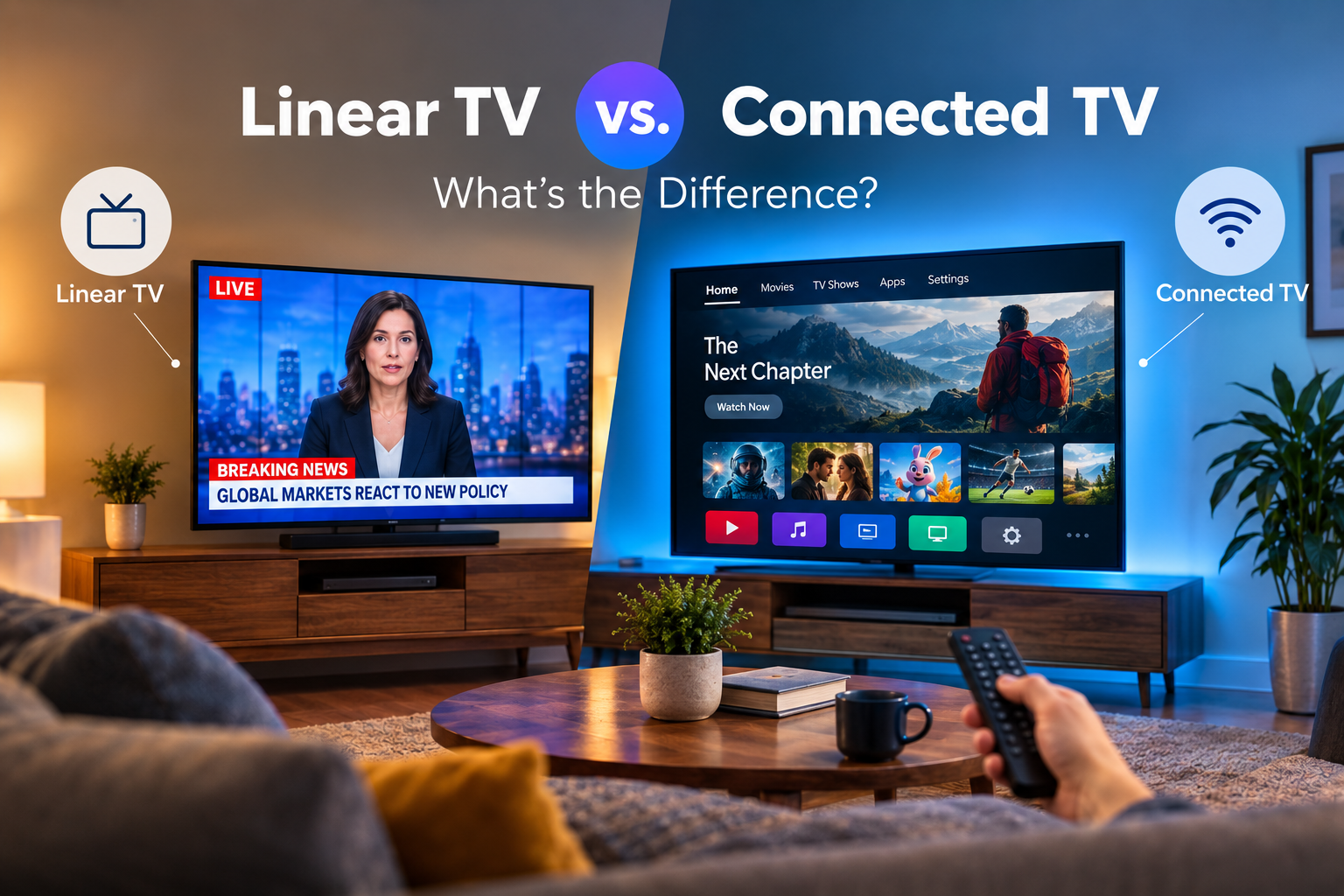
Linear TV vs. Connected TV: What’s the Difference?

Television advertising has changed significantly over the last few years.

For decades, linear TV was the primary way brands reached large audiences. People watched scheduled programs through cable, satellite, or broadcast television, and advertisers purchased commercial spots around those programs.

Today, viewers have many more choices. Instead of watching only scheduled programming, they can stream movies, TV shows, live events, news, and other content whenever they want. This has made Connected TV (CTV) an important part of modern advertising.

While linear TV and CTV both appear on television screens, the way audiences consume content-and the way advertisers buy and measure advertising-can be very different.

The simple way to think about it is

Linear TV = scheduled television programming.

CTV = television content delivered through an internet-connected device.

Both have their own advantages. The right choice depends on the campaign’s goals, audience, budget, and the type of reach an advertiser needs.

What Is Linear TV?

Linear TV refers to traditional television where viewers watch scheduled programming through broadcast, cable, or satellite services. The content follows a fixed schedule determined by the television network or channel.

For example, if a news program starts at 8:00 PM, viewers need to tune in at that time to watch it live.

The same principle applies to advertising. Advertisers purchase commercial spots within specific programs, channels, or time slots. The ads are then shown to the audience watching that programming.

Examples of linear TV environments include:

  • Broadcast television
  • Cable television
  • Satellite television
  • Scheduled news programming
  • Live sports
  • Live events
  • Traditional TV channels

Linear TV is still relevant, particularly for campaigns that require large-scale reach, live programming, and broad audience exposure.

Benefits of Linear TV Advertising

1. Reach Large Audiences Through Live Programming

One of the biggest strengths of linear TV is its ability to deliver large audiences around live and highly anticipated programming. Examples include:

  • Live sports
  • Breaking news
  • Awards shows
  • Major entertainment events
  • Political events
  • Special broadcasts

Live programming remains valuable because viewers often want to watch events as they happen rather than wait for them to become available on demand.

For advertisers, these environments can create opportunities to reach a large number of viewers at the same time.

However, live content is no longer exclusive to traditional television. Many major events are now distributed across both traditional and streaming platforms.

This means advertisers increasingly need to consider both linear TV and CTV when planning campaigns around major live events.

2. Reach Audiences That Still Prefer Traditional TV

Although streaming continues to grow, not every viewer has moved completely away from traditional television.

Some audiences-particularly older demographics-continue to spend significant time watching broadcast and cable television.

This makes linear TV useful for brands that want to reach audiences who are more likely to consume traditional TV content.

For example, a brand targeting an older consumer segment may find linear TV valuable because those viewers may have stronger traditional-TV viewing habits.

At the same time, audience behavior is changing across generations. Younger audiences are also watching television content, but they are increasingly doing so through streaming services.

Therefore, advertisers should avoid treating age as the only deciding factor. Actual audience behavior and campaign objectives should guide the media strategy.

3. Plan Campaigns Around Channels and Time Slots

Linear TV provides advertisers with a relatively predictable way to plan campaigns. Advertisers can select:

  • Specific channels
  • Programs
  • Time slots
  • Dayparts
  • Live events
  • Geographic markets

Different programs attract different types of viewers.

For example, a brand targeting families may choose programming that is popular among family audiences. A financial services company may prefer news or business-related programming.

Prime-time programming can also provide broad exposure and help brands build awareness.

The key advantage is that advertisers can plan around where and when their desired audience is likely to be watching.

What Is Connected TV?

Connected TV, or CTV, refers to television content that is delivered through an internet-connected TV or device. This can include:

  • Smart TVs
  • Streaming devices
  • Gaming consoles
  • Connected set-top boxes
  • Other internet-connected television devices

CTV allows viewers to watch content through streaming services instead of relying exclusively on traditional cable or satellite television.

Examples of CTV environments include streaming movies, TV shows, live channels, news, sports, and other digital content.

CTV advertising can appear before, during, or after video content. Depending on the publisher and platform, advertisers may also have access to different interactive or advanced video ad formats.

The major difference from traditional TV is the technology behind the advertising.

Instead of relying primarily on broad program or channel-based audiences, CTV advertising can use digital audience and contextual signals to make targeting more precise.

Benefits of Connected TV Advertising

1. More Precise Audience Targeting

One of the biggest advantages of CTV is its ability to bring digital-style targeting to the television environment.

Depending on the platform, publisher, and available data, advertisers may be able to target audiences using signals such as:

  • Demographics
  • Geographic location
  • Interests
  • Content preferences
  • First-party data
  • Audience segments
  • Contextual signals
  • Device information
  • Behavioral signals

For example, instead of showing an advertisement to everyone watching a particular TV channel, an advertiser may be able to focus on a specific audience segment within CTV inventory.

This can help advertisers reduce wasted impressions and make their campaigns more relevant.

Contextual targeting is also important: CTV doesn’t have to rely only on information about the viewer. Advertisers can also consider the content being watched.

For example:

  • A sports brand can advertise around sports content.
  • A travel company can advertise around travel-related programming.
  • A financial company can advertise around business or financial content.
  • A food brand can advertise around cooking or lifestyle content.

This combination of audience and contextual targeting gives CTV advertisers more flexibility than traditional TV buying.

2. Better Measurement and Optimization

Measurement is another major difference between traditional TV and CTV. Traditional TV campaigns often depend on estimated audience data and post-campaign reporting. CTV works more like other digital advertising channels.

Depending on the platform and measurement setup, advertisers can receive detailed campaign metrics such as:

  • Impressions
  • Video completion rate
  • Completed views
  • Reach
  • Frequency
  • Cost metrics
  • Conversion metrics
  • Audience performance

This allows advertisers to understand how campaigns are performing and identify opportunities for optimization.

For example, if one audience segment is performing better than another, an advertiser can adjust the campaign strategy based on available data.

Similarly, advertisers can compare different creatives, audiences, publishers, or inventory sources. This creates a more data-driven approach to TV advertising.

It’s important to remember that measurement capabilities are not identical across every CTV platform. Available metrics depend on the publisher, device, measurement partner, and campaign setup.

3. Engaging Digital Viewing Experience

CTV combines the large-screen viewing experience of television with the technology of digital advertising.

Viewers can watch content on a large screen, often in high-quality video, while advertisers can use digital buying and targeting capabilities.

CTV is particularly useful for video storytelling because advertisers can use:

  • Full-screen video
  • Sound
  • Motion
  • Brand visuals
  • Strong calls to action
  • Interactive experiences where supported

Because the ad appears within a television viewing environment, CTV can be particularly effective for brand awareness and consideration campaigns.

However, CTV is not only an awareness channel. With the right measurement and audience strategy, it can also support consideration and performance-focused campaigns.

Linear TV vs. CTV: Key Differences

FactorLinear TVConnected TV
Content deliveryBroadcast, cable, or satelliteInternet-based streaming
Viewing modelMostly scheduled programmingOn-demand and live streaming
TargetingPrimarily channel, program, time, and demographic basedAudience, contextual, geographic, and other digital signals
ReachStrong broad reach, especially through traditional TVGrowing reach across streaming audiences
Live contentStrong for traditional live broadcastsIncreasingly important as live sports and events move to streaming
MeasurementOften based on estimated audience dataMore granular digital-style measurement, depending on setup
OptimizationLimited once the media buy is placedMore flexible during a campaign
CreativePrimarily traditional TV commercialsVideo ads and other supported digital TV formats
Buying approachTraditionally planned and purchased in advanceCan be purchased through direct, programmatic, or hybrid approaches
Best suited forBroad awareness and large-scale reachTargeted reach, measurable campaigns, and incremental audiences

The important point is that linear TV and CTV are not competing formats in every situation. They can complement each other.

How to Use Linear TV and CTV Together

Instead of asking, “Should I use linear TV or CTV?”, advertisers can often ask, “How can I use both to reach more of the right audience?”

A combined strategy can help brands take advantage of the strengths of both channels.

Here are three approaches.

1. Extend Existing TV Campaigns to CTV

If a brand already has a TV commercial, the same core creative can often be adapted for CTV. This can make it easier to extend an existing campaign into streaming environments.

For example, a brand running a 30-second commercial on traditional television could also use an appropriate version of that creative in CTV inventory. However, simply copying the same creative isn’t always the best approach.

CTV is a digital environment, so advertisers should also consider:

  • Mobile and TV screen differences
  • Clear branding
  • Strong opening seconds
  • Captions where appropriate
  • Simple messaging
  • Clear calls to action
  • Different viewing environments

The goal is to make the creative work well on a large screen in a streaming environment, not simply reuse an asset without considering the context.

2. Use Linear TV and CTV to Increase Overall Reach

Using only one TV channel can limit the audiences a campaign reaches. A combined strategy can help advertisers reach people who still watch traditional television as well as audiences who primarily stream content.

For example: Linear TV can help reach traditional TV viewers and large audiences around scheduled programming.

CTV can help reach streaming audiences, including people who have reduced or completely stopped using traditional cable TV. Together, they can provide broader coverage across different viewing habits.

This is particularly useful as audiences become increasingly fragmented across broadcast channels, cable networks, streaming services, and digital platforms.

3. Build Cross-Channel Campaigns

CTV can also work as part of a broader digital advertising strategy. For example, a brand could:

  • Show a CTV video ad to introduce the brand.
  • Reach exposed audiences through display or native advertising.
  • Retarget eligible audiences where the platform and privacy framework support it.
  • Measure downstream actions such as website visits or conversions.

This creates a connected customer journey instead of treating every advertising channel as a separate campaign.

However, cross-device and cross-channel targeting should always follow the privacy, consent, identity, and measurement rules supported by the relevant platforms and markets.

Which One Should Advertisers Choose?

There isn’t one universal answer. The right choice depends on several factors, including:

Choose Linear TV when:

  • You need broad traditional TV reach.
  • Your audience strongly watches broadcast or cable TV.
  • You want to advertise around major live programming.
  • Your campaign is focused heavily on mass awareness.
  • Channel and program selection are important to your strategy.

Consider CTV when:

  • You need more precise audience targeting.
  • Your audience spends significant time streaming.
  • You want more detailed campaign measurement.
  • You want greater flexibility in campaign optimization.
  • You want to reach cord-cutters and streaming-first audiences.
  • You want to integrate TV advertising with your broader digital strategy.

Consider using both when:

  • You want broad reach and precise targeting.
  • Your audience is spread across traditional TV and streaming.
  • You want to increase incremental reach.
  • You want to connect TV exposure with digital campaigns.
  • You want to build a more complete video advertising strategy.

Final Thoughts

The television advertising landscape is no longer simply about choosing between traditional TV and streaming.

Viewers now move between broadcast television, cable, smart TVs, streaming services, connected devices, and live digital content depending on what they want to watch and when they want to watch it.

Linear TV continues to provide value through broad reach, scheduled programming, and live events. CTV brings many digital advertising capabilities to the television screen, including more flexible targeting, measurement, and optimization.

For many advertisers, the strongest strategy is therefore not linear TV vs. CTV, but linear TV + CTV.

By understanding where their audience watches content and matching each channel to the campaign objective, advertisers can build a more effective and flexible TV advertising strategy.
The Future of Connected TV and CTV Advertising

Understanding CTV, How It Works, and Its Benefits for Advertisers

What is Connected TV (CTV)?

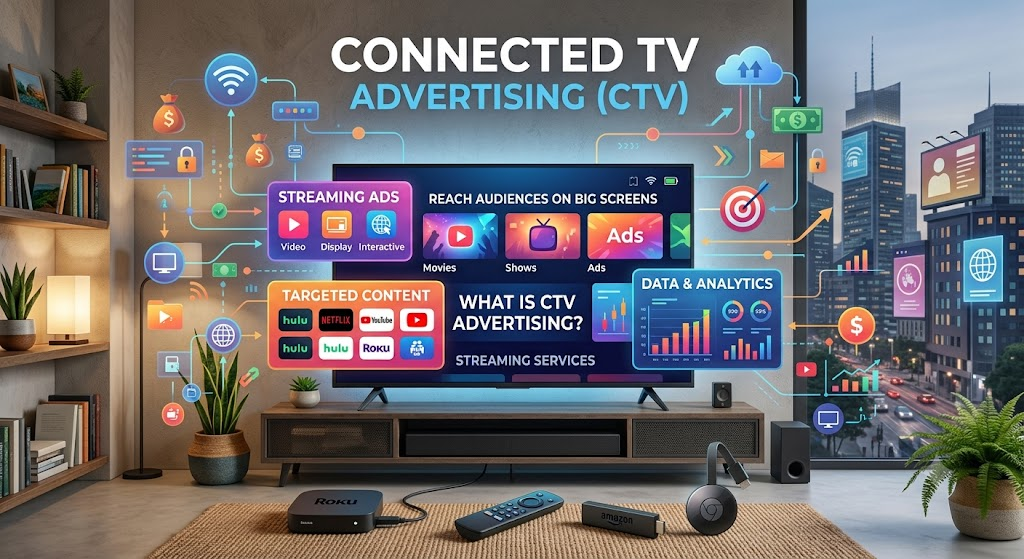
Connected TV (CTV) refers to a television that is connected to the internet and can stream digital content. This includes Smart TVs and television connected through devices such as Roku, Amazon Fire TV, Apple TV, and other streaming devices.

CTV Combines the big screen experience of traditional television with the targeting, flexibility, and measurement capabilities of digital advertising.

Why is CTV Growing rapidly?

More People are moving from traditional cable and satellite TV to streaming services. At the same time, viewers are spending more time watching digital contents on the television. This creates a growing opportunity for advertisers

  • Large and growing streaming audience
  • Big-screen impact with a digital advertising experience
  • More precise audience targeting and traditional TV
  • Better campaign measurement and reporting
  • Flexible buying options through programmatic advertising

CTV vs Linear TV

Linear TV follows a fixed schedule, and advertisers generally buy specific time slots or programs. CTV delivers streaming content over the internet, provides more flexibility in how audience are targeted, and how campaigns are measured.

  • Linear TV: Broad audience targeting and fixed schedules.
  • CTV: More data-driven targeting and flexible campaign management
  • CTV can support reach, frequency management, retargeting, and cross-device strategies

How CTV Advertising Works

CTV advertising can be purchased programmatically, similar to other forms of advertising. When a viewer reaches an available ad break, an ad opportunity is sent through the programmatic ecosystem.

  • Advertiser: Sets the campaign goal, audience, budget, and creative.
  • DSP: Evaluates available impressions and submits bids based on campaign targeting
  • SSP/Exchange: Provides access to available CTV inventory
  • CTV platform: Serves the winning ad within the streaming content.
  • Viewer: Sees the video advertisement on the connected TV.

Key benefits of CTV advertising.

  • High Engagement: Full screen video creates a strong viewing experience.
  • Advanced targeting: Advertisers can use available demographic, behaviour, geographic, and audience data.
  • Reach and frequency: Campaign can reach households while managing how often ads are shown.
  • Cross-device Marketing: CTV can work together with mobile, desktop, and other digital channels.
  • Measurable Results: Advertisers can report on impression, reach, frequency, VCR, completion rates, and other available metrics.
  • Brand safety: CTV campaign can access premium streaming environment, depending on the inventory source and deal.

What are Fast channels?

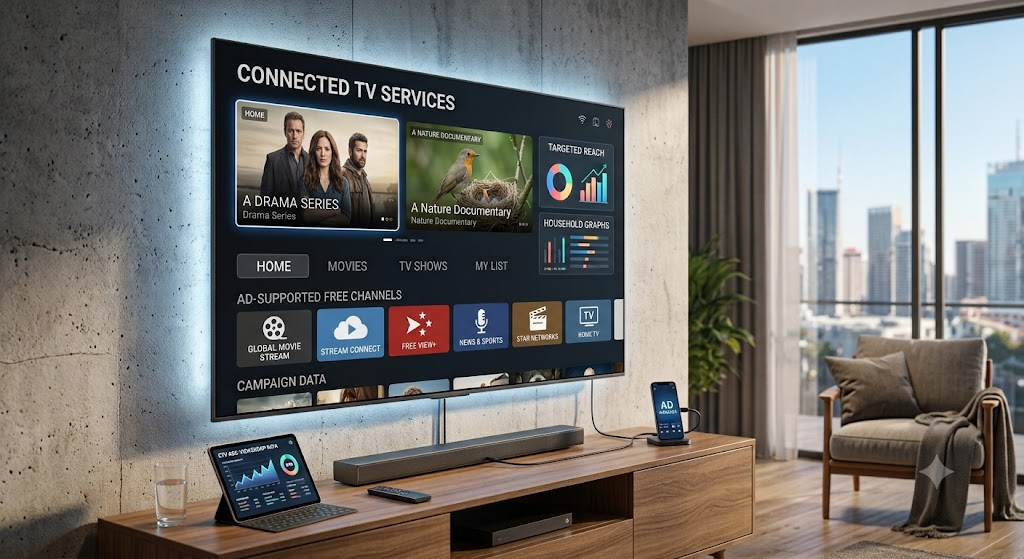
FAST stands for Free Ad-supported streaming Television. FAST services provides free, TV-style streaming content that is funded by advertising. Examples include platform such as Pluto TV, Tubi, Plex, Roku channel, Samsung TV Plus, and others ad-supported streaming services.

FAST inventory can be an important part of CTV advertising because advertisers can reach viewers in an ad-supported streaming environment.

The future of CTV Advertising.

The future of CTV is expected to become more data-driven, measurable, and integrated with other digital channels. As streaming audience continue to grow, advertisers can use CTV to combine the reach and impact of television with the targeting and measurement of digital advertising.

  • More advanced audience targeting
  • Improved measurement and attribution
  • Greater use of programmatic buying
  • More interactive and shoppable video experiences
  • Strong integration with multi-channel campaign

Final Thoughts

CTV is changing the way brands connect with television audiences. It offers the impact of the big screen while providing many of the benefits of the digital advertising, CTV can be powerful part of modern multi-channel strategy when the right audience, inventory, creative, and measurement approach.

CTV vs. OTT Advertising: What’s the Difference?

What is OTT?

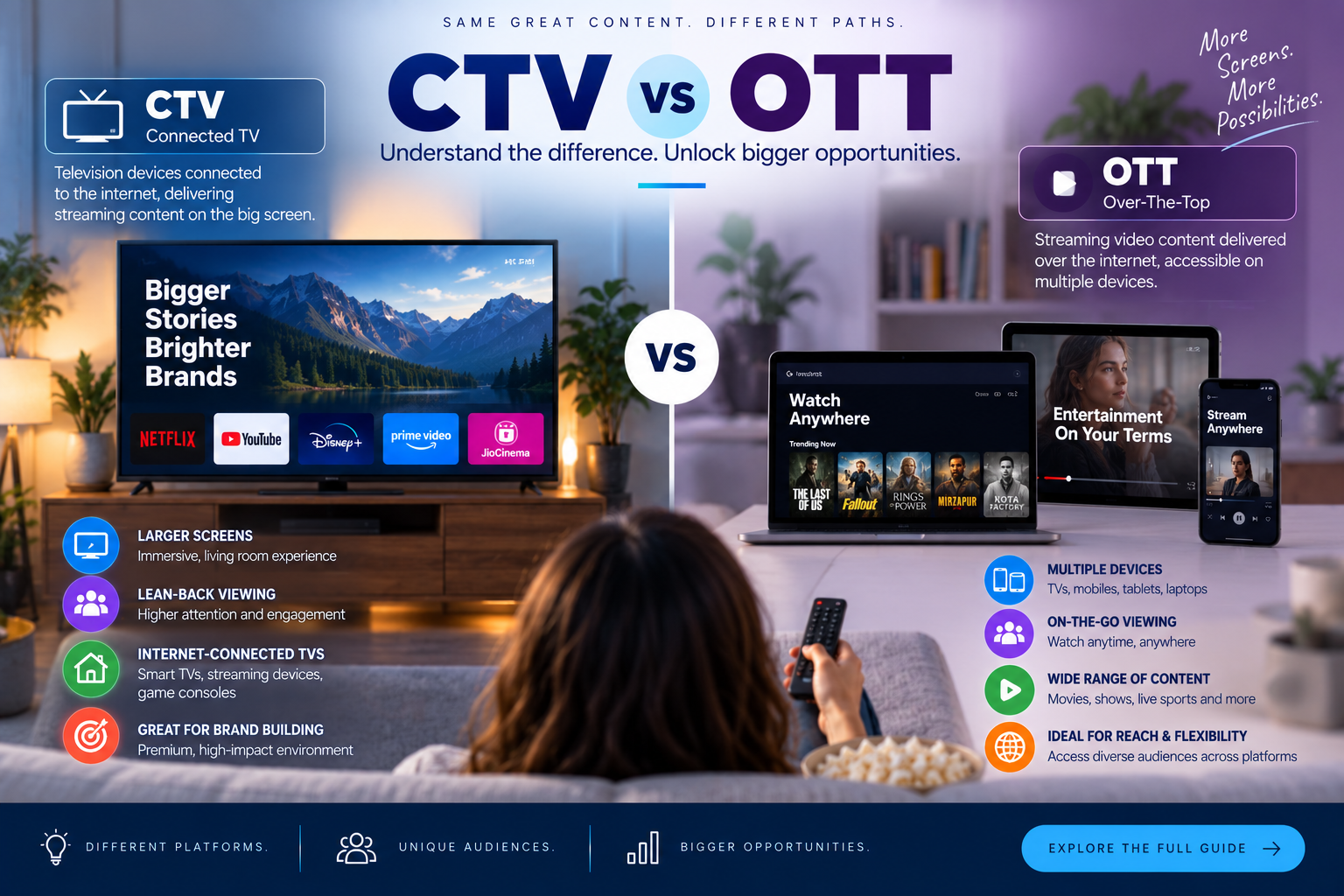
OTT stand for Over-The-Top. It refers to television shows, movies and other video content that people watch over the internet instead of through traditional cable or satellite television.

In the past, if you wanted to watch TV, you usually needed a cable or satellite connection. Today, you can simply connect to the internet and stream content whenever you want.

Popular OTT platforms include:

  • Netflix
  • Amazon Prime Video
  • Disney+
  • Hulu
  • Peacock
  • YouTube

OTT content can be streamed on many different devices:

  • Smart TVs
  • Smartphones
  • Tablets
  • Laptops
  • Desktop computers
  • Gaming consoles

What is CTV?

CTV stands for Connect TV. A connected TV is a television that can connect to internet and stream digital content.

For example:

  • Smart TV
  • Amazon Fire TV

When you watch Netflix on a Smart TV, you are watching OTT content on a CTV device.

CTV vs. OTT: What’s the difference?

CTV and OTT are closely connected, but they are not exactly the same thing.

A simple way to remember is:

  • OTT – the platform which streams content.
  • CTV – device used to watch OTT content.

For example, watching the same Netflix movie in two different situations.

  • Situation 1 – Watching OTT content on smartphone.
  • Situation 2 – Watching the same OTT content on a smart TV.

So, CTV is essentially a part of the larger OTT ecosystem.

Comparing OTT & CTV

OTTCTV
Describes content delivered through the internet.Describes a TV connected to internet.
Can be watched on phone, tablets, laptops and TVs.Specifically refers to television screens.
Includes streaming services and digital video.Includes smart TVs and TVs connected to streaming devices like amazon fire stick.
Focuses on how content is delivered.Focuses on where the content is viewed.

How do CTV and OTT work Together in Advertising?

This is where things become especially important for marketers and advertisers. When advertisers run ads on streaming television, they are often buying CTV advertising inventory, while the actual video content is being delivered Over-The-Top through the internet.

For example – A person watches a show on a smart TV, before the show begins, he sees an advertisement for a new smartphone.

The show delivered through on OTT streaming service, while the advertisement is shown on a CTV device. So, in advertising often CTV and OTT work together.

Advantages of CTV Advertising

CTV has become increasingly important for advertisers because it combines some of the strengths of traditional television with a targeting and measurement capabilities of digital advertising.

1. CTV Helps advertisers reach more Viewers.

More people are choosing streaming services instead of traditional cable and satellite TV. The change is often called cord-cutting. Cord-cutting happens when people cancel their traditional cable or satellite TV subscriptions and move towards streaming services.

Why are people moving from traditional to OTT? Instead of waiting for a particular program to come on at a particular time, viewers can choose:

  • What they want to watch?
  • When they want to watch it?
  • Which device they want to use?
  • Which streaming service they want to use?

As more people move from traditional television to streaming, CTV gives advertisers an opportunity to reach this growing audience.

2. CTV offers Better Targeting than Traditional TV

Traditional television advertising generally reaches a broad audience. For example, if a company places an advertisement during a popular tv show, everyone watching that show may see the advertisement.

CTV can provide advertisers with more advanced targeting options. Depending on the platform and available data, advertisers may be able to target audiences based on factors such as:

  • Location
  • Age
  • Interests
  • Viewing behaviour
  • Household characteristics
  • Previous interactions with brands

This means advertisers can try to show their ads to people who are more likely to be interested in their products or services. A sports brand can target viewers who frequently watch sports related content.

3. CTV provides better measurement and Optimisation

One major advantage of digital advertising is the ability to measure campaign performance. CTV brings some of these digital measurement capabilities to television advertising. However, CTV works differently from traditional display advertising.

With CTV, viewers are usually sitting several feet away from their television, so clicking directly on the advertisement isn’t practical. Because of this, advertisers often focus on metrics related to videos viewing and awareness.

Some important CTV metrics include:

Video Completion rate – VCR VCR tells what percentage of videos ads were watched until the end. A high VCR generally indicates that viewers are watching most or all of the advertisement. If 1,000 people watched an ad and 900 watch the entire video, the completion rate is 90%.

Cost Per Completed View – CPCV CPCV tells advertisers how much they are paying for each completed video view. This can help advertisers understand how efficiently their campaigns budget is being used.

4. CTV combines Strengths of TV and Digital Advertising

Traditional TV:

  • Large reach
  • High-quality video
  • Strong brand awareness
  • Big-screen viewing experience

Digital advertising:

  • Audience targeting
  • Campaign measurement
  • Performance tracking
  • Real time optimisation.

CTV combines many of these benefits. This is one of the reasons advertisers are increasingly interested in CTV advertising.

Conclusion

The shift from traditional television to streaming has created new opportunities for advertisers. OTT refers to television and video content delivered through the internet, while CTV refers specifically to televisions that can access and display the internet-based content. For advertisers CTV is particularly valuable because it combines the large screen experience of traditional television with many of the targeting, measurement and optimisation capabilities associated with digital advertising.

As more viewers move towards streaming and away from traditional cable and satellite television, CTV is becoming an increasingly important part of modern digital advertising strategies.

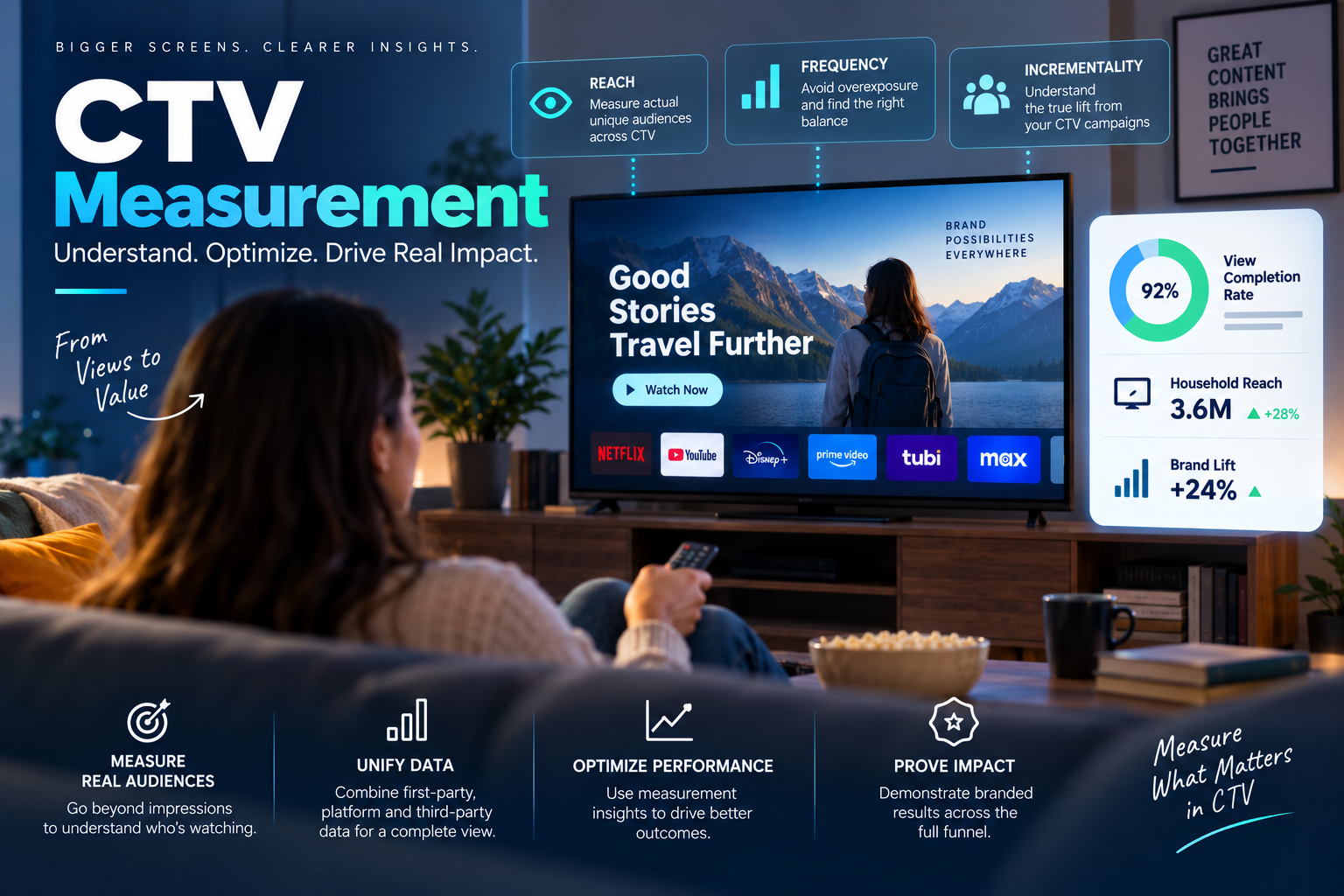
CTV Measurement: 9 Metrics You Should Track to Prove Impact

Since many years advertisers have used conventional TV as one of the best ways to reach a massive audience and build brand awareness. Unfortunately, measuring the performance of any TV advertisement has never been easy. Typically, advertisers have relied on estimates of viewers or changes in the number of visitors to websites and stores after airing a TV commercial.

CTV advertising is revolutionizing how TV campaigns are measured by advertisers. Through connected TV, advertisers will be able to collect a lot more information about their TV ads delivery and the interaction of viewers with commercials. The marketers will be able to know the exact number of people who viewed the ad, and whether the ad helped contribute to the conversion process. With these metrics and key performance indicators, it means that CTV is more than just a brand awareness channel.

What is CTV Measurement?

CTV measurement is the practice of measuring and analysing the success of connected TV advertising campaigns. It allows advertisers to measure things like:

  • How many viewers have seen my ad?
  • How many households were reached?
  • How often have they seen the ad?
  • Have they watched the ad in its entirety?
  • Have they visited my website following viewing?
  • Have they completed the desired action?

How Does CTV Measurement Work?

Specific actions or events are recorded through use of tracking pixel or other measurement technology. The choice of the actions to be measured is made between the advertiser and the CTV advertising platform.

Example, one individual can be viewing an ad from the CTV and later visit the site of the company advertising its products and complete the purchase. This action would be considered view through conversion in case it happens during the period of your campaign’s measurement.

Important CTV metrics

  1. Impression Impressions refers to number of times the ad was seen. If your ad received 50,000 impressions during your campaign, it means that the ad was shown 50,000 times.Impressions are great in determining how much delivery was achieved, however, it does not tell you how many unique people saw the ad. That is why impressions should be considered together with other metrics like reach or frequency.
  2. Frequency Frequency shows how many times your target viewer or household has been reached by your advertisement. Frequency is critical since advertisers must reach that balance, which means when the number of exposures is too low, there won’t be any recollection of brand and when the exposure is too high, ad fatigue may happen. Advertisers can use frequency caps that will allow them to limit how many times the same audience can see the same advertisement.
  3. Cost Per Mille (CPM) Cost per mille (CPM) is the price of reaching to 1,000 impressions. Formula for CPM is as below: CPM = (Campaign cost ÷ Impressions) x 1,000If an advertiser pays $10,000 and receives 500,000 impressions, then CPM will be $20. CPM allows advertisers to evaluate the price of the media and compare the CTV inventory or campaign strategy.
  4. Unique Households CTV differs from other digital channels in terms of the fact that the advertisement in the screen is seen by multiple viewers at once. Consider, four different people of come household can be watching the CTV advertisement simultaneously.Unique household helps the advertisers calculate how many unique households saw the ad instead of calculating impressions.
  5. Completion rate Completion rate measures how many times the viewers complete watching and advertisement to its end. Example, if out of 100,000 started ad views 95,000 people complete the process, the completion rate is 95%.It shows that people stay with the ad and get its brand message completely. In addition, it may assist in comparing the effectiveness of different creatives.
  6. Cost Per Completed View (CPCV) CPCV measures the average price per one completed video view. If the price of campaign is $5,000 and there are 100,000 completed views, then CPCV is $0,05. CPCV is effective if the goal of the campaign is to make the viewers watch the whole ad.
  7. Return On Ad Spend (ROAS) ROAS is used to measure the revenue against the price spent on advertising. The formula is as follows: ROAS = Revenue ÷ Advertising CostIf you are spending $10,000 for ads and the revenue is $40,000, ROAS would be 4. It means you are gaining $4 for each $1 invested. ROAS is especially effective for performance-driven campaigns aimed at linking CTV ads and their outcomes.
  8. View Through Conversions Many CTV ads lack a typical click-through format, which means that the user can watch an ad on TV and then proceed to visit the advertiser’s website from their mobile device or desktop computer. A view through conversion is a metric that reflects a conversion resulting form the exposure to an ad during the measurement period.
  9. Conversion rate Conversion rate is the metric that represents the share of the users who performed the desired action. It may be a purchase, registration, form fill-out, visiting of the website, etc. For example, if 1,000 measured users come to the website and 50 buy something, the conversion rate is 5%.

Using CTV Measurement for Brand Lift Studies

There are CTV campaigns which don’t necessarily aim to get instant conversions from the audience. In most cases, brands utilise CTV ads to improve brand awareness, brand recall and perception.

Brand lift studies consist in comparison of the group which saw the advertisement with another group which didn’t see the campaign. Advertisers can compare the following aspects between the groups:

  • Brand awareness
  • Brand recall
  • Brand favourability
  • Consumer perception
  • Brand consideration

Such type of measurement is especially important for campaigns that are designed to raise brand awareness.

Conclusion

The simplest wat to grasp CTV metrics is to consider hoe each metric answers the question “What is the performance of our CTV ad?”: Impressions, frequency, COM, Unique households and completion rate show how your ad was served and consumed by your audience. Whereas CPCV, view-through conversions, conversion rate and ROAS give insight into whether the campaign helped drive measurable action or outcomes.

CTV is also becoming increasingly performance driven. Retailers and streaming services are now looking into leveraging shoppable ads to measure performance against TV advertising exposure. Overall, the future of CTV measurement is heading toward a better and more accurate measurement, as well as cross-device and privacy conscious measurement.

What is Connected TV Advertising

What is Connected TV advertising, and why is everyone using it?

What is Connected TV (CTV):

Connected TV means a television that can connect to the internet and stream content.

If you’re watching something on the internet through your TV Screen, you’re using CTV simple as that.

Simply:

CTV: Watching internet-based video on a TV screen.

CategoryExample
Smart TVsSamsung, LG – TVs with streaming apps built in
Streaming DevicesAmazon Fire Stick, Roku,Apple TV, Google Chromecast
Gaming ConsolePlayStation,Xbox

What Is CTV Advertising?

Showing ads to people while they watch shows on their internet-connected TV.

Those short ads you see when you’re streaming show on Netflix YouTube on your TV or in a free app.

CTV ads can appear:

  • Before a video – Called a pre-roll ad
  • During a video – Called a mid-roll ad
  • After a video – Called a post-roll ad
  • On top of the content – through banners, overlays, or other interactive formats

Some CTV ads are also interactive. For example, an advertisement might show a QR code that you can scan with your phone to visit a website or buy a product.

How Is This Different From Regular TV Ads?

Let’s say there’s a company that sells running shoes. Instead of showing the advertisement to everyone watching TV, the company can use digital advertising technology to find views who match its target audience.

On regular TV: Advertisements are displayed during the program and shown to everyone watching, regardless of their interests or purchasing intent

On CTV: They say, “Show my ad only a people aged 15-30 who watch sports content and live in XXX place”. Now, only the right people see the ad.

Result: The Shoe company spends less money and gets better results.

How Does CTV Advertising Work?

The process usually works like this:

  1. Someone starts watching contentA viewer opens a streaming service and start watching a movie, show, or live sport event.
  2. An advertising opportunity becomes available.The streaming platform has an available advertising space during the content.
  3. Advertisers compete for that space.Advertisers can use automated advertising systems to decide whether they want to show their advertisement to that viewer.
  4. The winning advertisement is shown.The selected advertisement is delivered to the viewer’s TV.
  5. The advertiser measures the result.The advertiser can then see information such as how many people watched the advertisement, how many people watched it completely, and whether people took action forward.

Why Is CTV Advertising Becoming So Popular?

The biggest reason is simple:

People are changing the way they watch TV.

Instead of sitting down at a fixed time to watch a program on cable television, people now prefer streaming.

They can watch what they want, whenever they want.

More viewers are also cancelling traditional cable subscription and moving towards streaming services.

Why Do People Like CTV?

One reason is that CTV fits the way people watch content today.

Viewers don’t always want to follow a fixed TV schedule.

They want to choose:

  • What they watch
  • When they watch it
  • Where they watch it

Streaming gives viewers this flexibility.

CTV advertising also tends to appear on large screens, which can create a more engaging viewing experience than advertisements shown on smaller devices.

Conclusion:

CTV advertising is changing the way business connect with TV viewers. Unlike traditional TV ads, CTV allows advertiser to reach more specific audiences, measure results, and adjust campaigns more easily. As more people choose streaming over traditional cable, CTV is becoming an important part of modern advertising.