What is Programmatic Guaranteed (PG) and When Exactly to Use PG Deals

First, let’s understand what Programmatic Guaranteed (PG) is:

Imagine you are planning a big event and need to buy a specific number of tickets in advance. Instead of bidding against other people at the last minute, you go straight to the venue and lock in a fixed price for the exact seats you want. In programmatic advertising, programmatic guaranteed works the exact same way:

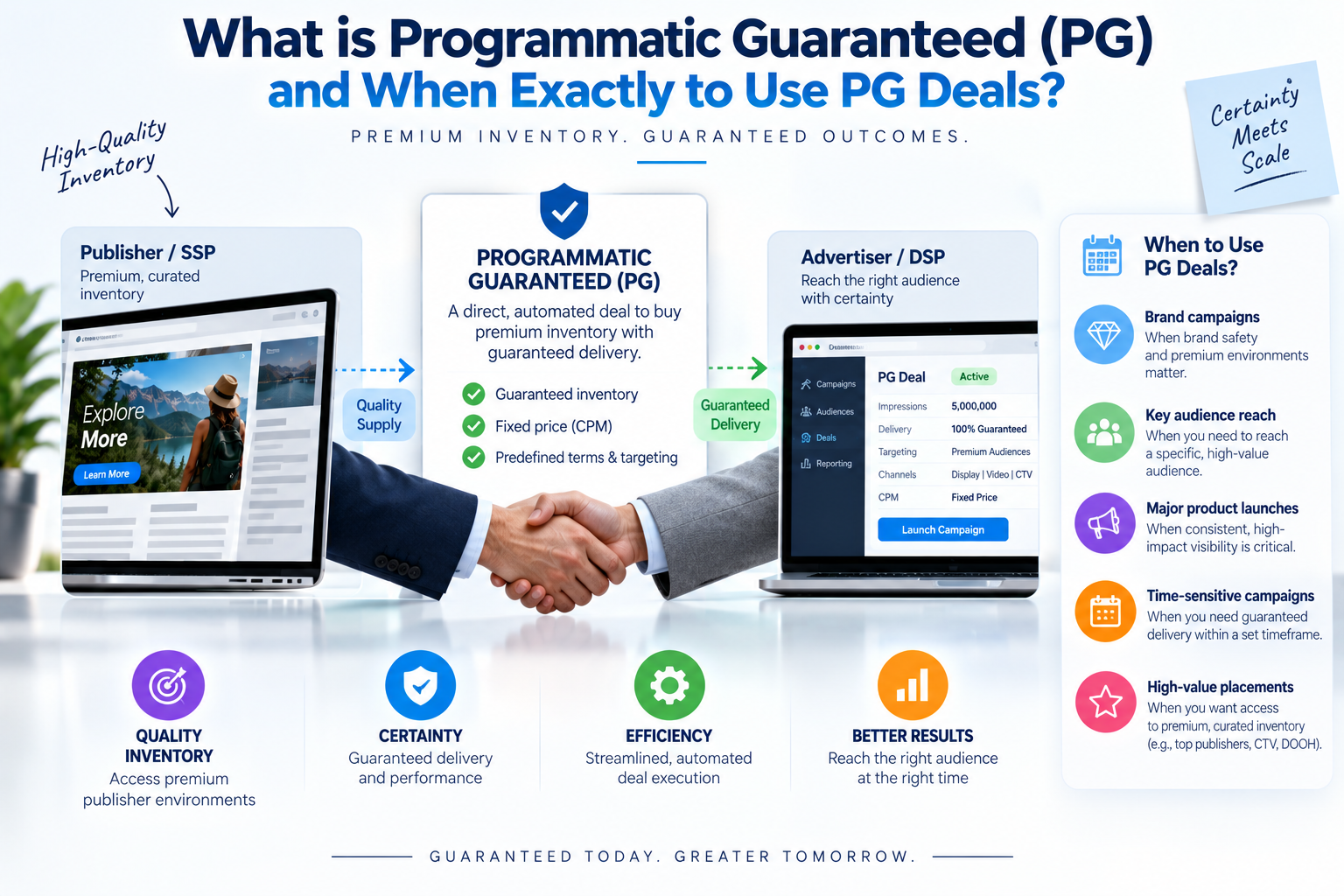
  • The deal: A website or an app (publisher) agrees to sell a specific number of impressions directly to a brand or advertiser at a set price.
  • No auctions: Unlike regular digital ads (open auction) where advertisers and brands fight for each impression via bidding, this bypasses the bidding process entirely.
  • The benefits: It gives advertisers total predictability, better brand safety (knowing exactly where their ad will show up), and guaranteed delivery.

Let’s Talk About Real-World Examples

To see why companies use this, let’s look at two common scenarios:

  • The political campaign: A political party needs to run ads strictly on trusted news websites to follow strict election laws and avoid appearing next to controversial content. Programmatic guaranteed lets them lock in those exact, safe spaces in advance.
  • The holiday retailer: A major store wants a massive homepage banner on a popular tech review site during the week of Cyber Monday. By using programmatic guaranteed, they lock in that slot ahead of time so that competitors can’t steal it when traffic is at its peak.

Why is Programmatic Guaranteed So Popular?

  • Huge time saver: According to a report published by Boston Consulting Group, agencies and advertisers save up to 29% more time using programmatic guaranteed compared to old-school manual buying methods.
  • Growing on Smart TVs: It’s becoming especially popular for Connected TVs (CTV)—the ads you see when watching your favorite shows on smart TVs—helping make up a quarter of all CTV ad buys in 2024.

The takeaway? While programmatic guaranteed doesn’t completely replace open auction ad buys or other ad buying methods, it’s a powerful tool for high-stakes campaigns where certainty, safety, and timing are everything.

Programmatic Guaranteed vs. Open Auction

FeatureProgrammatic GuaranteedOpen Auction
How it worksA direct, 1-on-1 agreement between an advertiser and a website owner (publisher).A virtual trading floor where dozens or hundreds of advertisers automatically bid against each other.
The analogyBooking a VIP table at a restaurant ahead of time for a set price.Showing up to a crowded auction house and fighting for whatever seats are left.
PriceFixed and pre-negotiated price.Dynamic – It changes second by second based on who bids the highest.
Is delivery guaranteed?Yes, you are promised a specific number of impressions which are guaranteed.No, you only win if your bid is high enough, and you might miss out if competition spikes.
Ad placement & safetyHigh control of ad placement and safety as you know the exact sites and apps where your ads will appear.Lower control, since your ads can end up on a wide variety of random websites and apps.
Best used forHigh-stakes campaigns, big brand launches, political campaigns, or major holidays (Cyber Monday, Black Friday, Thanksgiving, etc.).Campaigns which are focused on massive reach, flexibility, and getting a lot of cheap clicks or impressions.

In short:

  1. Use open auctions when you want maximum scale, flexibility, and low costs.
  2. Use PG when failure is not an option and you must have premium placement, absolute brand safety, and guaranteed visibility.

When to Use Programmatic Guaranteed

You should use programmatic guaranteed when your campaign requires absolute certainty, premium placement, and control. Because you are locking in a fixed price and a guaranteed number of views ahead of time, it is not meant for everyday, run-of-the-mill ads—it is reserved for high-stakes scenarios.

Let’s talk about the best scenarios for using PG deals:

  1. High-stakes and time-sensitive campaigns
    • The situation: Imagine you are running a campaign with a high budget and a tight window, where missing your timing or losing impressions to a competitor would ruin the campaign (e.g., political campaigns, movie premieres, or major retail holidays like Cyber Monday).
    • Why PG: It locks in your inventory in advance so you aren’t left scrambling or out-bid on an open market when traffic and competition peak.
  2. Strict brand safety and compliance needs
    • The situation: Your brand has a zero-tolerance policy for where ads appear (e.g., pharmaceuticals, finance, nutra, or government campaigns).
    • Why PG: Open auctions can sometimes land your ads on random low-quality websites. PG allows you to hand-pick specific, trusted publishers (major news sites or top review platforms) to protect your brand reputation.
  3. Buying premium or scarce inventory (like CTV)
    • The situation: You want high-impact ad formats, such as home page takeovers or ad slots on streaming services (CTV).
    • Why PG: Premium publishers often keep their best ad spaces out of open auctions to protect their pricing. PG gives you VIP access to inventory that you couldn’t otherwise buy programmatically.
  4. When you need exact forecasting
    • The situation: You have a fixed marketing budget and must hit a precise target of impressions to report back to stakeholders.
    • Why PG: Unlike open auctions where delivery can fluctuate based on how many people are bidding, PG guarantees that the publisher will deliver the exact number of impressions you agreed upon.
What is a Demand Side Platform – A Complete Guide

What is DSP (Demand Side Platform)? Introduction, and a complete guide.

Let’s talk about what is a DSP?

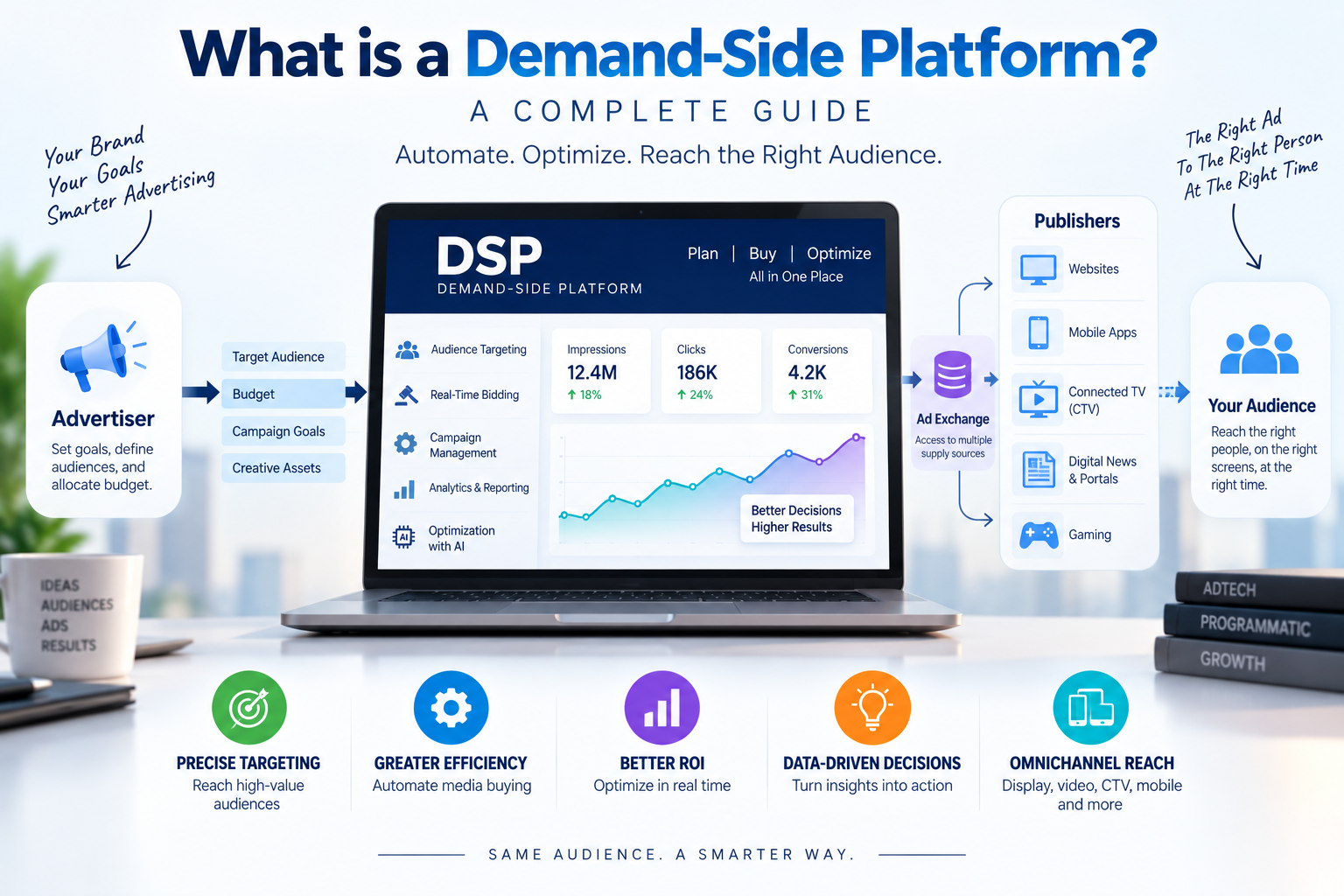
  • A Demand Side Platform is a software that helps advertisers and agencies to buy inventory, manage and optimize campaigns in real time across thousands of sites and apps.

How and from where do DSPs get the inventory?

  • A DSP is integrated with multiple SSPs (Supply Side Platforms) and Ad Exchanges, and every bid request (inventory) arrives from them. Fun Fact: A DSP almost never owns inventory!

Did you know?

  • The founding year of the DSP is 2007! The first DSP appeared around 2007, with companies like Invite Media and MediaMath building the tools.

What is a DSP? Did it simplify the advertising process?

A Demand Side Platform (DSP) is a software that helps advertisers and agencies to buy inventory, manage, and optimize campaigns in real time across thousands of sites and apps.

DSPs basically simplify the complex process of programmatic advertising by letting marketers, agencies, and advertisers set budgets, define audiences (1st party, 3rd party), upload creatives, and manage multiple campaigns seamlessly, all from one single platform.

The Difference Between a DSP and an SSP

In simple terms, a DSP is a buyer who buys inventory on behalf of advertisers and agencies, and an SSP is a seller who sells inventory programmatically via oRTB and VAST integrations.

  • DSP: DSPs are used by advertisers, agencies, and brands to buy ad inventory to reach the right audience at the right time by optimizing their spends against specific goals (e.g., Impressions, Clicks, CPC, Landing Page Visits, etc.).
  • SSP: SSPs are used by “Publishers” (such as The Times Of India, BBC, CNN, Forbes, etc.) to sell their available ad space to monetize their inventory. In simple terms, publishers sell the inventory to multiple SSPs to make the best out of the available inventory so that it doesn’t go to waste.

Ad Exchanges sit between DSPs and SSPs acting as a marketplace where impressions are bought and sold via a technology called Real-Time Bidding (RTB). Through these exchanges, Supply Side Platforms make inventory accessible and available to multiple DSPs, giving advertisers, brands, and agencies access to a broad range of placements without even needing to negotiate with individual publishers separately.

When an ad opportunity becomes available, SSPs offer it to the Ad Exchanges, and DSPs will be eligible to bid on those ad requests based on the advertiser’s pre-determined criteria such as bid price, frequency capping, creative dimensions, geo-targeting, and other targeting parameters set in the campaign. Finally, a winning ad is shown to the user.

This entire process takes less than a millisecond—faster than a publisher page or content can fully load—thus making a DSP the perfect and preferred platform for purchasing ad placements in bulk without sacrificing control.

Different Types of Targeting in Programmatic Advertising

  1. Demographic (Demo) Targeting: These are attributed to Age, Gender, and HHI (House Hold Income, if available).
  2. Contextual Targeting: The ads are placed alongside relevant content. This helps ensure the creatives align with the context of the page where the ads appear.
  3. Behavioural Targeting: This focuses on past browsing activity and engagement signals of a user, helping brands connect with users who have already shown interest in certain products or services based on their online behavior.
  4. Device Targeting: This targeting is done based on devices such as Device Type (Desktop, Mobile, Tablet, Connected TV (CTV)), Device Make, Model, Operating System (OS) and its versions, Browser, etc.
  5. Geo Targeting (Geographic Targeting): This allows the advertisers to control exactly where they want to show the ads. This ranges from Country, Region (State), City, Zip Code, and Co-Ordinates. Let us explain geo-targeting one by one:
    • Country/Region/City Targeting: You can target a campaign to an entire country or to a specific region or city. This is very common across all DSPs.
    • Zip Code Targeting: You can target a campaign to specific postal codes, giving advertisers complete control.
    • Coordinate-Based Targeting: This is precision targeting made using the Latitude and Longitude of a place and drawing a radius around it. This targeting works typically based on the device’s location signals.

Ways to Pitch Programmatic Advertising

Before Pitching, Understand the Advertising Goals

Most of the time, people make the same mistake of not trying to understand the advertisement requirements, client’s expectations, KPIs, etc., and straightaway pitching what services or products they have.

You need to sit with clients to understand what their objectives are and what products or services they are offering before you pitch the advertising strategy to them.

If the client or agency is expecting “brand awareness,” you can recommend high-impact display, CTV/OTT, online video/in-stream, etc. If they are expecting “engagement,” then you can pitch rich media and interactive ads, playable ads, rewarded video, native, and branded content. You should be very familiar with the client’s expectations even before giving them advertising plans.

Always lead with strategy, not the list of products you offer. Let’s understand the basics here. You have to act as a strategist. Instead of telling them what you offer, sit with the client to understand what their advertisement goals are. Are they looking for top-of-the-funnel (TOFU) or bottom-of-the-funnel (BOFU) advertising?

Match the format to the goal—recommend display for brand awareness and brand uplift, carousels to tell stories, and rich media for user engagement.

Addressing Common Misunderstandings

Myth: Programmatic is too complex and complicated.

A lot of clients think programmatic is way too complex. The first step towards solving this misunderstanding is by simplifying things and explaining to them that today’s DSPs are built for transparency and clarity. You can show them how easy the campaign set-up is, how precise the audience targeting can be, and how seamless the reporting is.

Myth: Programmatic is only for big brands and is too expensive.

We at Digital East GmbH have proved this wrong time and again. Programmatic advertising once used to be expensive, and only giants were using it. Now, we have made it so simple that you can start campaigns even with just a $1,000 budget. Anyone can launch a pilot campaign, test it, learn, and scale. In today’s era, most programmatic platforms support small brands and agencies with lower minimal spends.

Myth: Brands lose control due to automation.

Many brands and agencies think that they might lose complete control because of automation. The answer to this confusion is that automation enacts your strategy. New-age platforms offer real-time data, reporting, and performance dashboards that put oversight back in your hands. You have the control panel to manage budgets, pacing, frequency cap tightening, targeting, creative swaps, etc. Programmatic platforms are built on transparency.

Position Programmatic as High Reward and Minimal Risk

You need to guide with the promise of programmatic as transparent, fast, controllable, and reliable.

  1. Start Small and Scale: Brands don’t want to commit big budgets to something they haven’t seen work. Programmatic lets them start small, see results as they happen, and change course whenever they are ready and whenever they need to.
  2. Total Agility: Audiences change their minds mid-campaign. With programmatic, so can you! Move the budget, adjust the bids, or put up fresh creative without pausing anything. Programmatic has got everything.

Explain Why Multi-Channel Reach Matters

Trace the path across channels right from display – video – audio – CTV/OTT – pDOOH – In-Game.

Here is what this looks like in practice:

  • Start with native: Place the brand inside content the audience already trusts, in a format that doesn’t interrupt the read.
  • Follow with display: Keep the brand in view for anyone who has already come across the native placement.
  • Bring in CTV: A short, well-made spot on the big screen turns passing awareness into something the audience actually remembers.
  • Layer in audio: Reach the same set of people while they are driving their automobile, walking, jogging, or working—the moments a screen can’t reach.
  • Add pDOOH: Show up in high-footfall places such as malls, concerts, bus stations, airports, etc., so the brand appears in the physical world too.
  • Finish with in-game: Catch the audiences during long, attentive sessions where there’s little else competing for their focus.

A campaign might run like this: Native to introduce, display to keep the brand visible, CTV/OTT to make it memorable, audio to catch people on the move, pDOOH to plant it in the real world, and in-game to reach them where attention runs deepest.

Address Targeting and Measurement Without the Detail

Talk about smarter insights, not spreadsheets. The point of programmatic isn’t the numbers it produces. It’s what those numbers tell you about your business.

Start with what a client already owns—their own customer data. Because it’s collected with permission and comes straight from their own customers, it’s accurate; it tells them who those customers are and how they behave. That means they can group their audience sensibly, reach the right people, and run ads that actually land. The same data lets them find new people who look and behave like their best customers, or reconnect with people who have bought before without depending on third-party tracking.

Live dashboards then show what’s working while the campaign is still running, not days or weeks later.

When pitching, skip the industry vocabulary. Frame it around three things instead:

  • Knowing your audience: Who responded, and what they did next.
  • Making smarter moves: Changes based on evidence, not hunches.
  • Spending better: Every rupee reaching someone worth reaching.

Framed this way, targeting and measurement stop being a box to tick and start being something you work on together. The best programmatic pitches don’t sell the technology. They sell control—over who sees the brand, how often, and what happens next. Get that across in plain language, and the platform details take care of themselves.

Benefits of Programmatic Advertising

Even though digital advertising has been there since the early 1990s, programmatic advertising began in 2013 with the introduction of Google’s AdSense platform.

In the earlier days, the options were very limited, with brands and agencies primarily depending on just display advertising and very basic keyword targeting to reach audiences and enhance campaign performance.

Within a few years, a few other programmatic platforms entered the mix, allowing brands, agencies, and publishers to buy and sell inventory across multiple channels—including video, native, CTV, audio, in-game, and programmatic digital out-of-home (pDOOH)—revolutionizing programmatic advertising from a niche solution to the preferred method marketers use for delivering targeted multi-channel campaigns across digital and offline touchpoints like direct mail.

How Does Programmatic Advertising Fit Your Needs?

Let’s deep dive into how programmatic advertising fits into the modern marketing strategy.

In today’s world, marketers depend on an increasing number of strategies and channels, from SEO and content marketing to social media and email marketing, to engage their audiences and drive better results. But doing it efficiently and at scale has never been more demanding.

This is exactly where programmatic advertising enters.

Programmatic advertising provides supreme accuracy, flexibility, and efficacy, allowing marketers to target the right audiences on the right platform at the perfect time while supplementing and enhancing other marketing efforts they already have in place.

The Core Benefits of Programmatic Advertising

FeatureThe Old WayThe Programmatic Way
EfficiencyManual calls, price negotiations, contract signing, and uploading creatives to multiple publisher platforms individually.Login to a single DSP, launch across thousands of sites, apps, and smart TVs instantly with a few clicks.
Cost & ScaleProhibitive entry barriers; only multi-million dollar corporations could afford major TV networks or popular websites.Group buying power via single ad slots; local startups and giants can bid on the exact same premium inventories.
FlexibilityStatic print ads, billboards, or magazines. Zero room for edits once printed or published.Total real-time control; update imagery, rewrite copy, or pause campaigns mid-broadcast instantly.
ReachFragmented and siloed to one specific physical location, website, or single TV channel.Omnichannel presence everywhere your audience goes—news portals, mobile games, or streaming apps simultaneously.
TransparencyBlind trust metrics; hard to prove billboard impressions or exact conversion attribution.Real-time dashboards displaying precise site lists, view-ability duration, click-throughs, and purchase conversions.

1. Targeting

In simple terms, programmatic advertising is like hiring a digital matchmaker that instantly finds the perfect customers for your business. Instead of paying for a massive billboard on a highway hoping the right person sees it, you use a smart computer system to show your digital ad only to the exact people who care about your product or service.

Targeting parameters include:

  • Demographics: Showing ads based on age, gender, or location (e.g., targeting only 30-year-olds in Mumbai).
  • Behaviour: Targeting people based on actions, such as frequent online shoppers or frequent travelers.
  • Interests: Targeting people based on affinity categories like cooking, scuba diving, gym workouts, or yoga.

2. Efficiency – Done in a Flash

Eliminate the friction of old-school media buying. Instead of juggling multiple publisher contracts, a single login to a Demand-Side Platform (DSP) automates placement across the entire web ecosystem instantly.

3. Cost-Effective: Group Buying Power

Because programmatic systems allow purchasing on a granular, single-slot basis, barriers to entry vanish. A local bakery can compete for consumer attention on the exact same high-value properties as a multi-national enterprise.

4. Flexibility: Change Your Mind Instantly

If live performance data shows creative fatigue or a pricing typo, you don’t have to wait for new prints. Adjustments happen mid-flight with the click of a button, giving you total dynamic control every second.

5. Reach: Be Everywhere, at Once

Break free from single-channel constraints. Your target accounts encounter your brand messaging dynamically whether they are reading digital newspapers, playing mobile titles, or streaming connected TV content.

6. Transparency and Optimization

With programmatic advertising, there are no secrets. You can log into your DSP dashboard at any time to review granular performance metrics:

  • Exact lists of serving sites, apps, and TV channels.
  • Impressions delivered and video watch durations.
  • Click-through rates (CTR) and landing page conversions.

Why this matters: Because you have access to continuous data streams, you can optimize campaigns on the fly. If performance lags on gaming apps while thriving on news platforms, you can dynamically shift budgets instantly, ensuring capital works as hard as possible.