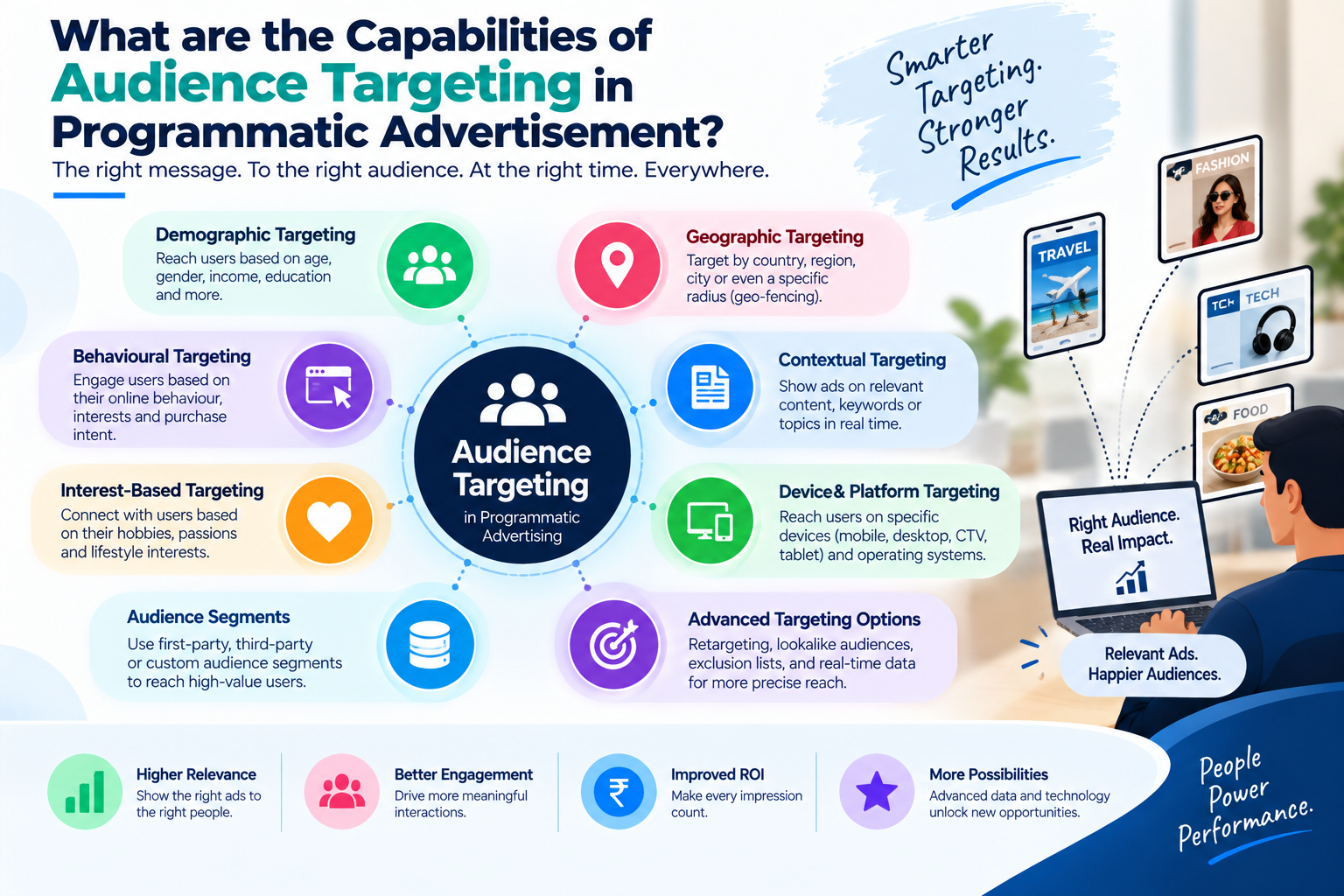
What are the capabilities of Audiences Targeting in Programmatic Advertising?

Audience targeting helps advertisers decide who should see an advertisement based on different characteristics, interests and behaviors and other available signals.

When this targeting is combined with programmatic advertising, advertisers can automatically buy digital advertising space and show ads to selected audience at scale.

What is Audience Targeting

Audience Targeting means selecting a specific group of people for an advertising campaign instead of showing an advertisement to everyone.

The Advertiser can create an audience based on available data and target signals. Audience targeting helps advertisers show the right message to a relevant group of people.

How does Audience Targeting work in Programmatic Advertising

Suppose a company wants to advertise smartwatches to people who may be interested in fitness.

  1. The advertiser Defines the Audience: The Advertiser decides who they want to reach.
  2. The Audience Is Built Using Available Signals: The advertising platform can use different signals to help identify suitable users or advertising opportunities. The signals can include things such as: First party data, website/app interactions, Location, Device information and other factors.
  3. The Programmatic System Finds Opportunities: When a suitable advertising opportunity becomes available, the programmatic system evaluates whether it matches the advertiser’s campaign requirements.
  4. The Advertisement is Shown: If the opportunity meets the campaign targeting and bidding requirements the advertiser can compete for the advertising space. If the advertiser wins the auction, the advertisement is displayed to the user.

Key Capabilities of Audience Targeting

  1. Demography Targeting: Demographic targeting allows advertisers to reach audience based on characteristics such as age or gender where those signals are available and permitted.
  2. Geographic Targeting: Geographic Targeting allows the advertiser to focus on the specific location.
  3. Interest-Based Targeting: Interest-Based targeting focuses on what people may be interested in.
  4. Behavior Targeting: Behavior Targeting uses available signals about a user’s previous interaction or activities.
  5. Contextual Targeting: It is slightly different Instead of focusing primarily on who the user is contextual targeting focuses on what content the user is viewing.
  6. First-Party audience targeting: Advertisers can use information collected directly from their own customers or users to create first-party audience.
  7. Retargeting: Have you ever visited an online store, looked at a product and noticed advertisements for the same brand later? This is commonly known as retargeting.
  8. Lookalike Audience Targeting: Some advertising platforms can help advertisers find new people who share characteristics or signal with an existing audience.
  9. Device Targeting: Programmatic advertising can also use device-related targeting.
  10. Audience Segmentation: Audience targeting allows advertisers to divide a large audience into smaller groups.Example:
    • Audience 1: New website visitors
    • Audience 2: Existing customer
    • Audience 3: Customer who haven’t purchased recently
    • Audience 4: People interested in particular products
    Each group can receive a different message.

Combining Multiple Targeting Capabilities

One of the biggest advantages of programmatic advertising is that advertisers can often combine different targeting segments. However, more targeting is not always better. If an audience becomes too narrow, the campaign may have difficulty reaching enough people or archiving efficient results.

Why Audience Targeting Is Important?

Without audience targeting an advertiser may show advertisements to a very broad audience.

Many people who see advertisements may not have interest in that product.

With audience targeting, the advertiser can focus its budget on audience that are more relevant to its campaign, this will help your business by reaching the relevant customers.

The future of Audience Targeting

Audience Targeting is changing as the digital advertising industry becomes more privacy focused.

The future of programmatic advertising is not simply about collecting more data. It is about using better signals, better technology and responsible data practices to deliver useful and relevant advertising.

Conclusion

Audience targeting is one of the most important capabilities of programmatic advertising.

It helps advertisers decide who they want to reach, where they want to reach them, and how they want to communicate with them.

Programmatic advertising automates the buying of digital advertising, while audience targeting helps determine audience and advertising opportunities are relevant to the campaign.
The Future of Connected TV and CTV Advertising

Understanding CTV, How It Works, and Its Benefits for Advertisers

What is Connected TV (CTV)?

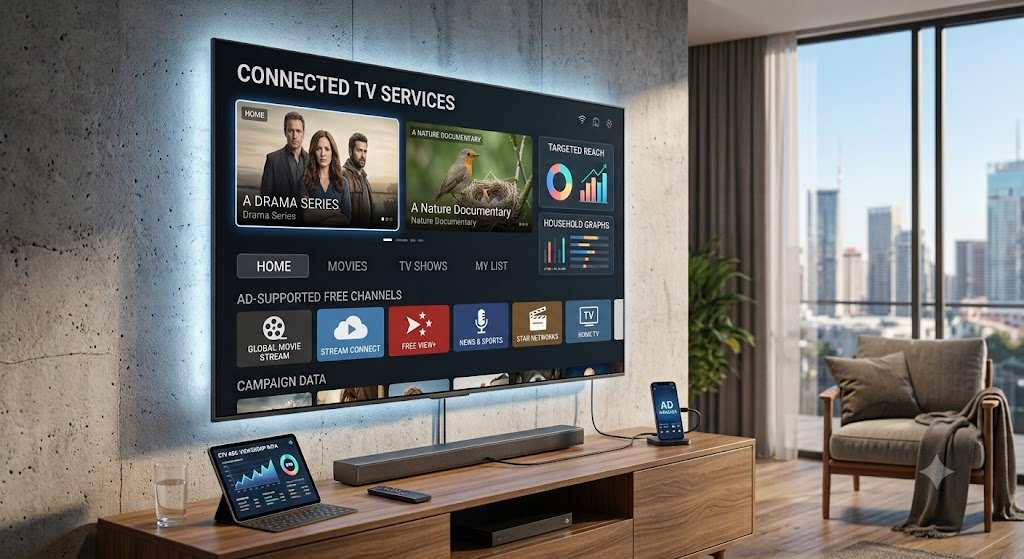
Connected TV (CTV) refers to a television that is connected to the internet and can stream digital content. This includes Smart TVs and television connected through devices such as Roku, Amazon Fire TV, Apple TV, and other streaming devices.

CTV Combines the big screen experience of traditional television with the targeting, flexibility, and measurement capabilities of digital advertising.

Why is CTV Growing rapidly?

More People are moving from traditional cable and satellite TV to streaming services. At the same time, viewers are spending more time watching digital contents on the television. This creates a growing opportunity for advertisers

  • Large and growing streaming audience
  • Big-screen impact with a digital advertising experience
  • More precise audience targeting and traditional TV
  • Better campaign measurement and reporting
  • Flexible buying options through programmatic advertising

CTV vs Linear TV

Linear TV follows a fixed schedule, and advertisers generally buy specific time slots or programs. CTV delivers streaming content over the internet, provides more flexibility in how audience are targeted, and how campaigns are measured.

  • Linear TV: Broad audience targeting and fixed schedules.
  • CTV: More data-driven targeting and flexible campaign management
  • CTV can support reach, frequency management, retargeting, and cross-device strategies

How CTV Advertising Works

CTV advertising can be purchased programmatically, similar to other forms of advertising. When a viewer reaches an available ad break, an ad opportunity is sent through the programmatic ecosystem.

  • Advertiser: Sets the campaign goal, audience, budget, and creative.
  • DSP: Evaluates available impressions and submits bids based on campaign targeting
  • SSP/Exchange: Provides access to available CTV inventory
  • CTV platform: Serves the winning ad within the streaming content.
  • Viewer: Sees the video advertisement on the connected TV.

Key benefits of CTV advertising.

  • High Engagement: Full screen video creates a strong viewing experience.
  • Advanced targeting: Advertisers can use available demographic, behaviour, geographic, and audience data.
  • Reach and frequency: Campaign can reach households while managing how often ads are shown.
  • Cross-device Marketing: CTV can work together with mobile, desktop, and other digital channels.
  • Measurable Results: Advertisers can report on impression, reach, frequency, VCR, completion rates, and other available metrics.
  • Brand safety: CTV campaign can access premium streaming environment, depending on the inventory source and deal.

What are Fast channels?

FAST stands for Free Ad-supported streaming Television. FAST services provides free, TV-style streaming content that is funded by advertising. Examples include platform such as Pluto TV, Tubi, Plex, Roku channel, Samsung TV Plus, and others ad-supported streaming services.

FAST inventory can be an important part of CTV advertising because advertisers can reach viewers in an ad-supported streaming environment.

The future of CTV Advertising.

The future of CTV is expected to become more data-driven, measurable, and integrated with other digital channels. As streaming audience continue to grow, advertisers can use CTV to combine the reach and impact of television with the targeting and measurement of digital advertising.

  • More advanced audience targeting
  • Improved measurement and attribution
  • Greater use of programmatic buying
  • More interactive and shoppable video experiences
  • Strong integration with multi-channel campaign

Final Thoughts

CTV is changing the way brands connect with television audiences. It offers the impact of the big screen while providing many of the benefits of the digital advertising, CTV can be powerful part of modern multi-channel strategy when the right audience, inventory, creative, and measurement approach.

Programmatic audio advertising

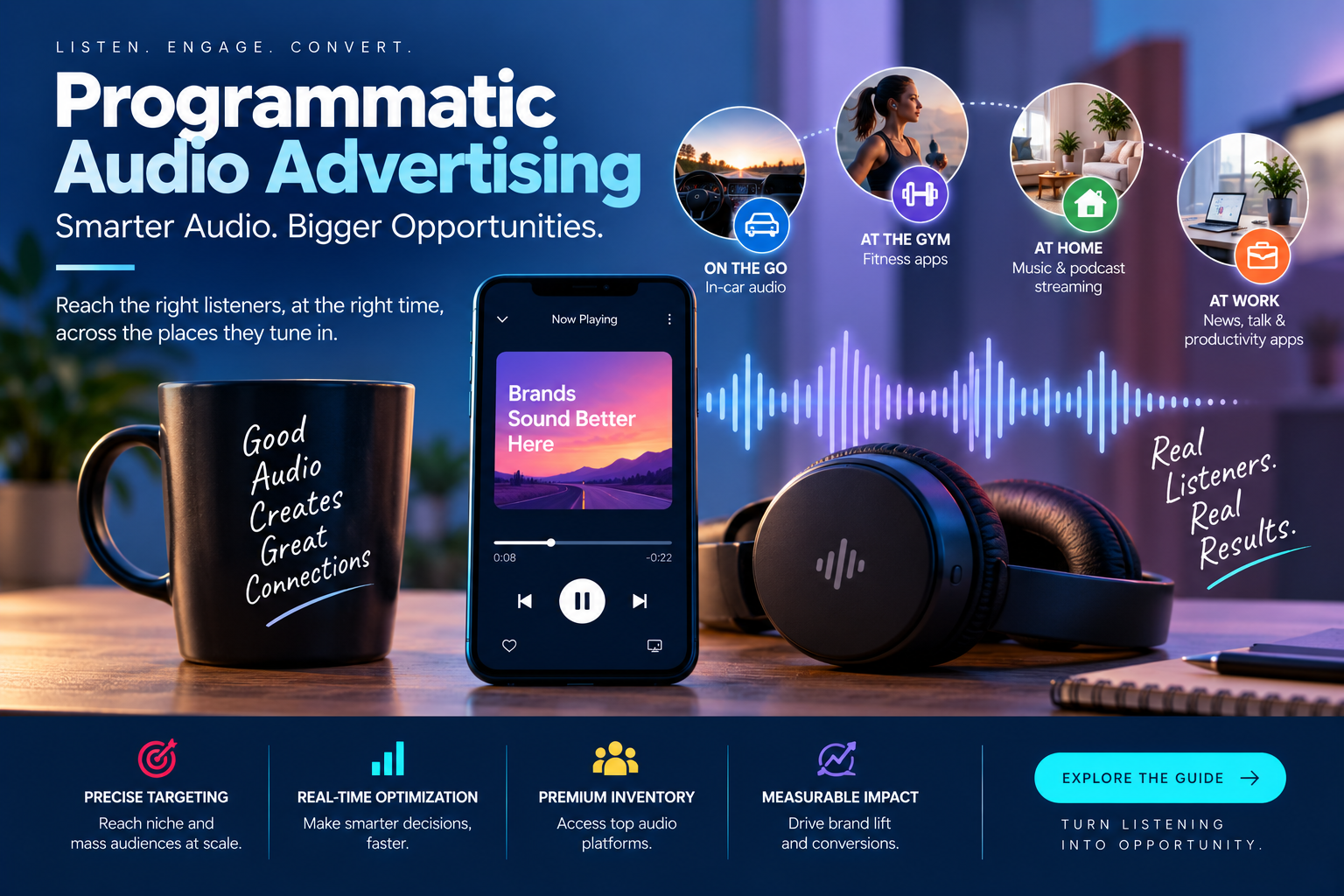
You know how Instagram and YouTube show you ads based on what you like, where you live and what you are browsing? Programmatic audio advertising does the same thing but with audio ads that play on platforms like Spotify, Apple Music, podcasts and internet radio.

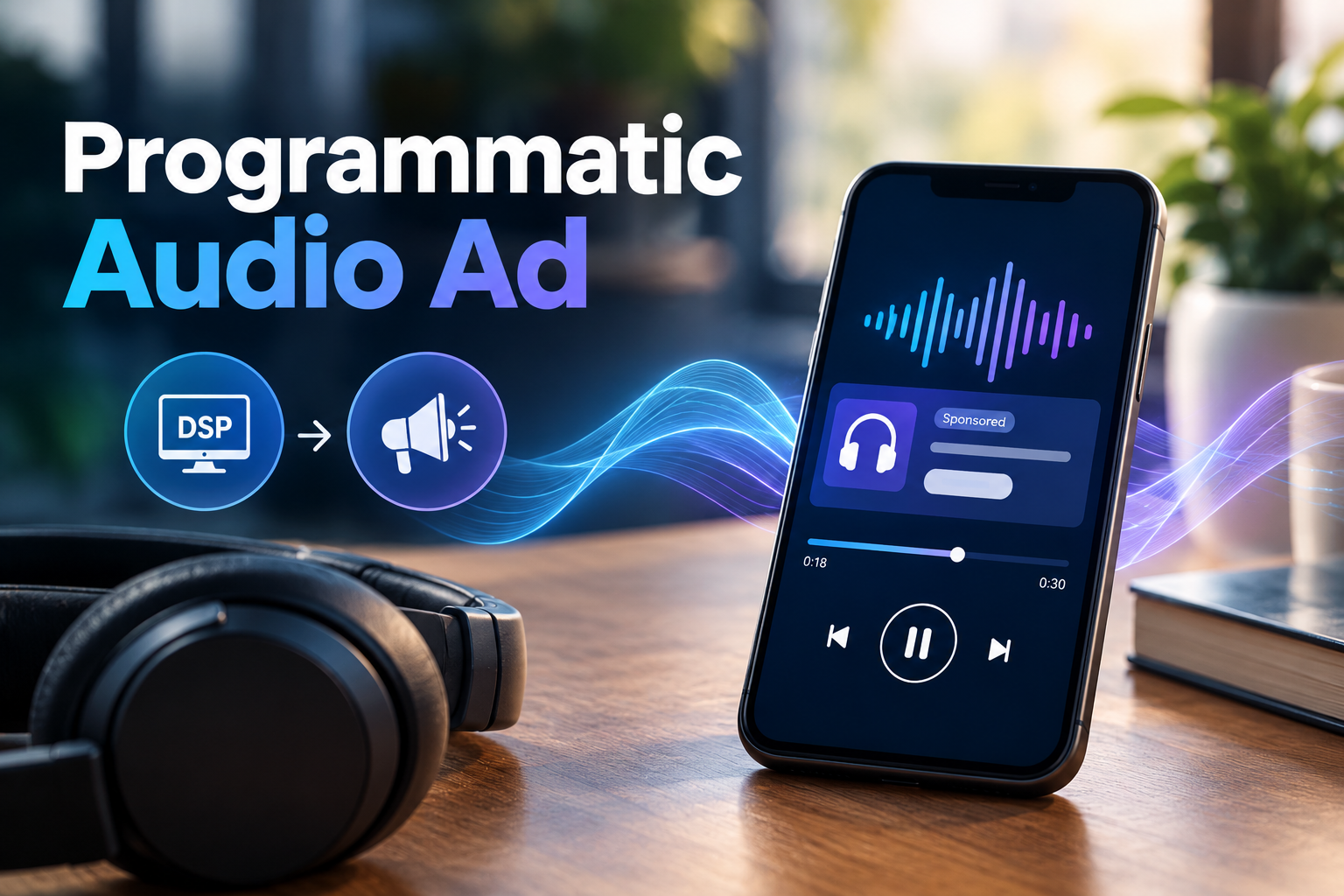
Programmatic audio advertising is the automated buying, selling and placement of audio advertisements within digital audio content.

Advertiser can use single platform to access inventory from multiple audio publishers and deliver ads to audiences across different devices.

The key difference between radio and programmatic audio advertising is targeting.

Why Is Audio Advertising So Effective?

One of the biggest strengths of audio is its ability to capture attention without requiring a screen.

When someone listens to a podcast or musical playlist, they are actively paying attention to what they hear. This creates an opportunity for brands to build a more personal connection.

How Programmatic Audio Can Improve Campaign Performance

Adding audio to a media plan can strengthen a campaign in several ways.

  1. It creates a more personal Brand Experience. Think about listening to someone speak through your headphones. Their voice feels much more direct and personal than a banner sitting on a webpage. A friendly and related voice can make a brand feel approachable while an energetic, soundtrack can create excitement.
  2. It Enable Precise Audience Targeting. Programmatic audio is not simply about playing an advertisement to anyone who happens to be listening. Advertiser can use audience and content data to create more relevant campaigns.

Depending on the available data and platform, targeting can include factors such as:

  • Location
  • Demographics
  • Online behaviour
  • Household income
  • Interests
  • Music genres
  • Playlists
  • Moods and moments

For example, a sports brand could focus on audience interested in fitness and sports.

Why Millennials and Gen Z Are Important for Audio Advertising.

Younger consumers, particularly Millennials and Gen Z are highly engaged with digital audio.

Music streaming, podcast and other forms of digital audio have become part of their everyday media habits. These audiences are also becoming increasingly important to brand as their purchasing power grows.

Creating An Audio Ad That People Actually Remember.

Programmatic technology can help you reach the right audiences, but targeting alone cannot make a campaign successful. Here are four important principles to keep in mind.

Keep It Brief

Audio advertisements are commonly produced in 15-30 seconds format. Focus on what really matters.

Keep The Message Simple

Audio script should clearly communicate:

  • What are you offering?
  • Why should the listener care?
  • What should they do next?

Avoid unnecessary details and complicated language.

Include a Strong Call to Action

Every good advertisement should tell the audience what to do next – CTA Example:

  • Shop now
  • Learn more
  • Download the app
  • Book today
  • Visit our website

Make It Conversional

Your audio ad should sound like belongs in the environment where it is being heard.

Programmatic Audio vs Traditional Radio

Traditional radio typically focuses on purchasing advertising spot within a particular station or program.

Programmatic audio focuses more heavily on audience targeting and digital measurement.

Conclusion:

Programmatic audio allows brands to reach relevant audiences while they are listening to music, podcast, playlists and other digital content. Unlike traditional radio, it can provide sophisticated audiences targeting, detailed measurement and opportunist for real time optimization.

How Does Brand Safety Work in Programmatic Advertising

Programmatic advertising allows brands to reach audiences across millions of websites, apps, videos, CTV platforms, and other digital environments.

While this provides huge opportunities for advertisers, it also creates a challenge how can brands make sure their ads appear in safe and appropriate environments. This is where brand safety controls come into play.

What Is Brand Safety in Programmatic Advertising?

Brand safety in programmatic advertising is the process of preventing ads from appearing alongside content or in environments that could negatively affect a brand’s reputation. Unlike traditional advertising, where advertisers may have more control over individual placements, programmatic advertising involves automated buying and selling of impressions.

A single campaign can potentially reach thousands of publishers and platforms. Therefore, brand safety needs to be built into the automated ad-buying process.

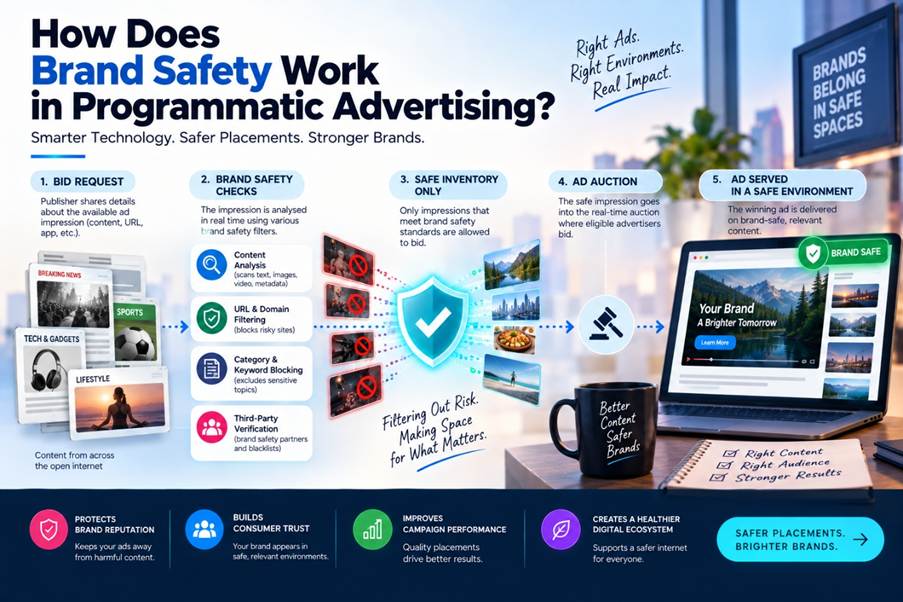
How Does Brand Safety Work?

A simplified programmatic advertising flow looks like this, Advertiser → DSP → Ad Exchange/SSP → Publisher → User

When a user visits a website or opens an app, an ad opportunity can be sent into the programmatic ecosystem. Before the advertiser’s ad is served, various signals and safety controls can be used to determine whether that opportunity is suitable.

If the impression meets the advertiser’s requirements, the DSP can participate in the auction and potentially serve the ad. If the environment is considered unsafe or unsuitable, the impression can be excluded from the bidding process. This decision happens within milliseconds.

Key Brand Safety Controls

1. Blocklists

  • A blocklist contains websites, apps, publishers, or other environments where an advertiser does not want its ads to appear.
  • For example, a brand may block domains associated with adult content, hate speech, or other sensitive categories.
  • Blocklists are useful for excluding known risks, but they need to be regularly updated as new websites and apps appear.

2. Whitelists

  • An whitelistlist works in the opposite way. It contains websites, apps, or publishers that have been approved by the advertiser.
  • The campaign can then be restricted to these approved environments.
  • whitelists provide greater control and can be particularly useful for brands with strict advertising requirements. However, they can also reduce the available inventory and campaign reach.

3. Content and Category Controls

Advertisers can exclude specific types of content or sensitive categories from their campaigns. Common exclusions may include,

  • Adult content
  • Violence
  • Hate speech
  • Extremist content
  • Illegal activities
  • Misinformation
  • Sensitive news

These controls help advertisers avoid broad categories of content without having to manually identify every individual website.

4. Keyword and Topic Exclusions

Advertisers can also use keywords or topics to identify content they want to avoid. For example, a brand may choose to exclude content related to certain sensitive subjects. However, keyword-based blocking has limitations. A keyword can appear in completely different contexts, so modern brand safety solutions increasingly consider the overall context of the content, rather than relying only on individual words.

The Role of AI and Contextual Technology

Modern brand safety increasingly uses AI and machine learning to understand digital content at scale. Instead of simply checking whether a page contains a particular keyword, technology can analyse the context and meaning of the content.

For example, a news article may contain the word “violence” while reporting responsibly on a current event. Automatically blocking every page containing that word could prevent ads from appearing on otherwise acceptable content. Contextual technology can help distinguish between content that discusses a sensitive topic and content that promotes it.

This allows advertisers to create more precise brand safety strategies while avoiding unnecessary restrictions.

Third-Party Brand Safety Solutions

Advertisers can also work with specialized third-party technology providers that evaluate websites, apps, video content, and other advertising environments. These solutions can provide additional signals about,

  • Content classification
  • Brand suitability
  • Invalid traffic
  • Publisher quality
  • Risk levels
  • Sensitive topics

These signals can then be used by advertisers and their programmatic partners to make better buying decisions.

Brand Safety and the Programmatic Auction

Brand safety can influence the programmatic auction before an advertiser actually bids on an impression. For example,

User visits website → Ad opportunity becomes available → Brand safety checks are applied → Unsafe impression is excluded → Safe impression enters bidding → Winning ad is served This approach helps advertisers avoid spending money on impressions that do not meet their brand safety requirements. It also makes brand safety more scalable because decisions can be made automatically across large volumes of inventory.

Brand Safety vs. Brand Suitability

It is also important to understand that brand safety and brand suitability are not exactly the same. Brand safety focuses on avoiding environments that are generally considered unsafe or inappropriate. Brand suitability goes further by considering what is appropriate for a specific brand.

For example, a news website covering a sensitive event may be acceptable for one advertiser but unsuitable for another. Each brand can define its own level of tolerance based on its audience, industry, and reputation.

Final Thoughts

Brand safety is an important part of programmatic advertising because automated buying gives advertisers access to a huge and constantly changing supply of inventory.

By using blocklists, allowlists, content controls, contextual technology, AI, and ongoing monitoring, advertisers can reduce the risk of their ads appearing in unsuitable environments. The key is finding the right balance. Overly strict controls can limit campaign reach, while weak controls can expose a brand to unnecessary risk.

A well-planned brand safety strategy allows advertisers to scale programmatic campaigns while maintaining control over where their brand appears.

How to create a Programmatic Audio Ad

Programmatic Audio campaign simple guide

Programmatic Audio advertising helps brands reach relevant audiences while they listen to music, podcasts, digital audios, and other online audio content. Unlike traditional radio, programmatic audio uses digital technology to help advertisers targeting audiences, manage budgets, and measure campaign performance.

What is programmatic Audio Advertising?

Programmatic audio is the automated buying and selling of digital audio ad placements. The basic process is: Advertisers à DSP à SSP/Exchange à Audio publishers à Listener The advertisers set the campaign objective, audience, budgets, and targeting. The DSP then finds suitable audio ad opportunities and bids on them automatically.

How to Create a Programmatic Audio Ad

  1. Define Your campaign Goal Start by deciding what you want to achieve. Common goals include:
    • Brand awareness
    • Website traffic
    • App downloads
    • Lead generation
    • Sales and conversion A clear goal helps determine the right audience, creative, and performance metrics.
  2. Select your target Audience Choose an audience that is relevant to your product or service. Depending on the platform, targeting may include:
    • Demographics
    • Location
    • Interests
    • Behaviours
    • Context
    • First-party audiences
    • Device
  3. Create a simple Audio Script A good audio ad should communicate the main message quickly. Keep the scripts:
    • Short
    • Clear
    • Engaging
    • Brand-focused
    • Action-oriented
  4. Produce the Audio Creative Record the script using a clear and engaging voice. You can also use background music or sound effects, but they should not overpower the voice. Before uploading, make sure the audio file meets the required format, duration, quality, and technical specifications of the DSP or publishers.

Launching the campaign

  1. Set up the Programmatic audio campaign. Once the creative is ready, configure the campaign in your DSP. Set:
    • Campaign objective
    • Audience
    • Location
    • Inventory
    • Budget
    • Bid strategy
    • Creative
    • Tracking
  2. QA before launch Check everything before the campaign goes live:
    • Audio quality
    • Creative duration and format
    • Targeting
    • Budget and bid
    • Landing page
    • Tracking
    • Call to action A proper QA helps to prevent delivery and tracking issue
  3. Launch and Monitor After launch, monitor the campaign regularly to understand how it is performing. Important matrices include:
    • Impression: Number of times the ad was served.
    • Reach: Number of unique listeners reached.
    • Frequency: Average number of times a listeners heard the ad.
    • Completion rate: percentage of ads played to completion.
    • CTR: Percentage of impressions that resulted in click.
    • CPM: Cost of every 1000 impressions.

Best Practices

Keep the message Simple Listeners should understand the main message quickly.

Use strong call to action Tell the listeners exactly what to do next.

Test Different Creative Try different message, voice and call to action.

Manage Frequency Avoid showing the same ad too many times to the same listener.

Optimize regularly Review performance and adjust audience, inventory, bids, and budget based on results.

Final takeaway

Creating a programmatic audio campaign can be summarized in six simple steps: Define à Target à Create à QA à Launch à Optimize With the right audience, a clear message, quality creative, and continuous optimization, Programmatic audio can help brand reach listeners effectively and become an important part of broader digital advertising strategy.

CTV vs. OTT Advertising: What’s the Difference?

What is OTT?

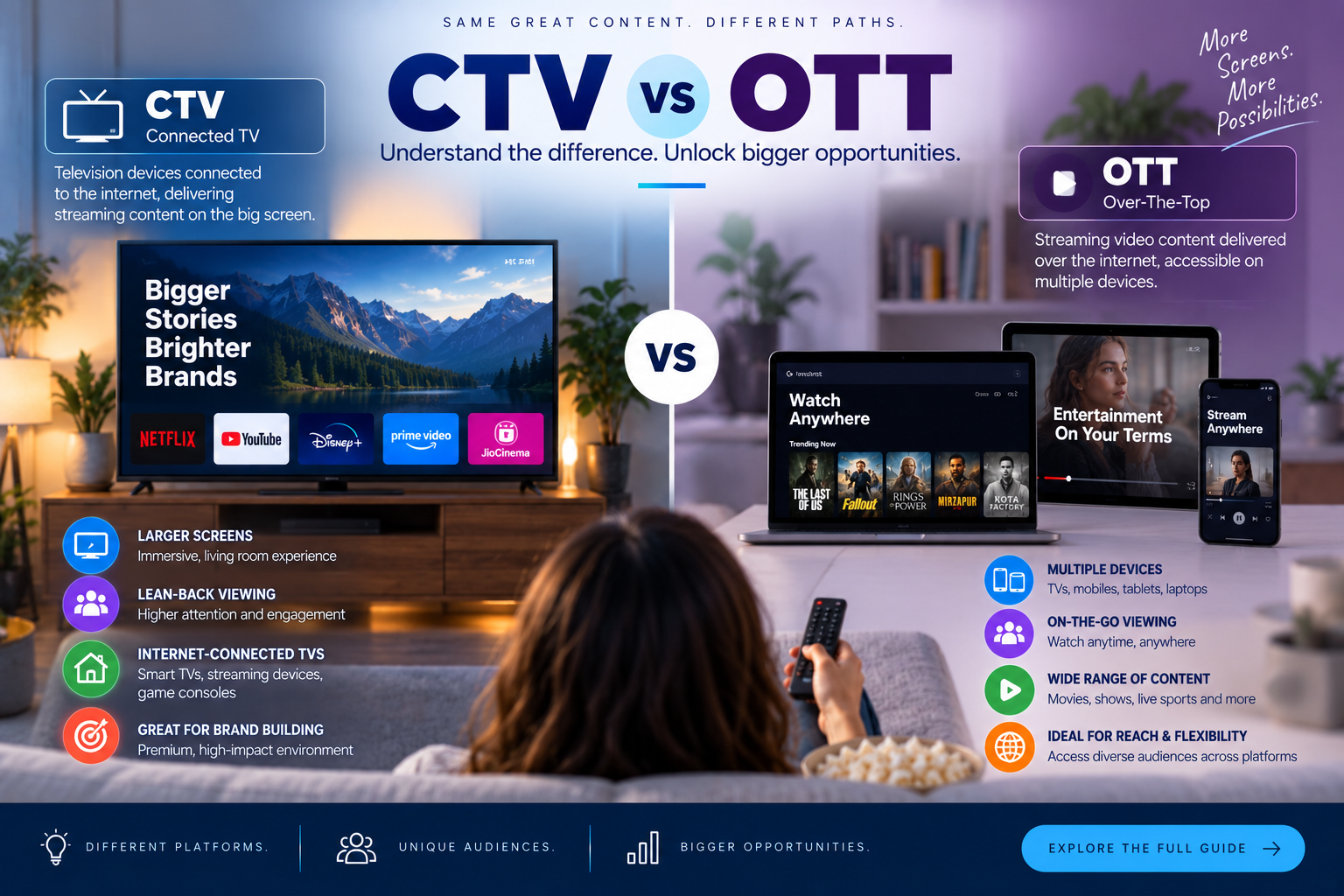
OTT stand for Over-The-Top. It refers to television shows, movies and other video content that people watch over the internet instead of through traditional cable or satellite television.

In the past, if you wanted to watch TV, you usually needed a cable or satellite connection. Today, you can simply connect to the internet and stream content whenever you want.

Popular OTT platforms include:

  • Netflix
  • Amazon Prime Video
  • Disney+
  • Hulu
  • Peacock
  • YouTube

OTT content can be streamed on many different devices:

  • Smart TVs
  • Smartphones
  • Tablets
  • Laptops
  • Desktop computers
  • Gaming consoles

What is CTV?

CTV stands for Connect TV. A connected TV is a television that can connect to internet and stream digital content.

For example:

  • Smart TV
  • Amazon Fire TV

When you watch Netflix on a Smart TV, you are watching OTT content on a CTV device.

CTV vs. OTT: What’s the difference?

CTV and OTT are closely connected, but they are not exactly the same thing.

A simple way to remember is:

  • OTT – the platform which streams content.
  • CTV – device used to watch OTT content.

For example, watching the same Netflix movie in two different situations.

  • Situation 1 – Watching OTT content on smartphone.
  • Situation 2 – Watching the same OTT content on a smart TV.

So, CTV is essentially a part of the larger OTT ecosystem.

Comparing OTT & CTV

OTTCTV
Describes content delivered through the internet.Describes a TV connected to internet.
Can be watched on phone, tablets, laptops and TVs.Specifically refers to television screens.
Includes streaming services and digital video.Includes smart TVs and TVs connected to streaming devices like amazon fire stick.
Focuses on how content is delivered.Focuses on where the content is viewed.

How do CTV and OTT work Together in Advertising?

This is where things become especially important for marketers and advertisers. When advertisers run ads on streaming television, they are often buying CTV advertising inventory, while the actual video content is being delivered Over-The-Top through the internet.

For example – A person watches a show on a smart TV, before the show begins, he sees an advertisement for a new smartphone.

The show delivered through on OTT streaming service, while the advertisement is shown on a CTV device. So, in advertising often CTV and OTT work together.

Advantages of CTV Advertising

CTV has become increasingly important for advertisers because it combines some of the strengths of traditional television with a targeting and measurement capabilities of digital advertising.

1. CTV Helps advertisers reach more Viewers.

More people are choosing streaming services instead of traditional cable and satellite TV. The change is often called cord-cutting. Cord-cutting happens when people cancel their traditional cable or satellite TV subscriptions and move towards streaming services.

Why are people moving from traditional to OTT? Instead of waiting for a particular program to come on at a particular time, viewers can choose:

  • What they want to watch?
  • When they want to watch it?
  • Which device they want to use?
  • Which streaming service they want to use?

As more people move from traditional television to streaming, CTV gives advertisers an opportunity to reach this growing audience.

2. CTV offers Better Targeting than Traditional TV

Traditional television advertising generally reaches a broad audience. For example, if a company places an advertisement during a popular tv show, everyone watching that show may see the advertisement.

CTV can provide advertisers with more advanced targeting options. Depending on the platform and available data, advertisers may be able to target audiences based on factors such as:

  • Location
  • Age
  • Interests
  • Viewing behaviour
  • Household characteristics
  • Previous interactions with brands

This means advertisers can try to show their ads to people who are more likely to be interested in their products or services. A sports brand can target viewers who frequently watch sports related content.

3. CTV provides better measurement and Optimisation

One major advantage of digital advertising is the ability to measure campaign performance. CTV brings some of these digital measurement capabilities to television advertising. However, CTV works differently from traditional display advertising.

With CTV, viewers are usually sitting several feet away from their television, so clicking directly on the advertisement isn’t practical. Because of this, advertisers often focus on metrics related to videos viewing and awareness.

Some important CTV metrics include:

Video Completion rate – VCR VCR tells what percentage of videos ads were watched until the end. A high VCR generally indicates that viewers are watching most or all of the advertisement. If 1,000 people watched an ad and 900 watch the entire video, the completion rate is 90%.

Cost Per Completed View – CPCV CPCV tells advertisers how much they are paying for each completed video view. This can help advertisers understand how efficiently their campaigns budget is being used.

4. CTV combines Strengths of TV and Digital Advertising

Traditional TV:

  • Large reach
  • High-quality video
  • Strong brand awareness
  • Big-screen viewing experience

Digital advertising:

  • Audience targeting
  • Campaign measurement
  • Performance tracking
  • Real time optimisation.

CTV combines many of these benefits. This is one of the reasons advertisers are increasingly interested in CTV advertising.

Conclusion

The shift from traditional television to streaming has created new opportunities for advertisers. OTT refers to television and video content delivered through the internet, while CTV refers specifically to televisions that can access and display the internet-based content. For advertisers CTV is particularly valuable because it combines the large screen experience of traditional television with many of the targeting, measurement and optimisation capabilities associated with digital advertising.

As more viewers move towards streaming and away from traditional cable and satellite television, CTV is becoming an increasingly important part of modern digital advertising strategies.

What is Programmatic Guaranteed (PG) and When Exactly to Use PG Deals

First, let’s understand what Programmatic Guaranteed (PG) is:

Imagine you are planning a big event and need to buy a specific number of tickets in advance. Instead of bidding against other people at the last minute, you go straight to the venue and lock in a fixed price for the exact seats you want. In programmatic advertising, programmatic guaranteed works the exact same way:

  • The deal: A website or an app (publisher) agrees to sell a specific number of impressions directly to a brand or advertiser at a set price.
  • No auctions: Unlike regular digital ads (open auction) where advertisers and brands fight for each impression via bidding, this bypasses the bidding process entirely.
  • The benefits: It gives advertisers total predictability, better brand safety (knowing exactly where their ad will show up), and guaranteed delivery.

Let’s Talk About Real-World Examples

To see why companies use this, let’s look at two common scenarios:

  • The political campaign: A political party needs to run ads strictly on trusted news websites to follow strict election laws and avoid appearing next to controversial content. Programmatic guaranteed lets them lock in those exact, safe spaces in advance.
  • The holiday retailer: A major store wants a massive homepage banner on a popular tech review site during the week of Cyber Monday. By using programmatic guaranteed, they lock in that slot ahead of time so that competitors can’t steal it when traffic is at its peak.

Why is Programmatic Guaranteed So Popular?

  • Huge time saver: According to a report published by Boston Consulting Group, agencies and advertisers save up to 29% more time using programmatic guaranteed compared to old-school manual buying methods.
  • Growing on Smart TVs: It’s becoming especially popular for Connected TVs (CTV)—the ads you see when watching your favorite shows on smart TVs—helping make up a quarter of all CTV ad buys in 2024.

The takeaway? While programmatic guaranteed doesn’t completely replace open auction ad buys or other ad buying methods, it’s a powerful tool for high-stakes campaigns where certainty, safety, and timing are everything.

Programmatic Guaranteed vs. Open Auction

FeatureProgrammatic GuaranteedOpen Auction
How it worksA direct, 1-on-1 agreement between an advertiser and a website owner (publisher).A virtual trading floor where dozens or hundreds of advertisers automatically bid against each other.
The analogyBooking a VIP table at a restaurant ahead of time for a set price.Showing up to a crowded auction house and fighting for whatever seats are left.
PriceFixed and pre-negotiated price.Dynamic – It changes second by second based on who bids the highest.
Is delivery guaranteed?Yes, you are promised a specific number of impressions which are guaranteed.No, you only win if your bid is high enough, and you might miss out if competition spikes.
Ad placement & safetyHigh control of ad placement and safety as you know the exact sites and apps where your ads will appear.Lower control, since your ads can end up on a wide variety of random websites and apps.
Best used forHigh-stakes campaigns, big brand launches, political campaigns, or major holidays (Cyber Monday, Black Friday, Thanksgiving, etc.).Campaigns which are focused on massive reach, flexibility, and getting a lot of cheap clicks or impressions.

In short:

  1. Use open auctions when you want maximum scale, flexibility, and low costs.
  2. Use PG when failure is not an option and you must have premium placement, absolute brand safety, and guaranteed visibility.

When to Use Programmatic Guaranteed

You should use programmatic guaranteed when your campaign requires absolute certainty, premium placement, and control. Because you are locking in a fixed price and a guaranteed number of views ahead of time, it is not meant for everyday, run-of-the-mill ads—it is reserved for high-stakes scenarios.

Let’s talk about the best scenarios for using PG deals:

  1. High-stakes and time-sensitive campaigns
    • The situation: Imagine you are running a campaign with a high budget and a tight window, where missing your timing or losing impressions to a competitor would ruin the campaign (e.g., political campaigns, movie premieres, or major retail holidays like Cyber Monday).
    • Why PG: It locks in your inventory in advance so you aren’t left scrambling or out-bid on an open market when traffic and competition peak.
  2. Strict brand safety and compliance needs
    • The situation: Your brand has a zero-tolerance policy for where ads appear (e.g., pharmaceuticals, finance, nutra, or government campaigns).
    • Why PG: Open auctions can sometimes land your ads on random low-quality websites. PG allows you to hand-pick specific, trusted publishers (major news sites or top review platforms) to protect your brand reputation.
  3. Buying premium or scarce inventory (like CTV)
    • The situation: You want high-impact ad formats, such as home page takeovers or ad slots on streaming services (CTV).
    • Why PG: Premium publishers often keep their best ad spaces out of open auctions to protect their pricing. PG gives you VIP access to inventory that you couldn’t otherwise buy programmatically.
  4. When you need exact forecasting
    • The situation: You have a fixed marketing budget and must hit a precise target of impressions to report back to stakeholders.
    • Why PG: Unlike open auctions where delivery can fluctuate based on how many people are bidding, PG guarantees that the publisher will deliver the exact number of impressions you agreed upon.

What is a Demand Side Platform – A Complete Guide

What is DSP (Demand Side Platform)? Introduction, and a complete guide.

Let’s talk about what is a DSP?

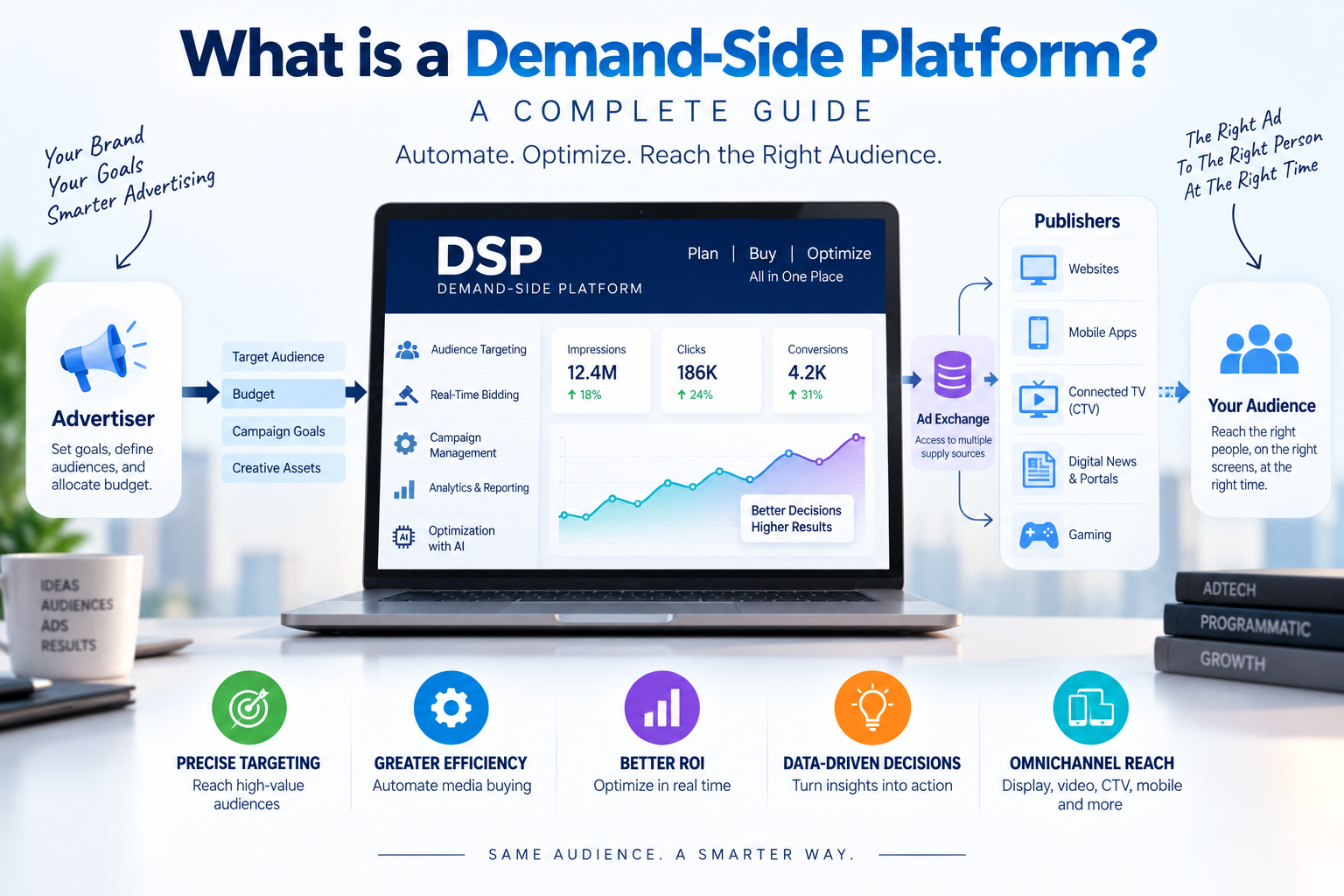
  • A Demand Side Platform is a software that helps advertisers and agencies to buy inventory, manage and optimize campaigns in real time across thousands of sites and apps.

How and from where do DSPs get the inventory?

  • A DSP is integrated with multiple SSPs (Supply Side Platforms) and Ad Exchanges, and every bid request (inventory) arrives from them. Fun Fact: A DSP almost never owns inventory!

Did you know?

  • The founding year of the DSP is 2007! The first DSP appeared around 2007, with companies like Invite Media and MediaMath building the tools.

What is a DSP? Did it simplify the advertising process?

A Demand Side Platform (DSP) is a software that helps advertisers and agencies to buy inventory, manage, and optimize campaigns in real time across thousands of sites and apps.

DSPs basically simplify the complex process of programmatic advertising by letting marketers, agencies, and advertisers set budgets, define audiences (1st party, 3rd party), upload creatives, and manage multiple campaigns seamlessly, all from one single platform.

The Difference Between a DSP and an SSP

In simple terms, a DSP is a buyer who buys inventory on behalf of advertisers and agencies, and an SSP is a seller who sells inventory programmatically via oRTB and VAST integrations.

  • DSP: DSPs are used by advertisers, agencies, and brands to buy ad inventory to reach the right audience at the right time by optimizing their spends against specific goals (e.g., Impressions, Clicks, CPC, Landing Page Visits, etc.).
  • SSP: SSPs are used by “Publishers” (such as The Times Of India, BBC, CNN, Forbes, etc.) to sell their available ad space to monetize their inventory. In simple terms, publishers sell the inventory to multiple SSPs to make the best out of the available inventory so that it doesn’t go to waste.

Ad Exchanges sit between DSPs and SSPs acting as a marketplace where impressions are bought and sold via a technology called Real-Time Bidding (RTB). Through these exchanges, Supply Side Platforms make inventory accessible and available to multiple DSPs, giving advertisers, brands, and agencies access to a broad range of placements without even needing to negotiate with individual publishers separately.

When an ad opportunity becomes available, SSPs offer it to the Ad Exchanges, and DSPs will be eligible to bid on those ad requests based on the advertiser’s pre-determined criteria such as bid price, frequency capping, creative dimensions, geo-targeting, and other targeting parameters set in the campaign. Finally, a winning ad is shown to the user.

This entire process takes less than a millisecond—faster than a publisher page or content can fully load—thus making a DSP the perfect and preferred platform for purchasing ad placements in bulk without sacrificing control.

Different Types of Targeting in Programmatic Advertising

  1. Demographic (Demo) Targeting: These are attributed to Age, Gender, and HHI (House Hold Income, if available).
  2. Contextual Targeting: The ads are placed alongside relevant content. This helps ensure the creatives align with the context of the page where the ads appear.
  3. Behavioural Targeting: This focuses on past browsing activity and engagement signals of a user, helping brands connect with users who have already shown interest in certain products or services based on their online behavior.
  4. Device Targeting: This targeting is done based on devices such as Device Type (Desktop, Mobile, Tablet, Connected TV (CTV)), Device Make, Model, Operating System (OS) and its versions, Browser, etc.
  5. Geo Targeting (Geographic Targeting): This allows the advertisers to control exactly where they want to show the ads. This ranges from Country, Region (State), City, Zip Code, and Co-Ordinates. Let us explain geo-targeting one by one:
    • Country/Region/City Targeting: You can target a campaign to an entire country or to a specific region or city. This is very common across all DSPs.
    • Zip Code Targeting: You can target a campaign to specific postal codes, giving advertisers complete control.
    • Coordinate-Based Targeting: This is precision targeting made using the Latitude and Longitude of a place and drawing a radius around it. This targeting works typically based on the device’s location signals.