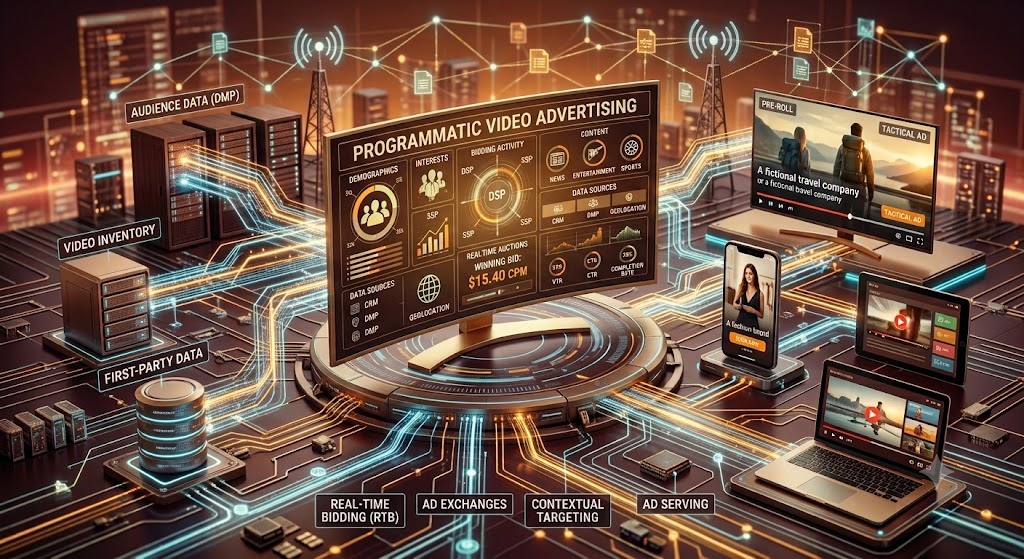
Programmatic Video Advertising uses technology and data to automatically find the right audience and show them the right video advertisement. It is becoming an important part of digital advertising because people spend a large amount of time watching videos on smartphones, websites, streaming services, apps and other digital platforms.
How It Is Different from Traditional Advertising?
In traditional advertising, a company might contact a publisher or media company and purchase advertising space directly. In programmatic advertising automatically evaluates available advertising opportunities and decides where an advertisement should appear based on the advertiser goal and targeting settings. Video is powerful because people can see and hear a message instead of simply reading it.
Benefits of Programmatic Video Advertising
Reach the Right Audience. One of the biggest advantages is targeting Businesses do not necessarily want to advertise to everyone. They want to reach people who are more likely to become customers. Depending on factors such as:
Age group
Location
Interests
Online behavior
Device
Content preferences
Save Time Traditional advertising can involve a lot of manual work Advertisers may need to communicate with different publishers, negotiate advertising space, arrange campaigns, and manage placements. In programmatic, Advertiser can set their campaigns goals, budget, audience, and other requirements through a platform, and the technology handles much of the buying process.
Make Better Use of Your Budget Programmatic advertising can help advertisers control how much they spend. System can use that budget according to the campaign settings and available advertising opportunity.
Measure Results Another important advantage is measurement. They can look the things such as:
How many people saw the advertisement
How many people watched the video
How many watched the entire video
How many clicked on the advertisement
How many people completed the desired actions
This information helps marketers understand what is working and what needs to be improved
Use the Same Video in Different Places A company may create one video and use it across several advertising channels. For Example, the same video could potentially be adapted for:
Websites/ applications
Connected TV
Online video platforms
Digital billboards
Display advertising
Types of Programmatic Video Ads
In-stream Video Ads These are the video ads you commonly see before, during, and after another video.
Advertisements that appear before a video are called pre-roll ad
Advertisements that appear during a video are called Mid-roll ad
Advertisements that appear after a video are called post-roll ad
Native ads Native ads are designed to fit naturally into the website or app where they appear. Instead of looking like a large, separate advertisement, they are designed to match the surrounding content.
Interstitial ads Interstitial ads are usually full-screen advertisements.
Outstream Video Ads Video advertisements that play automatically in non-video environment, such as within written articles, social media feeds or standard banner spaces.
Conclusion
Programmatic video advertising helps businesses connect with the right audience at the right time with the right message, making it a valuable part of a modern advertising strategy.
Video advertising is considered to be one of the most efficient ways of communication between brands and their target audience. Contrary to banners, which contain no visuals, sound, story telling and any other way to attract customer’s attention, explain his product, make him familiar with it and engage emotionally.
Through programmatic advertising, a brand can reach its potential client through video ads, displayed on multiple sites, applications or even other platforms. According to the type of video ad, a customer may come across the brand’s commercial before he watches the online video clip pr when he is reading an article.
There are three main types of video ads: In-stream, Interstitial & Native Outstream. In-stream video ads are shown to users before, during and after video clips, selected by them. Interstitial video ads cover the whole screen, especially mobile and appear between two clips or at some transition point. Native outstream video ads appear along with the written content, between the paragrah’s of an article or a blog. The video starts playing when it becomes visible and stops if the user scrolls down from it. Since native outstream are ads are meant to be natural to the page, it will be possible to deliver advertisements in a less disruptive way.
What is Native Outstream Video?
Native outstream video refers to a type of video ads that appear in the content of the page and not within a video. The term “native” refers to the fact that this type of ad is naturally part of the content. Unlike other video ads, native outstream video ads do not appear as disruptive ads since users are watching something else. The “outstream” refers to the fact that this type of video does not require pre-existing videos on the page. Rather, it appears in between text content.
Generally, the video plays automatically once the ad is in the viewing range of the user and pauses once the user scrolls past it.
Outstream vs. In-stream video Ads: What’s the difference?
The most straightforward way of distinguishing between these types of ads is by asking where the ad is placed. The in-stream video ad plays withing video content. If while watching YouTube, for instance, an advertisement pops up before or along with the video, this is the in-stream video advertisement.
Outstream video ads do not require video context to play. These ads can play within an article or any other content in the webpage. The video will start playing once it comes into view and pauses once it is out of the view.
To put it simply:
In-stream video ad: The ad plays withing the video.
Outstream video ad: The ad plays independently within the webpage.
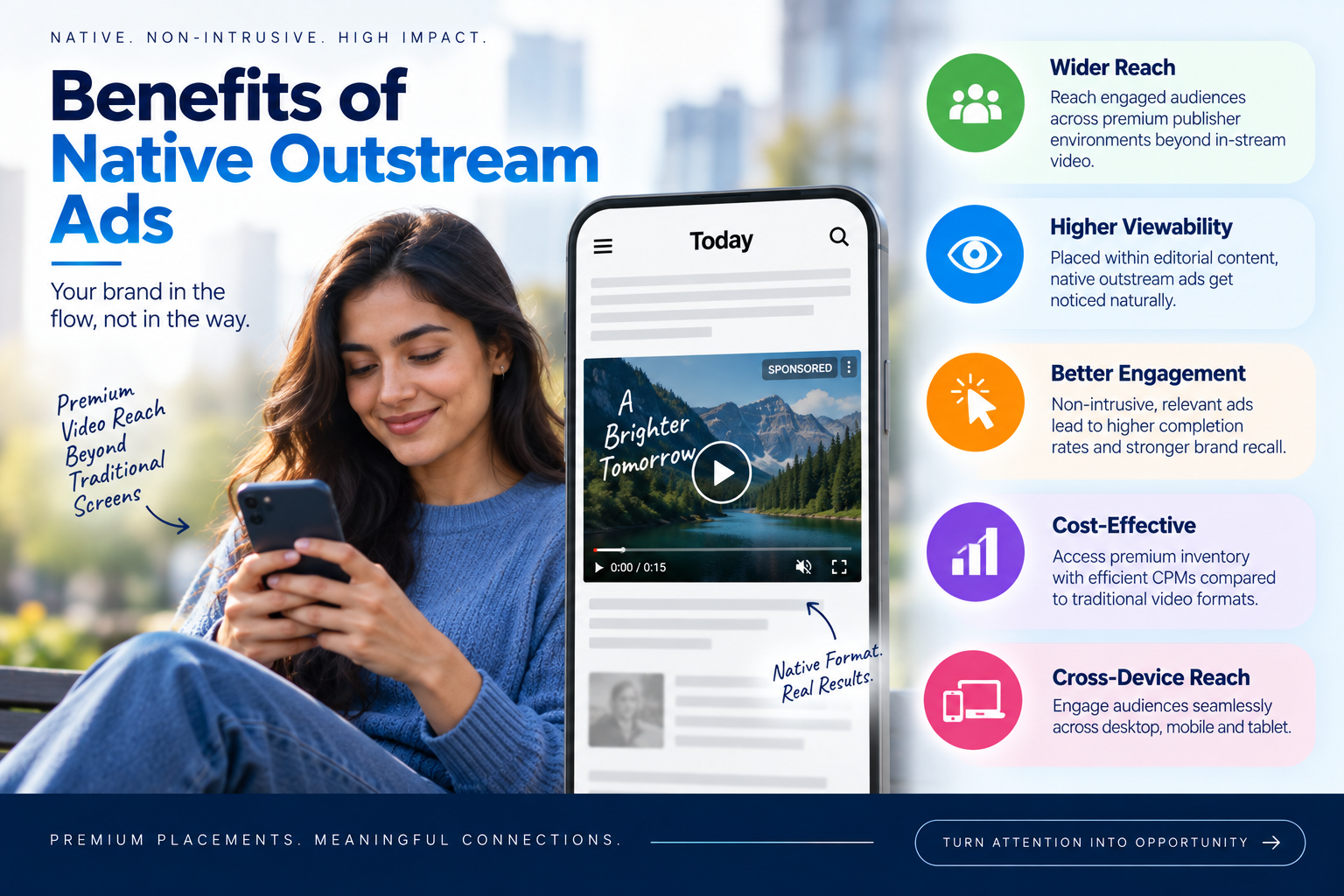
Benefits of Native Outstream Video Ad
There are many benefits of using Native Outstream video ads. Let us mention five of them.
1. Native Outstream Video Plays for viewability
One of the major benefits of native outstream video is that it is developed to play only when the ad is in view of the user. Outstream video will usually begin playing once the user has scrolled to the ad and will pause the user scrolls away from it.
The reason it is beneficial is that advertiser wants the video to be viewed. Outstream video addresses the issue of viewability by playing when the ad becomes visible. This could provide advertisers with valuable information on how users interact with their advertisements by watching videos.
2. Native Outstream May Provide Better Quality Video Completion
Quality of video completions is another crucial aspect. The video completion refers to the user watching a video until its end. In some traditional video advertisement formats, the video might still be playing even if the user is not watching it anymore.
Unlike in case of the native outstream, the video will most likely be paused whenever it goes out of out of view. Thus the video will be playing only for the time that the ad is in the user’s view. Therefore the video completion may better demonstrate whether the user watched the video from start to finish.
3. Access to inventory
The first benefit of native outstream is the ability for the advertiser to reach Tier 1 publishers, which are usually considered quality websites. Premium websites might not provide enough traditional video inventory to allow the campaign to be run at a needed scale through pre-roll or in-stream placement of the video ad.
That is why native outstream gives an additional option. As native outstream ads are being embedded into editorial content, the publisher can provide inventory even if there is no traditional video on the page. It allows advertisers to gain success to a larger pool of premium inventory.
4. Suits Longer Video Content
Most advertisers are acquainted with short form video ads, for example, 15 second and 30 second advertisements. However, nowadays brands are producing longer videos meant to teach, entertain or deliver an in-depth story.
Longer videos are not the best fit for traditional ore-roll advertising as the user would have to endure watching a long commercial in order to see the content he or she really wants to see. One alternative would be to use native outstream. Because video appears within the actual content, advertisers can utilize the format for distribution of longer branded content.
5. Native outstream can aid performance
At the end of the day, advertisers want their campaigns to be effective. The performance driven nature of viewability, user driven control, and availability of a lot of inventory. The video will play when in view. Thus the advertisers can find out whether the users were exposed to their videos.
Also native outstream may be useful format for advertisers, who measure metrics such as Cost Per Completed View (CPCV). CPCV informs the advertisers of the price they pay for each completed video view.
Conclusion
Native outstream video offers advertisers the possibility of using video content to engage audiences through use of different channel from instream video advertising. The capacity of native outstream video to play when the ad is in view, operate on editorial content, and incorporate long videos provides a number of benefits to programmatic advertising campaigns.
Native outstream video can be used by advertisers who seek to go beyond in-stream and pre roll video ads and increase their reach with the help of videos. The right metrics should be tracked, and it is crucial to understand how users behave and measure results to see whether they align with the goals of the campaign.
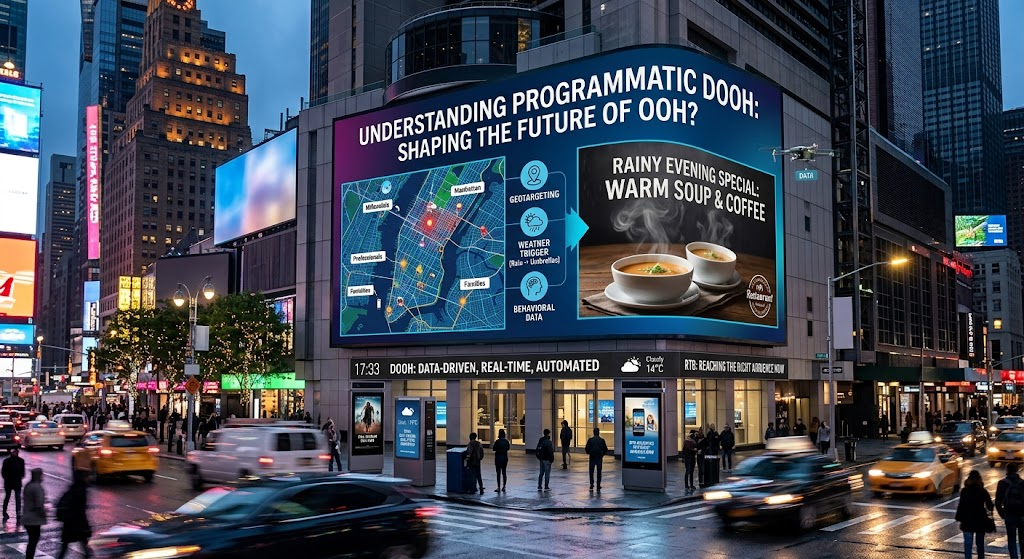
Understanding Programmatic DOOH: How is it Shaping the Future of OOH?
Digital Out-Of-Home (DOOH) Advertising
Programmatic digital out of home (DOOH) brings traditional outdoor advertising into the digital world. It uses software, data, and automation into the digital billboards and screen in public places.
As technology has developed, outdoor advertising has changed too. Traditional printed billboards have been joined by digital screens, creating what we now call digital out of home advertising or DOOH.
What is Programmatic DOOH?
Programmatic DOOH is the automated buying and deliver of digital outdoor advertising. In traditional OOH advertising, an advertiser usually works directly with a media owner to book a billboard or other physical advertising space. The advertiser chooses allocation, agrees on a schedule and price and then the creative is produced and installed.
Programmatic DOOH changes this process by using advertising technology to automate much of the busying and campaign management. Advertisers can use programmatic platforms such as a demand side platform, to choose digital screens, locations, audiences, schedules & budgets. They can also use data such as location, time of day, weather, traffic or nearby events to decide when an ad should appear.
The main idea is simple: instead od showing the same advertisement all the time, programmatic DOOH allows brands to make outdoor advertising more relevant and flexible.
What are the differences between traditional OOH, DOOH and Programmatic DOOH?
Traditional OOH & DOOH both help brands reach people in public spaces. The biggest difference is how the advertising is delivered and managed. Traditional OOH normally uses printed formats such as posters, billboards and building wraps. Once the creative is installed, changing it usually requires producing and installing a new physical advertisement.
DOOH uses digital screens, so advertisers can show videos, animations, multiple creatives and changing messages without physically replacing the advertisement. Programmatic DOOH adds another layer: automation and data. Advertiser can use software to decide which screens to use, when ads should run and what type of audience or situation they want to reach.
Feature
Traditional OOH
Programmatic DOOH
Creative
Printed posters, billboards, wraps
Digital, dynamic and video
Buying method
Mostly manual and booked in advanced
Automated, real-time or guaranteed deals
Targeting
Mainly based on location and estimated traffic
Location, audience and contextual signals
Speed
Slower because production and installation are required
Faster because creatives can be uploaded digitally
Optimization
Limited once the ad is installed
Campaigns can be adjusted while running
Measurement
Mainly estimated impressions
Reach, visits, lift and other performance measures
Flexibility
Lower
Higher
Benefits of Programmatic DOOH
Programmatic DOOH combines the broad reach of outdoor advertising with the flexibility of digital advertising. Some of the biggest advantages are below:
More Precise Targeting
Traditional billboards are mainly selected based on where they are located. Programmatic DOOH allows advertisers to go further. Advertisers can use information about audiences, locations, movement patterns and context to decide where and when and ad should appear.
For example, a sports brand could target areas where fitness-focused audiences are likely to be present. A travel company could focus on airports and other locations where travellers spend time. Advertisers can also combine targeting with signals such as weather and time of the day to make their messages more relevant.
Greater Campaign Flexibility
One of the biggest advantages of digital advertising is that campaigns can be changed quickly. Programmatic DOOH brings these advantages to outdoor advertising. Advertisers can launch, pause, change or adjust campaigns without physically replacing a billboard. For example, a clothing brand could promote rain jackets when the weather changes or increase advertising during a particular shopping period. This flexibility is especially useful for brands running campaigns across several cities or markets.
High Visibility and Consumer Impact
One major advantage of outdoor advertising is visibility. Unlike online ads, DOOH ads cannot simply be locked with an ad blocker. Digital screens are also much larger than most online advertising formats, making then difficult to overlook. Because DOOH appears in real-world environments, it can create strong brand awareness while people are travelling, shopping, commuting or spending time at public venues.
Measurable Foot Traffic and Sales Impact
Outdoor advertising is not limited to awareness. It can also encourage people to visit physical locations. This type of measurement is often called football attribution. It helps advertisers understand whether their outdoor campaigns are actually influencing real-world behaviour, such as store visits, restaurant visits, or attendance at an event.
Privacy Friendly Precision
Programmatic DOOH can provide relevant targeting without needing to identify individual people in the same way that some digital advertising channels do, instead, campaigns can often reply on information such as location, context, audience patterns, traffic, weather and time of the day. This makes DOOH an interesting option for advertisers looking for useful targeting while keeping privacy considerations in mind.
Expanded Inventory Across New Environments
Digital screens are no longer limited to large roadside billboards. Today. Advertisers can find DOOH screen in many different environments like shopping malls, airports, gyms, gas stations, transit locations, etc. This gives advertisers more opportunity to reach consumers at different points during their day.
Interactive Engagement
DOOH can also encourage people to action. An advertisement can include QR code that send the viewers to a website, product page, app or special offer. Touchscreens and other interactive formats can also turn a simple outdoor advertisement into a more engaging experience.
Better Budget Allocation
Programmatic buying can help advertisers make better use of their budgets. Instead of committing all their money to fixed placements, advertisers can adjust spending based in campaign performance and availability. If certain screens, locations or environments are performing better, advertisers can put more of their budget toward those opportunities. This can help reduce wasted spend and improve campaign efficiency.
Flexible Buying Options
Programmatic DOOH can give advertisers access to multiple screen networks and media owners though one platform. This can make the buying process easier because advertisers do not necessarily have to negotiate separately with every media owner. At the same time, programmatic DOOH can support different types of deals, including automated buying and guaranteed inventory.
Improved Measurements and Insights
Traditionally, one of the more challenging aspects of outdoor advertising was measurement. That’s now changing, thanks to programmatic DOOH providing advertisers with advanced reporting capabilities. Depending on the platform and partners involved, advertisers can analyse metrics including reach, frequency, impressions, foot traffic, conversions and brand lift.
Enhanced Omnichannel Capabilities
There’s no reason why programmatic DOOH needs to be utilized as a standalone medium. Instead, DOOH can be complemented by other digital advertising formats such as display, native, video, CTV and audio.
One might view a DOOH ad while traveling around a city and later receive a follow-up ad on another device or channel. This creates a seamless customer experience allowing DOOH to play a role in omnichannel marketing strategies,
How Programmatic DOOH Works?
To get the concept of programmatic DOOH, one should start with the technology behind it. Advertisers use programmatic platforms to identify available digital screens, set campaign parameters and send targeted advertising campaigns automatically.
The Role of DSPs in Programmatic DOOH
Demand-side Platform (DSP) is one of the key platforms that advertisers use for buying programmatic advertising. If you are not familiar with programmatic advertising, then you may regard the DSP as a single platform for managing media buying campaigns.
With the help of DSP advertisers can:
Set campaign objectives
Select locations
Choose types of screens
Set budgets
Upload creatives
Set targeting criteria
Select campaign dates and times
Manage campaign performance
DSPs connect the supply side of the advertising ecosystem that includes such entities as SSPs, ad exchanges, media owners and other supply partners. Modern DSPs make the process of discovering the available DOH inventory much easier than before. Advertisers can use maps and filters to browse screens by different attributes such as location, type of venue, media owner, etc.
Programmatic DOOH Formats
Programmatic DOOH can take various screen types. Popular formats are:
Large formats: Large outdoor digital boards placed along highways, urban centres, airports and other highly trafficked locations. Mostly intended to serve as a mass awareness tool.
Place based: Screens located either inside or near places like gym, shopping malls, gas stations, sports stadiums and even medical offices. These allow advertisers to target people in specific places.
Transit: Screens located in airports, subway stations, bus shelters, taxis and other fomrs of transit locations. Effective for targeting commuters and travellers.
Point of purchase: Screens located near retail locations, checkouts, store entrances and products displays. Influential in impacting people during the buying process.
High Impact: Extremely large screens meant to create brand experience through their size.
Targeting in Programmatic DOOH
One of the reasons why advertisers get excited about programmatic DOOH is targeting. Rather than simply selecting an ad placement and relying on chance, advertisers may consider various signals for reaching a proper time.
Some targeting techniques include the following:
Location targeting: Advertisers can select countries, regions, cities or even postcodes where their ads should show up.
Contextual Targeting: Advertisers can select certain environments such as airports, gyms, shopping centres, gas stations depending in where their target audience is most likely to be located.
Dynamic Targeting: Ads can be changed dynamically depending on weather, time of the day, sports results, traffic or local events.
Media owner targeting: advertisers can select certain media owners or screen networks.
Audience Targeting: Using audience and mobility data, advertisers may reach certain screens that are more likely to serve a proper audience.
Retargeting: Individuals who were exposed to the DOOH advertising campaign might also be targeted via other digital platforms such as display, CTV or audio.
How is Programmatic DOOH measured?
While with digital advertising one can measure clicks and conversions immediately, when it comes to outdoor advertising, it can be hard to make connections between seeing a billboard and entering the store later. However, new measurement solutions help to solve the problem.
Footfall Attribution
Footfall Attribution tries to establish a correlation between people who saw a DOOH ad and their visit to a physical location afterwards. For instance, if a person saw an ad in a certain place near a shopping centre and visited the store later, then this connection can be established by the measurement partner through location-based signals.
Brand lift research
Brand lift studies help determine whether a marketing effort has resulted in changes In consumers’ awareness, consideration, recall and intent to buy. Usually, in such a research, it is compared whether those who saw the ad have different attitudes towards a brand compared to a similar audience that did not see the ad.
Sales Lift
The sales lift research goes even further and helps understand whether there is a connection between the ad exposure and purchases made. Thus, sales lift helps determine whether DOOH marketing campaign has helped increase sales and not just views or awareness.
The Future of DOOH Advertising Is Programmatic
OOH advertising has always been highly effective due to the fact that brands have had the opportunity to address a large audience in the physical world through this medium. DOOH advertising has enhanced the format even more by substituting static ads with screens.
Programmatic DOOH technology goes even further than that. With the use of automation, data, targeting, dynamic creative and measurement, programmatic DOOH provides advertisers with greater level of control over their outdoor campaigns’ planning and delivery. It is also possible to integrate DOOH into other digital advertising channels like display, video, audio and CTV advertising.
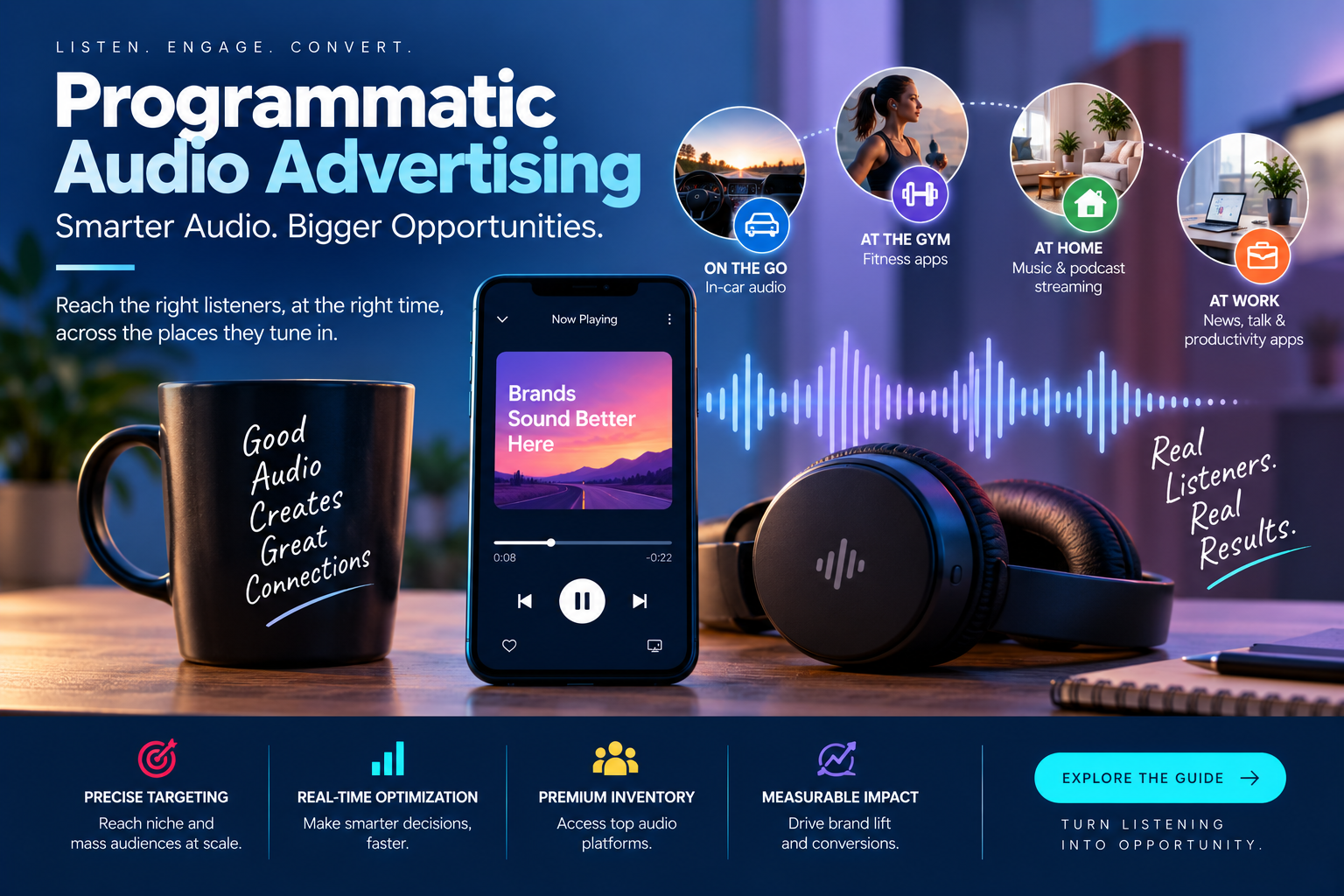
Audio has become an essential medium for digital content consumption. Music streaming, podcasts, internet radio, audiobooks, and other audio platforms give people opportunities to listen throughout the day.
Unlike display, video, or social advertising, audio does not require the user to look at a screen. People listen while commuting, exercising, cooking, working, or relaxing.
Programmatic audio advertising allows advertisers to automatically purchase audio ad placements using technology-driven bidding and targeting. Instead of manually selecting individual placements, advertisers use audience, contextual, geographic, device, and behavioural signals to reach listeners at scale.
1. Audio Creates a Strong Emotional Connection
Sound has a unique ability to influence how people feel. A familiar voice, piece of music, sound effect, or intentional tone can evoke an emotional response within seconds. This gives audio advertising an advantage when making a brand feel personal and memorable.
For example, a travel company can use calming music and an inspiring voiceover to create a feeling of relaxation and adventure. Similarly, a food delivery brand can use energetic sound design and conversational delivery to generate excitement.
A well-crafted audio ad coordinates five foundational elements:
Voice: The persona and pacing representing the brand.
Music: The melodic backing track setting the mood.
Sound Effects: Environmental cues that build immersive context.
Tone & Emotion: The feeling conveyed to the listener.
Brand Messaging: The core proposition and call to action.
Why this matters: Visual banners are frequently scrolled past or ignored, but a distinctive voice, sound signature, or sonic logo stays with the listener long after the audio stream finishes.
2. Reaching Audiences During Screen-Free Moments
Digital audio does not require visual attention. Listeners engage with audio in scenarios where looking at a screen is impossible or unsafe:
During morning and evening commutes
While driving
During gym workouts and runs
While cooking or preparing meals
During household chores
While working, designing, or studying
During leisure and relaxation time
These screen-free moments allow advertisers to maintain continuity outside conventional visual environments. Someone jogging cannot browse social feeds, but they remain engaged with a podcast or streaming playlist.
Complementing Existing Channels
Programmatic audio works alongside your multi-channel digital mix:
Display Advertising: Reinforces brand recall through visual impressions.
Video Advertising: Delivers high-impact initial product showcases.
Connected TV (CTV): Anchors living room awareness on big screens.
Modern programmatic audio platforms leverage rich data signals to reach relevant audiences without relying on visual real estate:
Demographics: Age, gender, and household metrics.
Geographic Location: Country, region, city, zip code, and radial geofencing.
Device Profiles: Mobile handsets, smart speakers, desktop apps, and in-car systems.
Interests & Affinities: Content categories, genres, and recreational preferences.
Contextual Alignment: Matching ad copy to specific genres (e.g., placing finance ads next to business podcasts, or athletic apparel next to workout playlists).
A recognizable voice talent, a tailored sonic signature, or recurring musical motifs enable listeners to identify a company instantly—even with their phone tucked away in a pocket.
Through audio storytelling, a 30-second spot can introduce a friction point, deliver an emotional hook, and resolve it with the brand’s solution. Voice delivery can shape brand perception across various dimensions:
Friendly and approachable
Authoritative and professional
Energetic and urgent
Inspirational and narrative-driven
Lighthearted and humorous
Final Thoughts
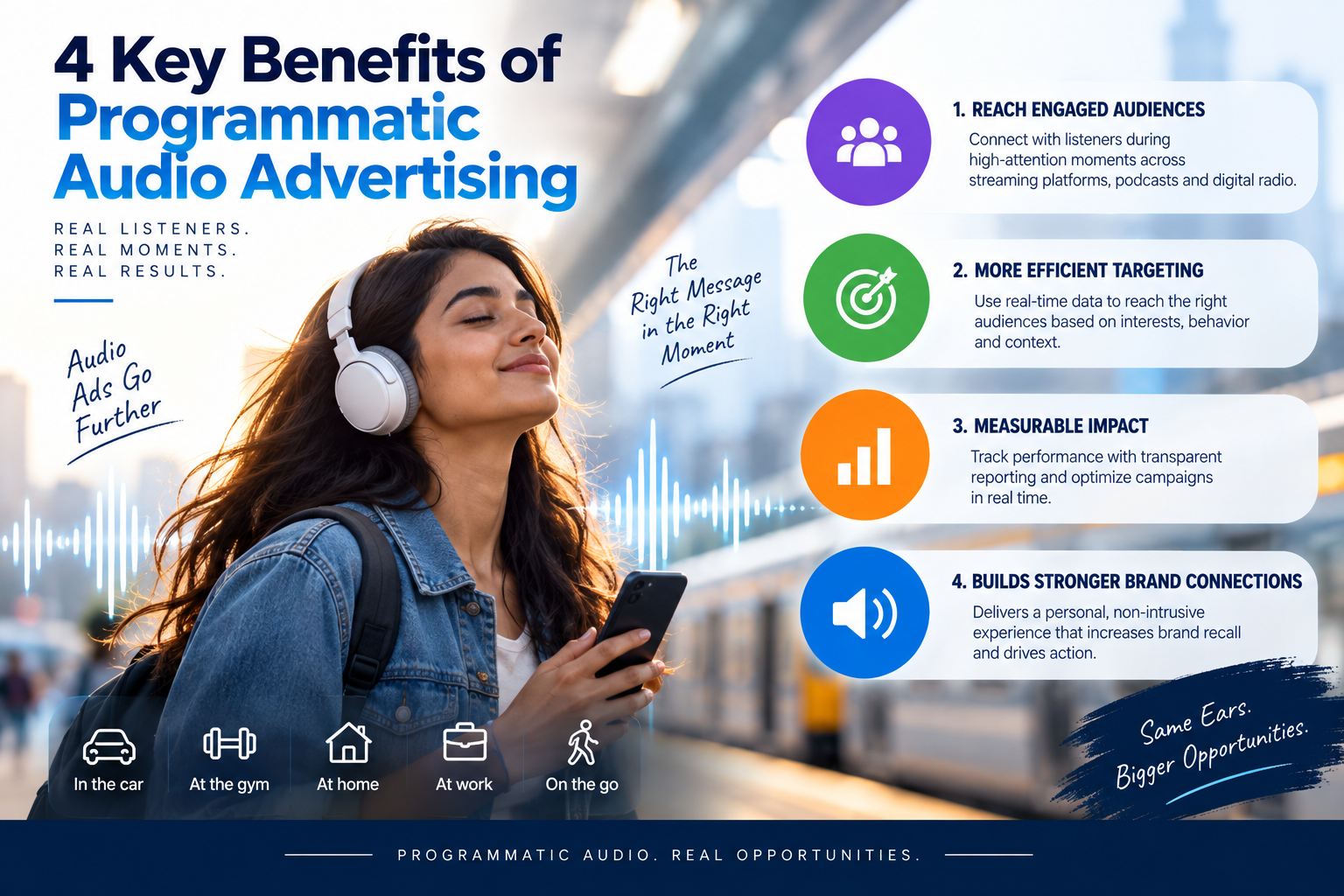
Programmatic audio provides access to consumers when they are listening rather than looking. The four foundational pillars are:
Emotional Engagement: Sound and voice cultivate deeper psychological resonance.
Screen-Free Reach: Brands maintain presence in moments visual media cannot penetrate.
Flexible Targeting: Real-time data ensures placement alongside relevant content and audiences.
Sonic Identity: Recurring audio motifs build durable brand recall.
Audio delivers the highest return when creative assets are written and produced specifically for listening rather than retrofitted from existing video voice tracks.
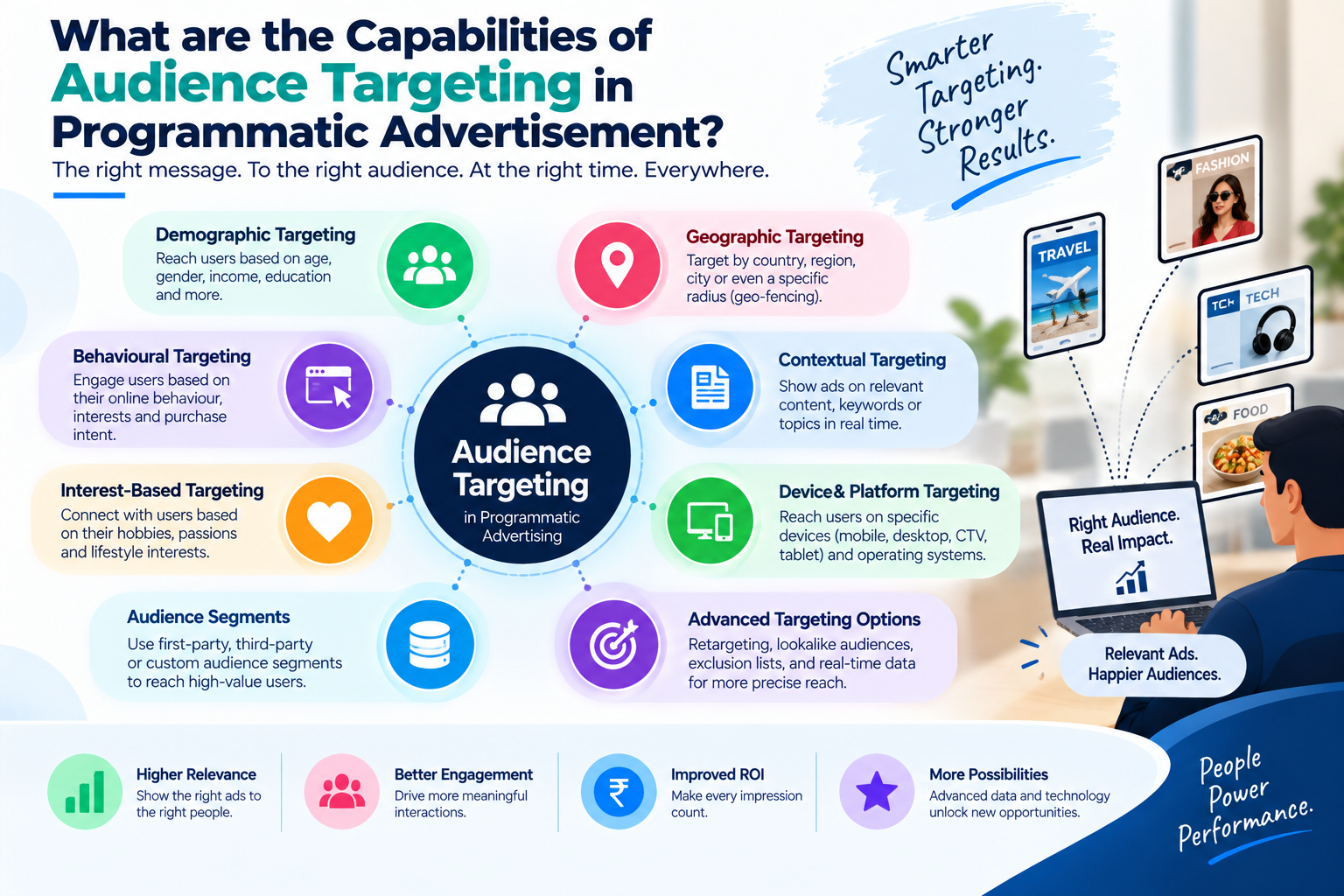
Audience targeting helps advertisers decide who should see an advertisement based on different characteristics, interests and behaviors and other available signals.
When this targeting is combined with programmatic advertising, advertisers can automatically buy digital advertising space and show ads to selected audience at scale.
What is Audience Targeting
Audience Targeting means selecting a specific group of people for an advertising campaign instead of showing an advertisement to everyone.
The Advertiser can create an audience based on available data and target signals. Audience targeting helps advertisers show the right message to a relevant group of people.
How does Audience Targeting work in Programmatic Advertising
Suppose a company wants to advertise smartwatches to people who may be interested in fitness.
The advertiser Defines the Audience: The Advertiser decides who they want to reach.
The Audience Is Built Using Available Signals: The advertising platform can use different signals to help identify suitable users or advertising opportunities. The signals can include things such as: First party data, website/app interactions, Location, Device information and other factors.
The Programmatic System Finds Opportunities: When a suitable advertising opportunity becomes available, the programmatic system evaluates whether it matches the advertiser’s campaign requirements.
The Advertisement is Shown: If the opportunity meets the campaign targeting and bidding requirements the advertiser can compete for the advertising space. If the advertiser wins the auction, the advertisement is displayed to the user.
Key Capabilities of Audience Targeting
Demography Targeting: Demographic targeting allows advertisers to reach audience based on characteristics such as age or gender where those signals are available and permitted.
Geographic Targeting: Geographic Targeting allows the advertiser to focus on the specific location.
Interest-Based Targeting: Interest-Based targeting focuses on what people may be interested in.
Behavior Targeting: Behavior Targeting uses available signals about a user’s previous interaction or activities.
Contextual Targeting: It is slightly different Instead of focusing primarily on who the user is contextual targeting focuses on what content the user is viewing.
First-Party audience targeting: Advertisers can use information collected directly from their own customers or users to create first-party audience.
Retargeting: Have you ever visited an online store, looked at a product and noticed advertisements for the same brand later? This is commonly known as retargeting.
Lookalike Audience Targeting: Some advertising platforms can help advertisers find new people who share characteristics or signal with an existing audience.
Device Targeting: Programmatic advertising can also use device-related targeting.
Audience Segmentation: Audience targeting allows advertisers to divide a large audience into smaller groups.Example:
Audience 1: New website visitors
Audience 2: Existing customer
Audience 3: Customer who haven’t purchased recently
Audience 4: People interested in particular products
Each group can receive a different message.
Combining Multiple Targeting Capabilities
One of the biggest advantages of programmatic advertising is that advertisers can often combine different targeting segments. However, more targeting is not always better. If an audience becomes too narrow, the campaign may have difficulty reaching enough people or archiving efficient results.
Why Audience Targeting Is Important?
Without audience targeting an advertiser may show advertisements to a very broad audience.
Many people who see advertisements may not have interest in that product.
With audience targeting, the advertiser can focus its budget on audience that are more relevant to its campaign, this will help your business by reaching the relevant customers.
The future of Audience Targeting
Audience Targeting is changing as the digital advertising industry becomes more privacy focused.
The future of programmatic advertising is not simply about collecting more data. It is about using better signals, better technology and responsible data practices to deliver useful and relevant advertising.
Conclusion
Audience targeting is one of the most important capabilities of programmatic advertising.
It helps advertisers decide who they want to reach, where they want to reach them, and how they want to communicate with them.
Programmatic advertising automates the buying of digital advertising, while audience targeting helps determine audience and advertising opportunities are relevant to the campaign.
Understanding CTV, How It Works, and Its Benefits for Advertisers
What is Connected TV (CTV)?
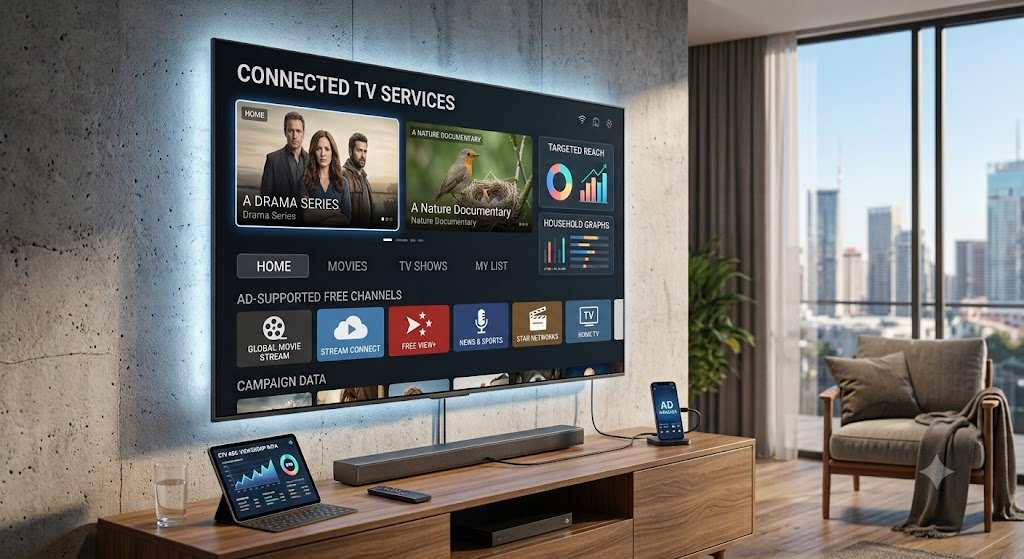
Connected TV (CTV) refers to a television that is connected to the internet and can stream digital content. This includes Smart TVs and television connected through devices such as Roku, Amazon Fire TV, Apple TV, and other streaming devices.
CTV Combines the big screen experience of traditional television with the targeting, flexibility, and measurement capabilities of digital advertising.
Why is CTV Growing rapidly?
More People are moving from traditional cable and satellite TV to streaming services. At the same time, viewers are spending more time watching digital contents on the television. This creates a growing opportunity for advertisers
Large and growing streaming audience
Big-screen impact with a digital advertising experience
More precise audience targeting and traditional TV
Better campaign measurement and reporting
Flexible buying options through programmatic advertising
CTV vs Linear TV
Linear TV follows a fixed schedule, and advertisers generally buy specific time slots or programs. CTV delivers streaming content over the internet, provides more flexibility in how audience are targeted, and how campaigns are measured.
Linear TV: Broad audience targeting and fixed schedules.
CTV: More data-driven targeting and flexible campaign management
CTV can support reach, frequency management, retargeting, and cross-device strategies
How CTV Advertising Works
CTV advertising can be purchased programmatically, similar to other forms of advertising. When a viewer reaches an available ad break, an ad opportunity is sent through the programmatic ecosystem.
Advertiser: Sets the campaign goal, audience, budget, and creative.
DSP: Evaluates available impressions and submits bids based on campaign targeting
SSP/Exchange: Provides access to available CTV inventory
CTV platform: Serves the winning ad within the streaming content.
Viewer: Sees the video advertisement on the connected TV.
Key benefits of CTV advertising.
High Engagement: Full screen video creates a strong viewing experience.
Advanced targeting: Advertisers can use available demographic, behaviour, geographic, and audience data.
Reach and frequency: Campaign can reach households while managing how often ads are shown.
Cross-device Marketing: CTV can work together with mobile, desktop, and other digital channels.
Measurable Results: Advertisers can report on impression, reach, frequency, VCR, completion rates, and other available metrics.
Brand safety: CTV campaign can access premium streaming environment, depending on the inventory source and deal.
What are Fast channels?
FAST stands for Free Ad-supported streaming Television. FAST services provides free, TV-style streaming content that is funded by advertising. Examples include platform such as Pluto TV, Tubi, Plex, Roku channel, Samsung TV Plus, and others ad-supported streaming services.
FAST inventory can be an important part of CTV advertising because advertisers can reach viewers in an ad-supported streaming environment.
The future of CTV Advertising.
The future of CTV is expected to become more data-driven, measurable, and integrated with other digital channels. As streaming audience continue to grow, advertisers can use CTV to combine the reach and impact of television with the targeting and measurement of digital advertising.
More advanced audience targeting
Improved measurement and attribution
Greater use of programmatic buying
More interactive and shoppable video experiences
Strong integration with multi-channel campaign
Final Thoughts
CTV is changing the way brands connect with television audiences. It offers the impact of the big screen while providing many of the benefits of the digital advertising, CTV can be powerful part of modern multi-channel strategy when the right audience, inventory, creative, and measurement approach.
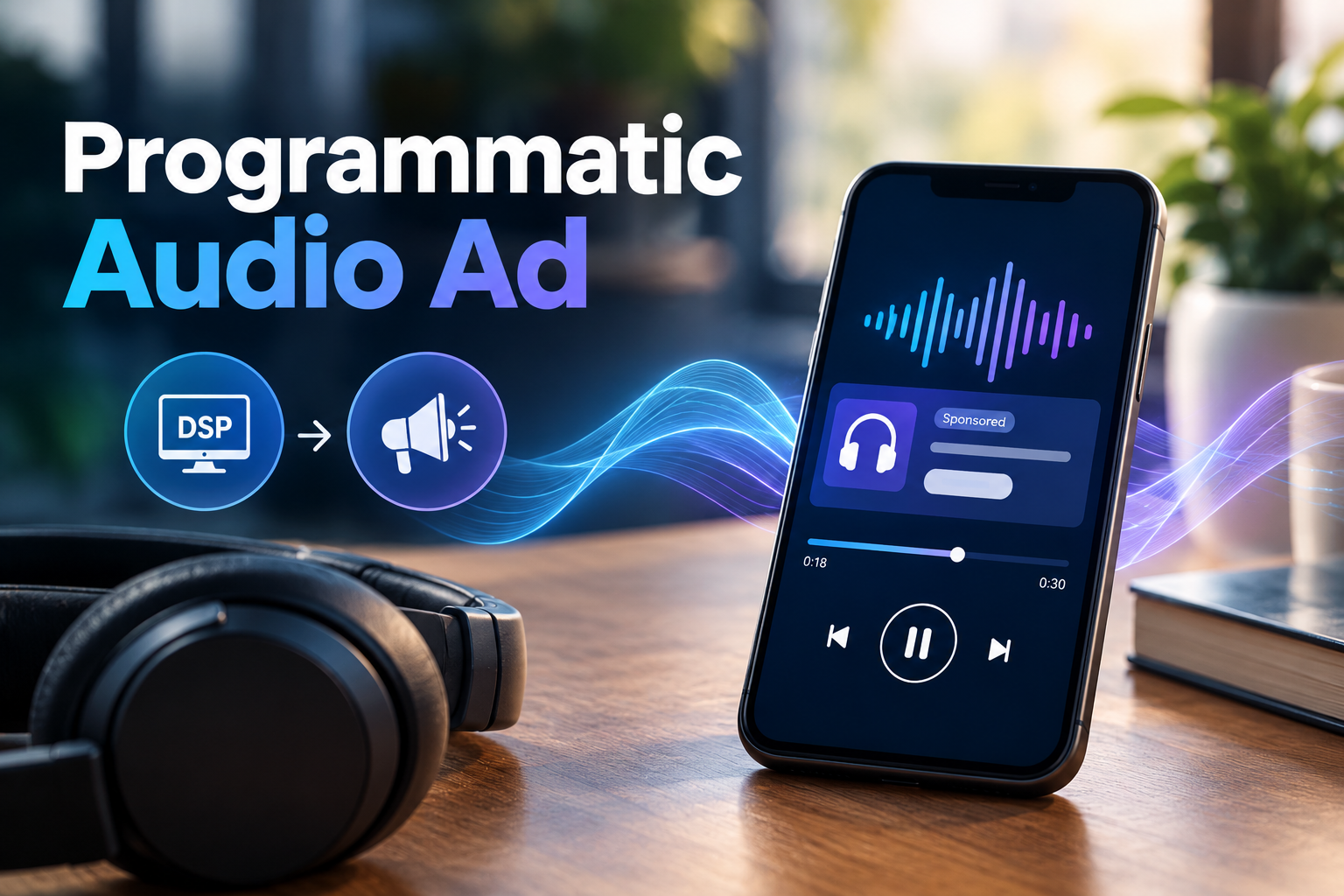
You know how Instagram and YouTube show you ads based on what you like, where you live and what you are browsing? Programmatic audio advertising does the same thing but with audio ads that play on platforms like Spotify, Apple Music, podcasts and internet radio.
Programmatic audio advertising is the automated buying, selling and placement of audio advertisements within digital audio content.
Advertiser can use single platform to access inventory from multiple audio publishers and deliver ads to audiences across different devices.
The key difference between radio and programmatic audio advertising is targeting.
Why Is Audio Advertising So Effective?
One of the biggest strengths of audio is its ability to capture attention without requiring a screen.
When someone listens to a podcast or musical playlist, they are actively paying attention to what they hear. This creates an opportunity for brands to build a more personal connection.
How Programmatic Audio Can Improve Campaign Performance
Adding audio to a media plan can strengthen a campaign in several ways.
It creates a more personal Brand Experience. Think about listening to someone speak through your headphones. Their voice feels much more direct and personal than a banner sitting on a webpage. A friendly and related voice can make a brand feel approachable while an energetic, soundtrack can create excitement.
It Enable Precise Audience Targeting. Programmatic audio is not simply about playing an advertisement to anyone who happens to be listening. Advertiser can use audience and content data to create more relevant campaigns.
Depending on the available data and platform, targeting can include factors such as:
Location
Demographics
Online behaviour
Household income
Interests
Music genres
Playlists
Moods and moments
For example, a sports brand could focus on audience interested in fitness and sports.
Why Millennials and Gen Z Are Important for Audio Advertising.
Younger consumers, particularly Millennials and Gen Z are highly engaged with digital audio.
Music streaming, podcast and other forms of digital audio have become part of their everyday media habits. These audiences are also becoming increasingly important to brand as their purchasing power grows.
Creating An Audio Ad That People Actually Remember.
Programmatic technology can help you reach the right audiences, but targeting alone cannot make a campaign successful. Here are four important principles to keep in mind.
Keep It Brief
Audio advertisements are commonly produced in 15-30 seconds format. Focus on what really matters.
Keep The Message Simple
Audio script should clearly communicate:
What are you offering?
Why should the listener care?
What should they do next?
Avoid unnecessary details and complicated language.
Include a Strong Call to Action
Every good advertisement should tell the audience what to do next – CTA Example:
Shop now
Learn more
Download the app
Book today
Visit our website
Make It Conversional
Your audio ad should sound like belongs in the environment where it is being heard.
Programmatic Audio vs Traditional Radio
Traditional radio typically focuses on purchasing advertising spot within a particular station or program.
Programmatic audio focuses more heavily on audience targeting and digital measurement.
Conclusion:
Programmatic audio allows brands to reach relevant audiences while they are listening to music, podcast, playlists and other digital content. Unlike traditional radio, it can provide sophisticated audiences targeting, detailed measurement and opportunist for real time optimization.
Programmatic advertising allows brands to reach audiences across millions of websites, apps, videos, CTV platforms, and other digital environments.
While this provides huge opportunities for advertisers, it also creates a challenge how can brands make sure their ads appear in safe and appropriate environments. This is where brand safety controls come into play.
What Is Brand Safety in Programmatic Advertising?
Brand safety in programmatic advertising is the process of preventing ads from appearing alongside content or in environments that could negatively affect a brand’s reputation. Unlike traditional advertising, where advertisers may have more control over individual placements, programmatic advertising involves automated buying and selling of impressions.
A single campaign can potentially reach thousands of publishers and platforms. Therefore, brand safety needs to be built into the automated ad-buying process.
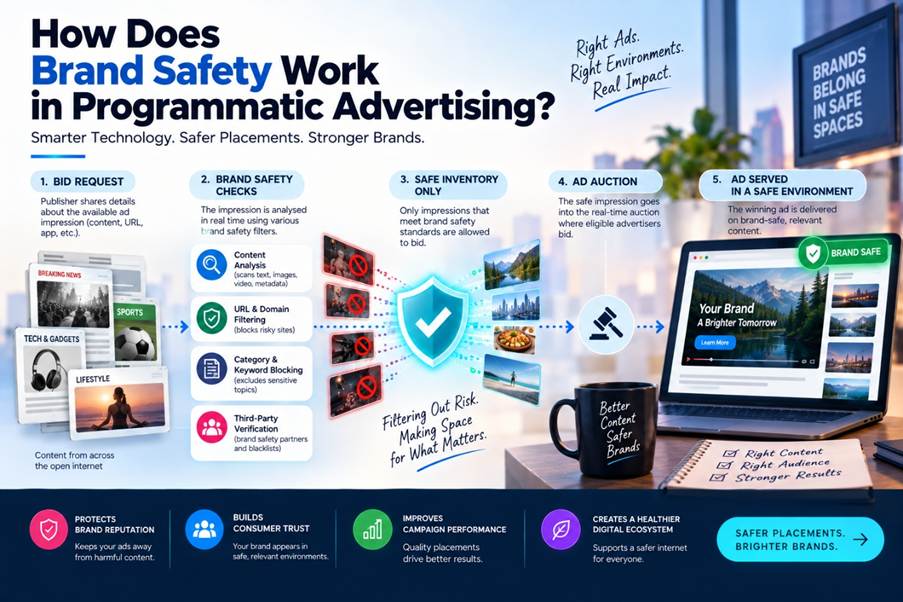
How Does Brand Safety Work?
A simplified programmatic advertising flow looks like this, Advertiser → DSP → Ad Exchange/SSP → Publisher → User
When a user visits a website or opens an app, an ad opportunity can be sent into the programmatic ecosystem. Before the advertiser’s ad is served, various signals and safety controls can be used to determine whether that opportunity is suitable.
If the impression meets the advertiser’s requirements, the DSP can participate in the auction and potentially serve the ad. If the environment is considered unsafe or unsuitable, the impression can be excluded from the bidding process. This decision happens within milliseconds.
Key Brand Safety Controls
1. Blocklists
A blocklist contains websites, apps, publishers, or other environments where an advertiser does not want its ads to appear.
For example, a brand may block domains associated with adult content, hate speech, or other sensitive categories.
Blocklists are useful for excluding known risks, but they need to be regularly updated as new websites and apps appear.
2. Whitelists
An whitelistlist works in the opposite way. It contains websites, apps, or publishers that have been approved by the advertiser.
The campaign can then be restricted to these approved environments.
whitelists provide greater control and can be particularly useful for brands with strict advertising requirements. However, they can also reduce the available inventory and campaign reach.
3. Content and Category Controls
Advertisers can exclude specific types of content or sensitive categories from their campaigns. Common exclusions may include,
Adult content
Violence
Hate speech
Extremist content
Illegal activities
Misinformation
Sensitive news
These controls help advertisers avoid broad categories of content without having to manually identify every individual website.
4. Keyword and Topic Exclusions
Advertisers can also use keywords or topics to identify content they want to avoid. For example, a brand may choose to exclude content related to certain sensitive subjects. However, keyword-based blocking has limitations. A keyword can appear in completely different contexts, so modern brand safety solutions increasingly consider the overall context of the content, rather than relying only on individual words.
The Role of AI and Contextual Technology
Modern brand safety increasingly uses AI and machine learning to understand digital content at scale. Instead of simply checking whether a page contains a particular keyword, technology can analyse the context and meaning of the content.
For example, a news article may contain the word “violence” while reporting responsibly on a current event. Automatically blocking every page containing that word could prevent ads from appearing on otherwise acceptable content. Contextual technology can help distinguish between content that discusses a sensitive topic and content that promotes it.
This allows advertisers to create more precise brand safety strategies while avoiding unnecessary restrictions.
Third-Party Brand Safety Solutions
Advertisers can also work with specialized third-party technology providers that evaluate websites, apps, video content, and other advertising environments. These solutions can provide additional signals about,
Content classification
Brand suitability
Invalid traffic
Publisher quality
Risk levels
Sensitive topics
These signals can then be used by advertisers and their programmatic partners to make better buying decisions.
Brand Safety and the Programmatic Auction
Brand safety can influence the programmatic auction before an advertiser actually bids on an impression. For example,
User visits website → Ad opportunity becomes available → Brand safety checks are applied → Unsafe impression is excluded → Safe impression enters bidding → Winning ad is served This approach helps advertisers avoid spending money on impressions that do not meet their brand safety requirements. It also makes brand safety more scalable because decisions can be made automatically across large volumes of inventory.
Brand Safety vs. Brand Suitability
It is also important to understand that brand safety and brand suitability are not exactly the same. Brand safety focuses on avoiding environments that are generally considered unsafe or inappropriate. Brand suitability goes further by considering what is appropriate for a specific brand.
For example, a news website covering a sensitive event may be acceptable for one advertiser but unsuitable for another. Each brand can define its own level of tolerance based on its audience, industry, and reputation.
Final Thoughts
Brand safety is an important part of programmatic advertising because automated buying gives advertisers access to a huge and constantly changing supply of inventory.
By using blocklists, allowlists, content controls, contextual technology, AI, and ongoing monitoring, advertisers can reduce the risk of their ads appearing in unsuitable environments. The key is finding the right balance. Overly strict controls can limit campaign reach, while weak controls can expose a brand to unnecessary risk.
A well-planned brand safety strategy allows advertisers to scale programmatic campaigns while maintaining control over where their brand appears.
Programmatic Audio advertising helps brands reach relevant audiences while they listen to music, podcasts, digital audios, and other online audio content. Unlike traditional radio, programmatic audio uses digital technology to help advertisers targeting audiences, manage budgets, and measure campaign performance.
What is programmatic Audio Advertising?
Programmatic audio is the automated buying and selling of digital audio ad placements. The basic process is: Advertisers à DSP à SSP/Exchange à Audio publishers à Listener The advertisers set the campaign objective, audience, budgets, and targeting. The DSP then finds suitable audio ad opportunities and bids on them automatically.
How to Create a Programmatic Audio Ad
Define Your campaign Goal Start by deciding what you want to achieve. Common goals include:
Brand awareness
Website traffic
App downloads
Lead generation
Sales and conversion A clear goal helps determine the right audience, creative, and performance metrics.
Select your target Audience Choose an audience that is relevant to your product or service. Depending on the platform, targeting may include:
Demographics
Location
Interests
Behaviours
Context
First-party audiences
Device
Create a simple Audio Script A good audio ad should communicate the main message quickly. Keep the scripts:
Short
Clear
Engaging
Brand-focused
Action-oriented
Produce the Audio Creative Record the script using a clear and engaging voice. You can also use background music or sound effects, but they should not overpower the voice. Before uploading, make sure the audio file meets the required format, duration, quality, and technical specifications of the DSP or publishers.
Launching the campaign
Set up the Programmatic audio campaign. Once the creative is ready, configure the campaign in your DSP. Set:
Campaign objective
Audience
Location
Inventory
Budget
Bid strategy
Creative
Tracking
QA before launch Check everything before the campaign goes live:
Audio quality
Creative duration and format
Targeting
Budget and bid
Landing page
Tracking
Call to action A proper QA helps to prevent delivery and tracking issue
Launch and Monitor After launch, monitor the campaign regularly to understand how it is performing. Important matrices include:
Impression: Number of times the ad was served.
Reach: Number of unique listeners reached.
Frequency: Average number of times a listeners heard the ad.
Completion rate: percentage of ads played to completion.
CTR: Percentage of impressions that resulted in click.
CPM: Cost of every 1000 impressions.
Best Practices
Keep the message Simple Listeners should understand the main message quickly.
Use strong call to action Tell the listeners exactly what to do next.
Test Different Creative Try different message, voice and call to action.
Manage Frequency Avoid showing the same ad too many times to the same listener.
Optimize regularly Review performance and adjust audience, inventory, bids, and budget based on results.
Final takeaway
Creating a programmatic audio campaign can be summarized in six simple steps: Define à Target à Create à QA à Launch à Optimize With the right audience, a clear message, quality creative, and continuous optimization, Programmatic audio can help brand reach listeners effectively and become an important part of broader digital advertising strategy.
OTT stand for Over-The-Top. It refers to television shows, movies and other video content that people watch over the internet instead of through traditional cable or satellite television.
In the past, if you wanted to watch TV, you usually needed a cable or satellite connection. Today, you can simply connect to the internet and stream content whenever you want.
Popular OTT platforms include:
Netflix
Amazon Prime Video
Disney+
Hulu
Peacock
YouTube
OTT content can be streamed on many different devices:
Smart TVs
Smartphones
Tablets
Laptops
Desktop computers
Gaming consoles
What is CTV?
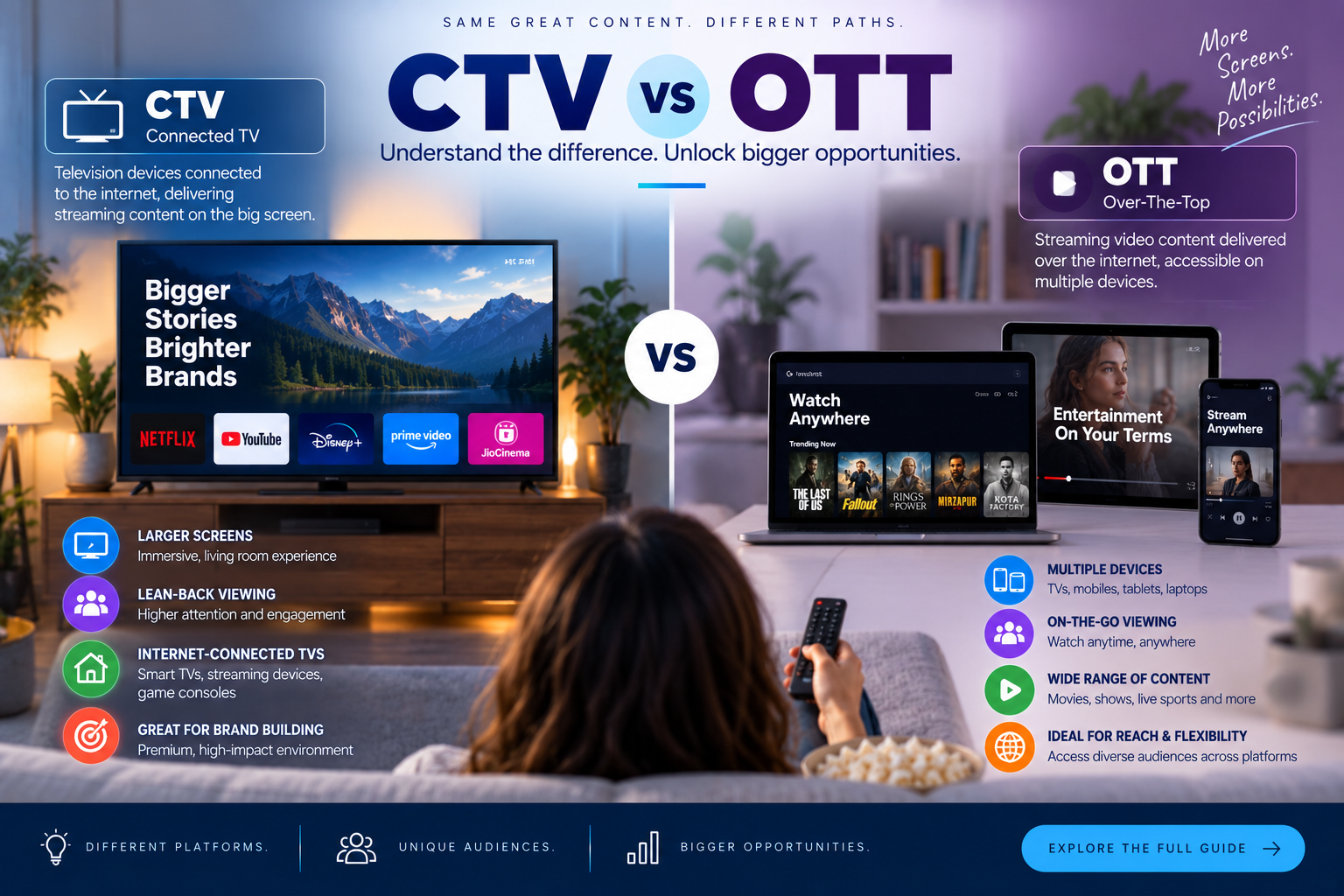
CTV stands for Connect TV. A connected TV is a television that can connect to internet and stream digital content.
For example:
Smart TV
Amazon Fire TV
When you watch Netflix on a Smart TV, you are watching OTT content on a CTV device.
CTV vs. OTT: What’s the difference?
CTV and OTT are closely connected, but they are not exactly the same thing.
A simple way to remember is:
OTT – the platform which streams content.
CTV – device used to watch OTT content.
For example, watching the same Netflix movie in two different situations.
Situation 1 – Watching OTT content on smartphone.
Situation 2 – Watching the same OTT content on a smart TV.
So, CTV is essentially a part of the larger OTT ecosystem.
Comparing OTT & CTV
OTT
CTV
Describes content delivered through the internet.
Describes a TV connected to internet.
Can be watched on phone, tablets, laptops and TVs.
Specifically refers to television screens.
Includes streaming services and digital video.
Includes smart TVs and TVs connected to streaming devices like amazon fire stick.
Focuses on how content is delivered.
Focuses on where the content is viewed.
How do CTV and OTT work Together in Advertising?
This is where things become especially important for marketers and advertisers. When advertisers run ads on streaming television, they are often buying CTV advertising inventory, while the actual video content is being delivered Over-The-Top through the internet.
For example – A person watches a show on a smart TV, before the show begins, he sees an advertisement for a new smartphone.
The show delivered through on OTT streaming service, while the advertisement is shown on a CTV device. So, in advertising often CTV and OTT work together.
Advantages of CTV Advertising
CTV has become increasingly important for advertisers because it combines some of the strengths of traditional television with a targeting and measurement capabilities of digital advertising.
1. CTV Helps advertisers reach more Viewers.
More people are choosing streaming services instead of traditional cable and satellite TV. The change is often called cord-cutting. Cord-cutting happens when people cancel their traditional cable or satellite TV subscriptions and move towards streaming services.
Why are people moving from traditional to OTT? Instead of waiting for a particular program to come on at a particular time, viewers can choose:
What they want to watch?
When they want to watch it?
Which device they want to use?
Which streaming service they want to use?
As more people move from traditional television to streaming, CTV gives advertisers an opportunity to reach this growing audience.
2. CTV offers Better Targeting than Traditional TV
Traditional television advertising generally reaches a broad audience. For example, if a company places an advertisement during a popular tv show, everyone watching that show may see the advertisement.
CTV can provide advertisers with more advanced targeting options. Depending on the platform and available data, advertisers may be able to target audiences based on factors such as:
Location
Age
Interests
Viewing behaviour
Household characteristics
Previous interactions with brands
This means advertisers can try to show their ads to people who are more likely to be interested in their products or services. A sports brand can target viewers who frequently watch sports related content.
3. CTV provides better measurement and Optimisation
One major advantage of digital advertising is the ability to measure campaign performance. CTV brings some of these digital measurement capabilities to television advertising. However, CTV works differently from traditional display advertising.
With CTV, viewers are usually sitting several feet away from their television, so clicking directly on the advertisement isn’t practical. Because of this, advertisers often focus on metrics related to videos viewing and awareness.
Some important CTV metrics include:
Video Completion rate – VCR VCR tells what percentage of videos ads were watched until the end. A high VCR generally indicates that viewers are watching most or all of the advertisement. If 1,000 people watched an ad and 900 watch the entire video, the completion rate is 90%.
Cost Per Completed View – CPCV CPCV tells advertisers how much they are paying for each completed video view. This can help advertisers understand how efficiently their campaigns budget is being used.
4. CTV combines Strengths of TV and Digital Advertising
Traditional TV:
Large reach
High-quality video
Strong brand awareness
Big-screen viewing experience
Digital advertising:
Audience targeting
Campaign measurement
Performance tracking
Real time optimisation.
CTV combines many of these benefits. This is one of the reasons advertisers are increasingly interested in CTV advertising.
Conclusion
The shift from traditional television to streaming has created new opportunities for advertisers. OTT refers to television and video content delivered through the internet, while CTV refers specifically to televisions that can access and display the internet-based content. For advertisers CTV is particularly valuable because it combines the large screen experience of traditional television with many of the targeting, measurement and optimisation capabilities associated with digital advertising.
As more viewers move towards streaming and away from traditional cable and satellite television, CTV is becoming an increasingly important part of modern digital advertising strategies.